A comprehensive, science-based guide debunking common myths about sex positions and fertility. Covers what research says about missionary, doggy style, and other positions, addresses tilted uterus considerations, and redirects readers to evidence-based strategies that actually improve conception chances.

A comprehensive, science-based guide debunking common myths about sex positions and fertility. Covers what research says about missionary, doggy style, and other positions, addresses tilted uterus considerations, and redirects readers to evidence-based strategies that actually improve conception chances.
Let's address the elephant in the Google search bar: you've probably typed "best sex positions to get pregnant" at 11 PM on a Tuesday, lying next to your partner, wondering if missionary is really the way to go or if you should be attempting some gravity-defying acrobatics in the name of conception.
You're not alone. It's one of the most-searched fertility questions on the internet, right up there with "why is my period late" and "can I eat sushi while trying to conceive." (The answers: many reasons, and yes, respectively.)
Here's the truth bomb right up front: there is virtually no scientific evidence that sex positions affect your chances of getting pregnant.
Before you close this tab in disappointment, stay with me. While your position in bed probably doesn't matter, there are several things that dramatically impact conception and we're going to cover all of them. Plus, we'll tackle the one anatomical exception where position might (emphasis on might) make a tiny difference, and debunk the myths that have been floating around since your grandmother's generation.
Let's separate the TikTok fiction from the fertility facts.
The Short Answer: Do Sex Positions Affect Your Chances of Getting Pregnant?
Here's what you came for: No, sex positions do not significantly affect your chances of conception.
Sperm are remarkably powerful swimmers. Once ejaculation occurs, sperm can reach your cervix within seconds to minutes, regardless of whether you're in missionary, doggy style, standing on your head, or attempting some position from the Kama Sutra that requires a yoga certification.
Here's what actually happens after ejaculation:
- Sperm travel at approximately 1-4 millimeters per minute
- They can reach the cervical canal within 1-2 minutes
- Cervical crypts (small indentations in the cervix) capture and protect sperm
- Uterine contractions help transport sperm toward the fallopian tubes
- Sperm can swim against gravity without breaking a sweat (well, flagella)
The female reproductive system is beautifully designed for this exact purpose. Your body doesn't need you to engineer the perfect angle or worry about gravitational physics. Evolution has handled the logistics.
However, and this is important, certain positions may help in specific anatomical situations, such as if you have a tilted uterus. More on that later.
What matters infinitely more than position:
- Timing sex during your fertile window (the 6-day span ending on ovulation day)
- Sperm quality and health
- Cervical mucus quality
- Overall reproductive health for both partners
Think of it this way: position is like rearranging deck chairs on the Titanic while your fertile window is the iceberg you actually need to navigate around. Focus on the timing, and the position will take care of itself.
Why the Sex Position Myth Won't Die (And Where It Came From)?
Before we dive into the science, let's acknowledge why this question persists. It's not silly to wonder about this, it's actually completely logical.
The gravity theory makes intuitive sense. If you're standing up, doesn't gravity pull sperm down and away from where they need to go? If you prop your hips up, aren't you giving them a helpful boost? Our brains love this kind of mechanical reasoning.
Trying to conceive can feel powerless. When you're navigating infertility or simply waiting month after month for a positive test, controlling something, anything, feels necessary. If adjusting your position gives you a sense of agency, that's not absurd. It's human.
Anecdotal evidence is everywhere. Your cousin's friend's sister swears she got pregnant because she did this specific thing (elevated hips, certain position, ate pineapple, wore lucky socks). Anecdotes are compelling even when they're not scientific.
Historical beliefs have staying power. For generations, people believed things about conception that we now know aren't true (sleeping in certain positions, phases of the moon, specific foods). Some of these myths get passed down through families or persist in online forums because they feel like they should work.
Social media amplifies misinformation. Influencers sharing "conception hacks" often lack medical credentials but have massive reach. A viral video claiming "this position worked for me!" gets more engagement than a peer-reviewed study abstract.
The bottom line: wanting to optimize every variable when trying to conceive is normal. But the science just doesn't support the position theory, and that's actually good news. It means you have one less thing to stress about.
What Science Actually Says About Sex Positions and Conception
Let's get into the biology, because understanding why position doesn't matter will free you from endless Googling and bedroom anxiety.
How Sperm Actually Travel to Meet the Egg
After ejaculation, millions of sperm are deposited in the vagina near the cervix. Here's their journey:
Phase 1: The Sprint (First Minutes) Within 1-2 minutes, the strongest, fastest sperm reach the cervical canal. They're swimming at about 1-4 millimeters per minute, which might not sound fast until you remember that a sperm cell is only about 50 micrometers long. Proportionally, they're moving at incredible speeds.
Phase 2: The Sanctuary (Cervical Crypts) The cervix isn't just a passageway, it's a sophisticated storage system. Cervical crypts are small pockets in the cervical lining that capture and protect sperm, releasing them gradually over the next several days. This is why you can have sex a few days before ovulation and still get pregnant, the sperm hang out in these crypts, waiting for the egg.
Phase 3: The Journey (Uterus to Fallopian Tubes) Sperm don't swim this journey alone. Your uterus actually helps by producing contractions (yes, even during non-period times) that help propel sperm upward toward the fallopian tubes. These contractions occur regardless of your position during or after sex.
Phase 4: The Destination (Fertilization) Only a few hundred sperm out of millions make it to the fallopian tubes, where they can potentially meet an egg. The egg is only viable for 12-24 hours after ovulation, which is why timing sex around your LH surge matters so much more than position.
The key takeaway: Sperm are designed to swim through cervical mucus and navigate the female reproductive tract. They don't need gravity's help. They're not going to fall out or get lost because you stood up after sex.
The Gravity Myth: Does Lying Down with Legs Up Help?
This is the most persistent myth: that you should lie on your back with your legs elevated (sometimes against a wall!) for 10-30 minutes after sex to "help" sperm reach the cervix.
The science says: This doesn't work.
Here's why:
- Sperm reach the cervix in 1-2 minutes. By the time you've repositioned yourself with legs up, the sperm that matter have already entered the cervical canal.
- Sperm swim actively; they're not passive passengers. They don't rely on gravity or body position. They're using their flagella (tails) to propel themselves through cervical mucus.
- Your cervix faces downward anyway. Regardless of your body position, sperm need to swim up into the cervix. Lying down doesn't change this angle significantly.
- No research supports the "legs up" method. Despite how popular this advice is, no peer-reviewed studies show improved conception rates from elevating your hips or legs after intercourse.
That said: If lying down for 10-15 minutes after sex feels relaxing or helps you feel more in control, it won't hurt. Some people find it a nice moment of quiet reflection or connection with their partner. Just know that it's not medically necessary for conception.
What about immediately standing up or going to the bathroom? Also fine. The sperm that matter are already in your cervical crypts. What you might see leak out afterward is seminal fluid and millions of sperm that weren't going to make the journey anyway. Your body knows what to keep and what to discard.
Research on Sexual Position and Fertility: What Studies Actually Exist?
Here's an uncomfortable truth for anyone hoping for a definitive answer: there aren't many high-quality studies on sex positions and fertility.
Why? Because it doesn't matter enough to warrant extensive research funding. Scientists study what's likely to make a meaningful difference in conception rates, and position isn't high on that list.
What we do have:
The Wilcox Study (1995) - Timing of Sexual Intercourse in Relation to Ovulation This landmark study, published in the New England Journal of Medicine, focused on when couples had sex relative to ovulation, not how. It found that conception occurred when sex happened during the 6-day fertile window ending on ovulation day, with the highest probability on the day before ovulation. Position was not tracked or analyzed because researchers considered it irrelevant to outcomes.
Sperm Motility Research - Multiple studies have examined how sperm move through cervical mucus under various conditions. These studies consistently show that healthy sperm are powerful swimmers capable of navigating the female reproductive tract regardless of external forces like gravity. What impairs sperm? Poor sperm quality, certain lubricants, and extreme temperatures, not your post-sex body position.
Retroverted Uterus Literature - Some medical literature suggests that women with a retroverted (tilted) uterus might benefit from certain positions, but even this is theoretical rather than proven. More on this in the next section.
The absence of research is telling - If sexual position significantly impacted conception rates, we'd have dozens of studies examining it. The fact that we don't suggests that fertility researchers and reproductive endocrinologists consider it a non-factor.
The One Exception: Sex Positions for a Tilted Uterus
Alright, here's where we address the asterisk: if you have a tilted uterus, position might matter slightly.
Notice that's a "might," not a "definitely will." Even this is more theory than proven fact, but let's break it down.
What Is a Tilted (Retroverted) Uterus?
About 20-30% of women have a retroverted uterus, meaning the uterus tilts backward toward the spine rather than forward toward the bladder (anteverted uterus, which is more common).
Important: A tilted uterus is a normal anatomical variation, not a medical problem. It usually doesn't affect fertility at all.
However, because the cervix faces at a different angle in a retroverted uterus, some healthcare providers theorize that certain positions might align the cervix more favorably with where sperm are deposited during ejaculation.
Emphasis on "theorize." This hasn't been rigorously tested in clinical trials.
Suggested Positions for Tilted Uterus (Based on Anatomy, Not Evidence)
If you have a retroverted uterus and want to try positions that theoretically might help, consider:
1. Rear-Entry (Doggy Style) The logic: This position allows for deeper penetration and may align the penis closer to a posteriorly-tilted cervix.
2. Modified Missionary with Hips Elevated Place a pillow under your hips to tilt your pelvis, which may change the cervical angle slightly.
3. Side-Lying Positions Some people find that lying on their side with knees bent toward the chest changes pelvic positioning in a way that feels more comfortable.
The reality check: Even if you have a tilted uterus, timing your sex during your fertile window matters exponentially more than position. You could have perfect anatomical alignment, but if you're not having sex when an egg is present, conception won't happen.
How Do You Know If You Have a Tilted Uterus?
Your OB/GYN can tell you during a pelvic exam or ultrasound. If you've never been told you have a tilted uterus, you probably have a typical anteverted uterus.
If you do have a tilted uterus and you're concerned about conception, talk to your doctor. They can assess whether your specific anatomy might benefit from any interventions (though position recommendations are unlikely to be high on the list).
Positions That Might Make Conception Theoretically Harder (But Probably Don't)
For the sake of completeness, let's address whether any positions could work against conception.
Woman-on-Top or Reverse Cowgirl
The concern: Gravity pulls sperm away from the cervix.
The reality: Sperm reach the cervix within seconds and are swimming actively. Gravity is not a significant barrier for healthy sperm. Millions of couples conceive from these positions every year.
Standing or Vertical Positions
The concern: Sperm have to swim "uphill" against gravity.
The reality: Again, sperm are strong swimmers. While less semen might be retained in the vaginal canal in a standing position (more might leak out), the sperm that matter have already entered the cervix.
Does Any Position Actually Prevent Pregnancy?
No position reliably prevents pregnancy. That's why "just pull out" or "do it standing up" are notoriously ineffective forms of birth control.
The bottom line: If you and your partner enjoy a particular position, there's no reason to avoid it when trying to conceive. Comfort, pleasure, and emotional connection matter more than mechanical positioning.
What ACTUALLY Matters for Getting Pregnant (Way More Than Position)
Now that we've thoroughly debunked the position myth, let's talk about what you should be focusing on if you're trying to conceive.
#1: Timing Is Everything
This cannot be emphasized enough: when you have sex matters infinitely more than how.
Your fertile window is the 6-day period ending on the day of ovulation. You're most likely to conceive if you have sex during this window, particularly on the 2-3 days before ovulation.
Why? Because:
- Sperm can survive in the female reproductive tract for up to 5 days (in fertile cervical mucus)
- An egg is only viable for 12-24 hours after ovulation
- Having sex before ovulation ensures sperm are already waiting when the egg is released
How to identify your fertile window:
- Track your menstrual cycle (though this alone isn't precise)
- Use ovulation predictor kits to detect your LH surge
- Monitor cervical mucus changes (fertile mucus is clear, stretchy, and egg-white-like)
- Use quantitative hormone tracking (like Oova) to measure LH and progesterone precisely
Read more: When to Have Sex After the LH Surge for detailed timing guidance.
#2: Frequency Matters More Than Position
Another question people often wonder: how often should you have sex to get pregnant?
Research shows:
- Having sex every day during your fertile window: ~37% pregnancy rate per cycle
- Having sex every other day during your fertile window: ~33% pregnancy rate per cycle
The difference is small. What matters most is that you're having sex during the fertile window at all.
For most couples, every other day during the fertile window is sustainable and highly effective. Daily sex is fine if you're both up for it, but it's not necessary and can feel exhausting or stressful.
#3: Sperm Quality Is Critical
50% of fertility challenges involve male factor infertility, yet it's often overlooked when couples focus on timing and other female-related factors.
What affects sperm quality:
- Heat exposure: Prolonged hot baths, saunas, tight underwear, laptops on laps
- Lifestyle factors: Smoking, excessive alcohol, recreational drugs
- Nutrition: Poor diet, lack of key nutrients (zinc, folate, antioxidants)
- Weight: Both obesity and being significantly underweight
- Medications and medical conditions: Certain prescriptions, diabetes, varicoceles
- Age: Male fertility declines with age, though less dramatically than female fertility
If you've been trying to conceive for several months without success, both partners should get fertility evaluated. A semen analysis is non-invasive and can quickly identify any issues with sperm count, motility, or morphology.
Read more: What You Need To Know About Male Factor Infertility
#4: Cervical Mucus Quality Makes a Difference
Here's something that does matter: the quality of your cervical mucus during your fertile window.
Fertile cervical mucus (often described as egg-white cervical mucus) is:
- Clear or slightly white
- Stretchy and slippery
- Abundant
This type of mucus creates protective channels that help sperm travel through the cervix and survive for several days. It also filters out damaged sperm and helps the healthiest ones proceed.
Non-fertile mucus is:
- Thick or sticky
- Scant or absent
- Opaque or creamy
What can harm cervical mucus or sperm:
- Certain commercial lubricants (many common brands like KY Jelly, Astroglide)
- Douching
- Some vaginal medications or suppositories
- Dehydration
What helps cervical mucus quality:
- Staying hydrated
- Adequate nutrition
- Monitoring mucus changes as part of fertility awareness
- Using sperm-friendly lubricants if needed (Pre-Seed, mineral oil, canola oil)
Learn more about ovulation signs: What Is Ovulation?
#5: Reduce Stress and Prioritize Connection
While we shouldn't overstate the stress-fertility connection (telling someone to "just relax" is not helpful or scientifically sound), chronic stress can impact reproductive hormones.
How stress affects fertility:
- High cortisol levels can disrupt ovulation
- Stress can reduce libido, making it harder to have sex during the fertile window
- Anxiety can delay cycles or make them irregular
How to support emotional wellbeing while TTC:
- Maintain intimacy with your partner outside of "baby-making" sex
- Consider therapy or counseling if TTC is affecting your mental health
- Set boundaries around when and how you discuss conception
- Take breaks from tracking if it becomes overwhelming
Read more: Understanding the Link Between Stress and Ovulation
#6: Consider Pleasure, Not Just Procreation
Here's a controversial but intriguing point: female orgas help with conception, though it's not proven.
The theory: Uterine contractions during orgasm could help propel sperm toward the fallopian tubes, similar to the natural contractions that assist sperm transport.
The evidence: Mixed and limited. Some small studies suggest a potential benefit, but it's not conclusive. Orgasm is certainly not necessary for conception, millions of people conceive without it.
The practical takeaway: Prioritizing pleasure during sex can:
- Reduce stress and make TTC feel less clinical
- Improve intimacy and connection with your partner
- Make sex more sustainable over many months of trying
- Potentially (emphasis on potentially) create physiological conditions that support conception
So even if orgasm doesn't definitively improve conception odds, it doesn't hurt, and it makes the process a lot more enjoyable.
The Bottom Line: Choose Positions for Pleasure, Not Pregnancy
Here's what you need to remember: Sex positions do not significantly affect your chances of getting pregnant. Sperm are powerful swimmers that reach your cervix within minutes, regardless of gravity or body positioning.
The possible exception: If you have a tilted uterus, certain positions might (emphasis on might) help slightly, but this is theoretical and unproven.
What actually matters:
- Timing sex during your fertile window (the 6 days before and including ovulation)
- Sperm quality and male fertility factors
- Cervical mucus quality
- Frequency during the fertile window (every 1-2 days)
- Managing stress and maintaining connection
The best sex position for conception is the one you and your partner enjoy most. Here's why this matters:
- Pleasure reduces stress and promotes relaxation
- Enjoyment makes sex sustainable over many months of trying
- Emotional connection supports overall wellbeing
- Comfort allows you to focus on timing rather than mechanics
- Orgasm may have minor physiological benefits (though unproven)
Instead of worrying about positions, focus your energy on:
- Tracking your ovulation accurately (learn how to identify your fertile window)
- Having sex every 1-2 days during your fertile window
- Supporting both partners' reproductive health
- Choosing sperm-friendly lubricants if needed
- Reducing stress and enjoying intimacy
The fact that position doesn't matter is actually liberating. You have one less variable to control, one less thing to stress about, and one more reason to simply enjoy sex with your partner.
What To Focus On Instead of Sex Positions
Now that you know position doesn't matter, here's your action plan for what actually increases conception chances:
1. Track Your Ovulation Accurately
The single most important factor in conception is timing sex during your fertile window. You can't rely on calendar counting alone, you need to track ovulation.
Options for tracking:
- Ovulation predictor kits (OPKs): Detect the LH surge that occurs 24-36 hours before ovulation
- Cervical mucus monitoring: Track changes in cervical fluid throughout your cycle
- Basal body temperature (BBT): Track your temperature to confirm ovulation has occurred (though this is retrospective)
- Quantitative hormone tracking: Measure actual hormone levels (LH, progesterone) to predict and confirm ovulation with precision
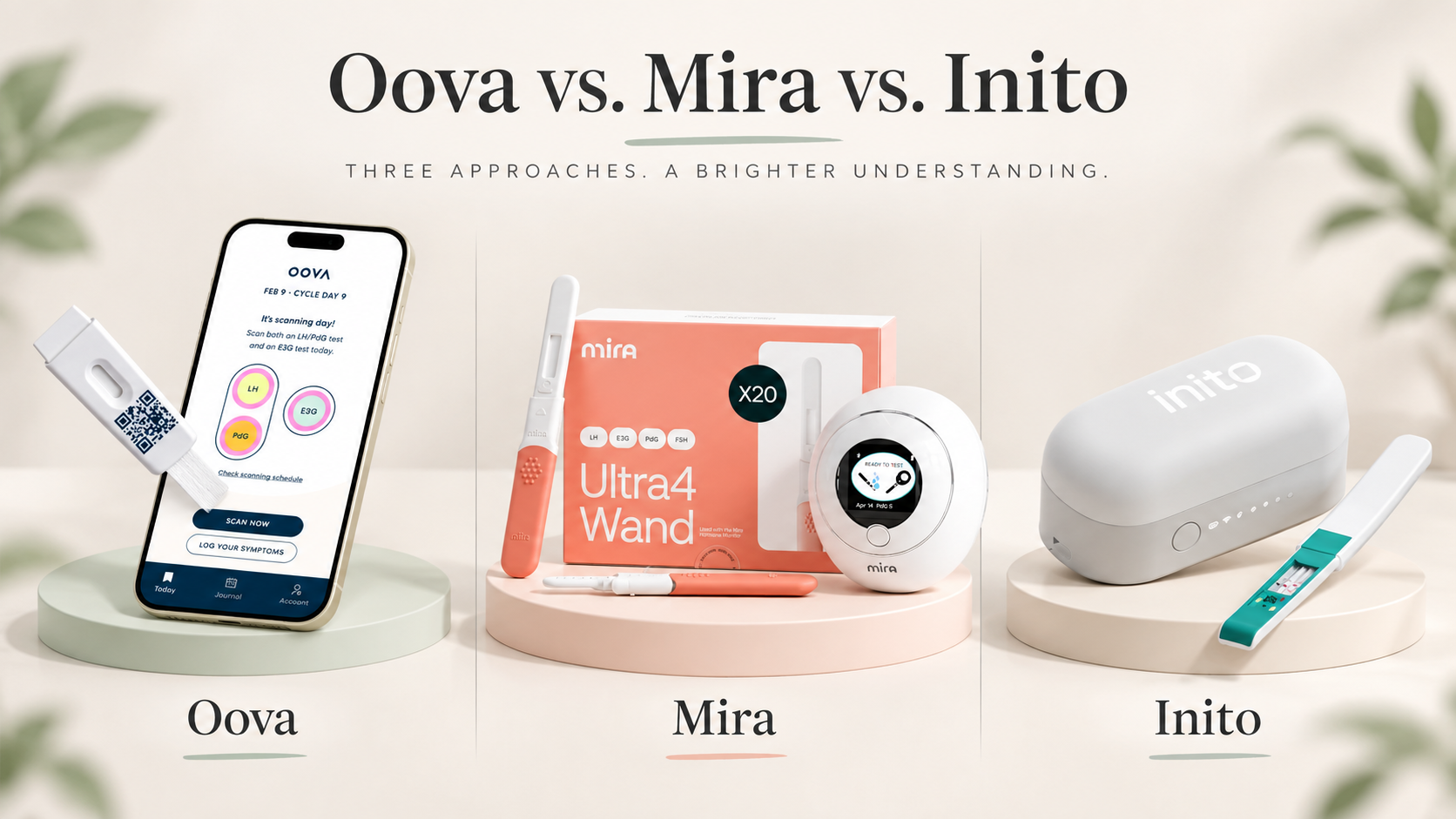
Oova provides quantitative hormone tracking that measures your exact LH, progesterone and estrogen levels, giving you personalized insights into your fertility window.
2. Time Sex During Your Fertile Window
Once you know when you're ovulating, have sex every 1-2 days during the 6-day fertile window, with focus on the 2-3 days before ovulation.
Why this timing works:
- Sperm can survive 3-5 days in fertile cervical mucus
- The egg is only viable 12-24 hours after ovulation
- Having sex before ovulation ensures sperm are waiting when the egg releases
Read the detailed guide: When to Have Sex After the LH Surge
3. Support Sperm Health
Both partners need to prioritize reproductive health. For men, this means:
- Avoiding excessive heat (hot tubs, saunas, tight underwear)
- Limiting alcohol and eliminating smoking
- Maintaining a healthy weight
- Getting adequate sleep
- Managing stress
- Eating a nutrient-rich diet (zinc, folate, antioxidants)
Consider a semen analysis if you've been trying for several months without success.
4. Choose Sperm-Friendly Lubricants
Many commercial lubricants can impair sperm motility. If you need lubrication:
Avoid:
- KY Jelly
- Astroglide
- Most water-based lubricants
Use instead:
- Pre-Seed (specifically designed for TTC)
- Mineral oil
- Canola oil
- Baby oil (unscented)
Or, better yet, spend more time on foreplay to encourage natural lubrication.
5. Reduce Stress and Prioritize Connection
While the research is not clear on how stress impacts fertility, managing chronic stress does matter for hormonal balance and overall wellbeing.
Strategies that help:
- Maintain non-conception-focused intimacy with your partner
- Set boundaries around baby talk
- Consider therapy or support groups
- Take breaks from tracking if it becomes overwhelming
- Remember that pleasure and connection matter, not just mechanics
Learn more: Understanding the Link Between Stress and Ovulation
6. Know When to Seek Help
If you've been trying for 12 months without conception (or 6 months if you're over 35), it's time to see a fertility specialist.
What to expect:
- Comprehensive fertility evaluation for both partners
- Semen analysis
- Ovarian reserve testing
- Evaluation of fallopian tubes and uterine health
- Discussion of next steps (medication, IUI, IVF, etc.)
Earlier evaluation is recommended if you have:
- Irregular or absent periods
- Known reproductive health conditions (PCOS, endometriosis)
- Previous pelvic surgery or infections
- Male partner with known fertility concerns
Starting point: Trying to Conceive: Your Go-To Guide
Final Thoughts: Let Go of What Doesn't Matter
If you take away one thing from this article, let it be this: stop stressing about sex positions.
The internet is full of conception "hacks" and fertility myths that promise to give you control over an inherently uncertain process. Sex positions fall squarely into this category, they feel like they should matter, but science says they don't.
What does matter: timing, sperm quality, cervical mucus, overall health, and giving yourself grace during this journey.
Trying to conceive can be stressful, clinical, and exhausting. You don't need to add "am I doing this at the right angle?" to your list of worries. Choose positions that feel good, that bring you and your partner together, and that you can sustain over the months it might take to conceive.
Focus your energy on what's proven to work: tracking your fertile window, timing sex around ovulation, supporting both partners' reproductive health, and maintaining your emotional and physical wellbeing.
The right position for conception is the one that lets you enjoy sex with your partner, and the right timing is during your fertile window. Everything else is just noise.
Ready to stop guessing and start knowing when you're fertile? Oova's quantitative hormone tracking measures your LH and progesterone levels to pinpoint your exact fertile window, so you can focus on timing, not positions. Learn more about how Oova works.
Frequently Asked Questions
Should I lie down after sex when trying to conceive?
It's not necessary, but it won't hurt. Some people find lying down for 10-15 minutes after sex relaxing, which may help reduce stress. However, sperm reach the cervix within 1-2 minutes of ejaculation, so staying horizontal doesn't significantly impact conception. You can stand up, use the bathroom, or go about your day immediately after sex without decreasing your chances of pregnancy.
Does female orgasm help you get pregnant?
Possibly, but it's not proven. The theory is that uterine contractions during orgasm may help transport sperm toward the fallopian tubes. However, orgasm is not necessary for conception, millions of people get pregnant without it. That said, prioritizing pleasure during sex can reduce stress and improve intimacy, both of which support your overall fertility journey.
What about the "legs up against the wall" position after sex?
There's no scientific evidence this helps conception. By the time you've repositioned yourself with legs elevated, sperm that matter have already entered your cervical canal and crypts. Sperm swim actively using their flagella (tails) and don't rely on gravity. If lying with legs up feels relaxing or gives you a sense of control, it won't hurt, but it's not medically necessary.
Can the wrong position prevent pregnancy?
No. Even positions where gravity works "against" sperm (like standing up or woman-on-top) don't reliably prevent pregnancy. This is why withdrawal or positional methods are ineffective forms of birth control. Healthy sperm can reach the cervix within minutes regardless of position or gravitational forces.
Do I need to have an orgasm to get pregnant?
No. Female orgasm is not required for conception. While some theories suggest that uterine contractions during orgasm might help transport sperm, this hasn't been proven. Many people conceive without experiencing orgasm during intercourse. However, pleasure and enjoyment during sex can reduce stress and improve your overall experience while trying to conceive.
How long should I stay lying down after sex?
You don't need to stay lying down at all, but 5-15 minutes won't hurt if you find it comfortable or relaxing. After that timeframe, gravity won't prevent sperm from doing their job, they've already entered your cervical canal. What leaks out afterward is primarily seminal fluid and sperm that weren't going to make the conception journey anyway.
Does missionary position increase chances of pregnancy?
There's no scientific evidence that missionary position is better for conception than any other position. While it's often recommended because it allows for deep penetration and semen to pool near the cervix, sperm are powerful enough to reach the cervix from any position. The exception might be if you have a tilted uterus, where rear-entry positions could theoretically align better with your cervical angle, though even this is unproven.
Should I avoid certain sex positions when trying to conceive?
No. While some people worry that positions like woman-on-top or standing might work against conception due to gravity, there's no evidence this is true. Sperm reach the cervix within 1-2 minutes and swim actively, they don't need gravity's assistance. Choose positions based on comfort and pleasure, not conception theory.
About the author
Sources
- Wilcox AJ, Weinberg CR, Baird DD. Timing of sexual intercourse in relation to ovulation. New England Journal of Medicine. 1995;333(23):1517-1521. doi: 10.1056/NEJM199512073332301
- Dcunha R, Hussein RS, Ananda H, Kumari S, Adiga SK, Kannan N, Zhao Y, Kalthur G. Current Insights and Latest Updates in Sperm Motility and Associated Applications in Assisted Reproduction. Reproductive Sciences. 2022 Jan;29(1):7-25. doi: 10.1007/s43032-020-00408-y. Epub 2020 Dec 7. PMID: 33289064; PMCID: PMC7721202.
- Ellington JE, Daugherty M, Eggert J, Branco S. Effects of lubricants on sperm motility. Fertility and Sterility. 1991;55(4):815-817. doi: 10.1016/s0015-0282(16)54252-1
- Barrett JC, Marshall J. The risk of conception on different days of the menstrual cycle. Population Studies. 1969;23(3):455-461. doi: 10.1080/00324728.1969.10405297
- American Society for Reproductive Medicine (ASRM). Optimizing Natural Fertility: A Committee Opinion. Fertility and Sterility. 2017;107(1):52-58. doi: 10.1016/j.fertnstert.2016.09.029
- American Society for Reproductive Medicine (ASRM). Stress and Infertility Factsheet. 2023. Available at: https://www.reproductivefacts.org/
- Cleveland Clinic. Retroverted Uterus. Updated July 6, 2022. Available at: https://my.clevelandclinic.org/health/diseases/14155-tilted-uterus
- Mayo Clinic. Getting pregnant: Myths, facts and tips. Updated 2023. Available at: https://www.mayoclinic.org/healthy-lifestyle/getting-pregnant/in-depth/fertility/art-20047584
- Mayo Clinic. Low sperm count. Updated 2023. Available at: https://www.mayoclinic.org/diseases-conditions/low-sperm-count/symptoms-causes/syc-20374585
- National Institutes of Health (NIH). What is infertility? Eunice Kennedy Shriver National Institute of Child Health and Human Development. Updated 2021. Available at: https://www.nichd.nih.gov/health/topics/infertility
About the Oova Blog:
Our content is developed with a commitment to high editorial standards and reliability. We prioritize referencing reputable sources and sharing where our insights come from. The Oova Blog is intended for informational purposes only and is never a substitute for professional medical advice. Always consult a healthcare provider before making any health decisions.