The follicular phase is the time of the month when you get your period and your ovaries prepare an egg for ovulation. Here’s more about what exactly is happening in your body during the follicular phase, and what it all means for pregnancy.

The follicular phase is the time of the month when you get your period and your ovaries prepare an egg for ovulation. Here’s more about what exactly is happening in your body during the follicular phase, and what it all means for pregnancy.
Quick answer: The follicular phase is the first half of your menstrual cycle, starting on day one of your period and ending at ovulation. During this time, FSH prompts your ovaries to develop follicles, one typically becomes dominant, and rising estrogen thickens your uterine lining and eventually triggers the LH surge that ends the phase. It typically lasts 10–16 days, but normal length varies by person and by cycle, and tracking your own hormone pattern over time gives a clearer picture than a fixed calendar range.
What is the follicular phase?
The follicular phase is one of the two main phases of your menstrual cycle, running from day one of your period until ovulation. Its counterpart, the luteal phase, picks up after ovulation and runs until your next period. During the follicular phase, your body is doing two things at once: shedding the previous cycle's uterine lining (your period) while simultaneously beginning to prepare a new egg for release.
Your ovaries produce follicles
At the same time as your period, the hypothalamus and pituitary gland, two structures in your brain crucial to hormone production, get involved. Your hypothalamus signals your pituitary gland to begin producing follicle-stimulating hormone (FSH). In response to rising FSH, your ovaries start producing follicles, each housing an immature egg that grows as the phase continues.
An egg matures and prepares to be released during ovulation
Soon, one follicle typically becomes dominant. The other follicles generally start to deteriorate and are reabsorbed. In the dominant follicle, the egg continues maturing until it reaches full maturity.
Your uterine lining (or endometrium) thickens
The maturing follicle produces estrogen, so overall estrogen levels rise. Rising estrogen stimulates your uterine lining to grow thick and nutrient-rich, which is necessary for a fertilized egg to be able to implant. These rising estrogen levels also signal the hypothalamus and pituitary gland to decrease FSH and increase luteinizing hormone (LH) levels. When LH surges, ovulation is triggered: the mature egg is released from its follicle, and the follicular phase ends. Ovulation marks the start of the luteal phase, the next phase of your cycle.
RELATED: What Are Normal Estrogen Levels (And How Do I Measure Mine)?
What happens to your hormones during the follicular phase?
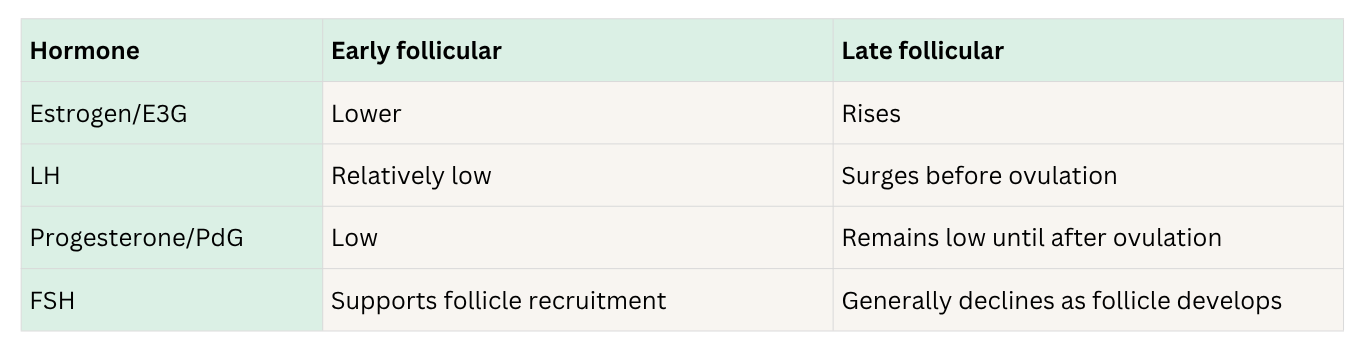
Several hormones move through a coordinated pattern during this phase, and understanding the shape of that pattern, rather than any single hormone in isolation, is what tends to be most useful.
Estrogen. Estrogen starts relatively low at the beginning of the follicular phase and rises as a dominant follicle develops, generally peaking just before ovulation. This rise is what signals your uterine lining to thicken and helps trigger the LH surge.
LH. Luteinizing hormone stays relatively low for most of the follicular phase, then surges sharply in the day or two before ovulation. The LH surge is the signal most ovulation tests are built around, since it reliably precedes ovulation by roughly 24 to 36 hours.
Progesterone/PdG. Progesterone (measured at home as its urine metabolite, PdG) typically stays low throughout the follicular phase and doesn't rise meaningfully until after ovulation, during the luteal phase.
FSH as biological context. Follicle-stimulating hormone is what kicks off the follicular phase in the first place, prompting the ovaries to begin developing follicles. FSH is generally higher early in the phase and declines as estrogen rises. FSH isn't part of Oova's hormone panel, but understanding its role helps explain what's driving the estrogen, LH, and PdG changes you can track directly.
What does a typical follicular hormone pattern look like?
Rather than a single "normal" number, a typical follicular phase looks like a pattern over time: estrogen starts lower and rises as a follicle matures, PdG stays low, and LH remains relatively quiet until the preovulatory surge. These are the three hormones Oova tracks directly. Because timing and hormone levels can vary meaningfully between individuals and even between cycles for the same person, tracking your own hormone pattern over several cycles tends to be more informative than comparing a single reading to a population average. For a broader look at what a full-cycle hormone pattern can look like, including the follicular and luteal phases together, see what a progesterone pattern may reveal about fertility and what estrogen levels typically look like across the cycle.
How long is the follicular phase?
Just like your cycle length, the length of your follicular phase can vary, too—from person to person and from month to month.
The length of your follicular phase is determined by how long it takes for a given follicle to mature into an egg.
When the maturing process takes longer, the follicular phase is longer and your cycle is longer. On the flip side, the follicular phase, and your cycle, are shorter when it takes less time for a follicle to mature. The length of your follicular phase also changes with age.
Cycles can be anything from 21 to 35 days long and still fall within a normal range, and the follicular phase varies along with that. The follicular phase can range from 10 to 16 days.
Keep in mind that follicular phase length changes, meaning it’s entirely possible to have short, long, and mid-range follicular phases from one cycle to the next.
What does it mean if the follicular phase is long?
If your follicular phase lasts longer than 16 days, it can be considered long. This doesn’t necessarily mean much, aside from the fact that your overall cycle is long, too.
Your follicular phase may be longer if you’ve used birth control pills for a long time, or if you were on the pill recently.
If your follicular phase is longer, it doesn’t impact your fertility or mean that you’re less likely to become pregnant.
What does it mean if the follicular phase is short?
If your follicular phase lasts less than 10 days, it’s considered short.
When the follicular phase is short, the egg released during ovulation may not have had enough time to fully mature, which also means it may not be able to be fertilized by sperm. This can impact the chances of conceiving in a given cycle, or overall if your follicular phases are consistently short.
In other words, a shorter follicular phase may make it harder for you to get pregnant.
A shorter follicular phase may also be a sign that you’re entering perimenopause, or the transition into menopause, as the follicular phase shortens near menopause.
How do you know if you’re in the follicular phase?
Symptoms can shift somewhat across the phase. Early on, alongside your period, you may notice the symptoms commonly associated with menstruation, such as cramping, bloating, fatigue, or lower back discomfort. As estrogen rises later in the phase, cervical mucus changes become more noticeable as ovulation approaches. Some people also notice changes in energy, mood, or other symptoms as estrogen rises, although these experiences vary considerably from person to person, so absence of any particular symptom isn't itself meaningful. During the follicular phase, you may experience symptoms typically associated with your period, like:
RELATED: 8 Symptoms That Could Be Related to Your Period - And How to Get Relief
Your basal body temperature (BBT), or your body temperature when you’re fully at rest, can also indicate which phase of your cycle you’re experiencing. BBT is at its lowest during the follicular phase, typically ranging from 97°F to 98°F. BBT increases following ovulation and the start of the luteal phase. To track how your BBT changes throughout your cycle, take your temperature in the morning, right when you wake up and before you get out of bed. After a few cycles-worth of daily temperature readings, you may be able to use your BBT to track the phases of your cycle and find when you’re most fertile.
How do you know when the follicular phase is ending?
The LH surge is one of the clearest signs that the follicular phase is nearing its end, because it typically occurs shortly before ovulation. Basal body temperature (BBT) is a lower-cost option some people use, since it tends to be at its lowest during the follicular phase and rises after ovulation, but BBT confirms that ovulation has already happened rather than helping you anticipate it in advance. Because it relies on a single daily measurement and can be affected by sleep, illness, and other factors, hormone tracking through LH and estrogen tends to give a clearer, more forward-looking signal of where you are in the phase than BBT or calendar counting alone, particularly for anyone whose cycles don't follow a consistent 28-day pattern.
Can you get pregnant during the follicular phase?
Yes, you can get pregnant during the follicular phase.
More specifically, the late follicular phase is the time when you should have sex if you’re trying to conceive, as this part of your cycle corresponds with your fertile window.
Your fertile window is the time during your cycle when you’re most fertile, and most likely to get pregnant. At-home fertility testing kits are one tool to track your cycle phases and find your fertile window. Generally, the fertile window lasts six days: the five days leading up to ovulation, and the day after ovulation.
This timeline means that most of your fertile window occurs during the late follicular phase, making the follicular phase the time in your cycle when you’re most likely to get pregnant.
Knowing you're in the follicular phase is one thing. Knowing exactly when your LH surge is coming, and when your fertile window actually opens, is another. Oova tracks LH, estrogen, and progesterone daily so you're not timing based on a calendar. You're timing based on your hormones.
How can you track your follicular phase?
Cycle tracking during the follicular phase generally falls into a few categories: calendar-based counting, symptom and cervical mucus observation, basal body temperature, and hormone tracking through urine tests that measure LH, estrogen, and PdG. Calendar counting works best for very regular cycles and tends to be less reliable for anyone with irregular cycles or PCOS. Hormone tracking doesn't require assuming a fixed cycle length, which is part of why it can be useful for identifying your own follicular phase pattern rather than relying on a population average.
The Bottom Line
There’s a lot going on in your body during the follicular phase of your menstrual cycle.
You get your period, your ovaries start producing follicles, a follicle matures into an egg to be released during ovulation, and your endometrium thickens.
The follicular phase can vary in length from cycle to cycle, depending on how long it takes for a follicle to mature. While a longer follicular phase doesn’t impact fertility, a shorter follicular phase may make it harder for you to get pregnant in a given cycle.
If you’re trying to conceive, knowing the signs of the follicular phase and tracking your menstrual cycle can be key for timing when to have sex. When all goes well, the follicular phase may just be the part of your cycle when you’re most likely to get pregnant.
Frequently Asked Questions
What is the follicular phase of the menstrual cycle?
The follicular phase is the first half of your menstrual cycle, starting on day 1 of your period and ending when you ovulate. During this phase, follicle-stimulating hormone (FSH) triggers your ovaries to produce follicles, one egg matures, and your uterine lining thickens in preparation for pregnancy.
How long does the follicular phase last?
The follicular phase typically lasts 10-16 days, though this varies from person to person and cycle to cycle. The length depends on how long it takes for a follicle to mature into a ready-to-release egg. A 28-day cycle usually has a 14-day follicular phase.
What are the signs you're in the follicular phase?
Signs of the follicular phase include your period (early phase), increased energy levels, clearer skin, and rising basal body temperature. As you approach ovulation in the late follicular phase, you may notice clearer, stretchy cervical mucus and increased sex drive.
What's the difference between the follicular phase and the luteal phase?
The follicular phase runs from your period until ovulation and centers on egg development and rising estrogen. The luteal phase runs from ovulation until your next period and centers on rising progesterone in support of a potential pregnancy.
Can you get pregnant during the follicular phase?
Yes, especially during the late follicular phase. Your fertile window includes the 5 days before ovulation and the day of ovulation itself, all of which fall within the follicular phase. This is the best time to have sex if you're trying to conceive.
What happens if your follicular phase is too short?
A follicular phase shorter than 10 days may mean the egg didn't have enough time to fully mature, potentially making it harder to conceive. Short follicular phases can also be an early sign of perimenopause as egg quality and ovarian reserve decline.
What is the difference between follicular phase and luteal phase?
The follicular phase starts on day 1 of your period and ends at ovulation, focusing on egg maturation and preparing for pregnancy. The luteal phase starts after ovulation and ends when your next period begins, focusing on supporting a potential pregnancy through progesterone production.
Can lifestyle factors affect my follicular phase length?
Yes, several lifestyle factors can influence follicular phase length. Research shows that women with a history of miscarriage tend to have shorter follicular phases, while lifestyle factors such as recent oral contraceptive use can lead to longer follicular phases. Maintaining a balanced diet rich in vegetables, antioxidants, and healthy fats, along with moderate exercise, can support healthy follicular development and overall reproductive health.
Does exercise during the follicular phase impact fertility?
Moderate physical activity can be beneficial for fertility, especially when coupled with healthy weight management. However, excessive exercise can negatively affect your reproductive system by creating an energy imbalance that may disrupt hormone production and lead to menstrual abnormalities. During the follicular phase, as your energy levels increase with rising estrogen, you may find yourself able to handle more intense workouts like cardio and strength training.
What foods should I eat during the follicular phase to support fertility?
During the follicular phase, focus on iron-rich foods to compensate for blood loss during your period, including red meat, seafood, legumes, and green leafy vegetables. Lean proteins and complex carbohydrates like chicken, fish, brown rice, and quinoa can help support rising energy levels, while cruciferous vegetables such as broccoli and cauliflower can help balance increasing estrogen levels.
Can stress affect the follicular phase?
While stress alone does not cause infertility, psychological stress is one of several lifestyle factors that can impact fertility and overall reproductive health. Managing stress through relaxation techniques and moderate exercise may support a healthy follicular phase and improve your chances of conception.
When is a changing follicular phase worth discussing with a provider?
A single shorter or longer cycle usually isn't a reason for concern on its own. It's more worth raising with a provider if you notice a consistent, ongoing shift from your typical pattern, if follicular phase changes are showing up alongside other new symptoms, or if you're trying to conceive and want to understand what your pattern means for timing. Bringing a record of your actual cycle lengths and any symptoms, rather than a general sense that "things feel different," tends to make that conversation more useful. If you're also noticing broader symptoms without a clear explanation, this piece on whether your symptoms are hormonal or something else may be a useful next read.
About the author
Sources
- Cleveland Clinic. (2024). Low Estrogen: Causes, Symptoms, Diagnosis & Treatment.
https://my.clevelandclinic.org/health/diseases/22354-low-estrogen - Peacock K, Carlson K, Ketvertis KM. (2024). Menopause. StatPearls Publishing.
https://www.ncbi.nlm.nih.gov/books/NBK507826/ - The North American Menopause Society. (2024). The 2024 Hormone Therapy Position Statement.
https://www.menopause.org/docs/default-source/professional/nams-2024-hormone-therapy-position-statement.pdf - Harvard Health Publishing. (2024). Perimenopause: Rocky road to menopause.
https://www.health.harvard.edu/womens-health/perimenopause-rocky-road-to-menopause - National Institute on Aging. (2024). What Is Menopause?
https://www.nia.nih.gov/health/menopause/what-menopause - Office on Women's Health. (2024). Menopause and your health.
https://www.womenshealth.gov/menopause - Santoro N, Roeca C, Peters BA, Neal-Perry G. (2021). The Menopause Transition: Signs, Symptoms, and Management Options. The Journal of Clinical Endocrinology & Metabolism, 106(1), 1-15.
https://academic.oup.com/jcem/article/106/1/1/5998524 - Davis SR, et al. (2023). Menopause. Nature Reviews Disease Primers, 9(1), 51.
https://www.nature.com/articles/s41572-023-00451-0
About the Oova Blog:
Our content is developed with a commitment to high editorial standards and reliability. We prioritize referencing reputable sources and sharing where our insights come from. The Oova Blog is intended for informational purposes only and is never a substitute for professional medical advice. Always consult a healthcare provider before making any health decisions.