< Back to the Blog
Hormones

Understanding Addyi: What Women Need to Know About Treating Low Sexual Desire

Amy Divaraniya
Amy Divaraniya

Low sexual desire affects millions of women, but conversations about treatment remain frustratingly rare. In this evidence-based guide, read about Addyi (flibanserin), the first and only FDA-approved medication specifically designed to treat hypoactive sexual desire disorder in women.
No items found.
Modified On:
Published:
Dec 17, 2025
Est. Read Time:
0
Diagram showing how Addyi affects brain neurotransmitters including dopamine, serotonin, and norepinephrine to restore sexual desire
Published:
Dec 17, 2025
Est. Read Time:
0

Low sexual desire affects millions of women, but conversations about treatment remain frustratingly rare. In this evidence-based guide, read about Addyi (flibanserin), the first and only FDA-approved medication specifically designed to treat hypoactive sexual desire disorder in women.

Hormones
Share to:

Low sexual desire affects millions of women, but conversations about treatment remain frustratingly rare. In this evidence-based guide, read about Addyi (flibanserin), the first and only FDA-approved medication specifically designed to treat hypoactive sexual desire disorder in women.

If you've noticed your interest in sex has significantly declined and it's bothering you, you're not alone. Approximately one in ten women experiences hypoactive sexual desire disorder (HSDD), making it one of the most common female sexual concerns. Yet many women suffer in silence, unsure whether their experience is normal or if help is available.

Let's talk honestly about Addyi (flibanserin), the first FDA-approved medication for treating low sexual desire in women.

Why This Matters Now More Than Ever

For decades, women's sexual health has been dismissed, minimized, or simply not talked about. When Viagra was approved in 1998 for men's erectile dysfunction, it took just six months. When Addyi was submitted for approval to treat women's low desire, it took six years and required clinical trials three times larger than those for Viagra.

This isn't just about medication. It's about recognizing that women's sexual wellbeing matters.

Here's why this conversation is so important:

Sexual desire affects quality of life. For many women, loss of desire creates feelings of disconnection, inadequacy, and frustration. It can strain even strong relationships and chip away at your sense of self. Sexual intimacy is a legitimate part of human wellbeing, not a trivial concern.

Women's health is finally getting the attention it deserves. We're living in a time when women are increasingly refusing to accept that their health concerns are "just part of being a woman" or "all in your head." From endometriosis to menopause to sexual dysfunction, women are demanding, and receiving, better research, better treatments, and better conversations.

This affects more women than you might think. HSDD is more prevalent than erectile dysfunction, yet it receives a fraction of the attention and research funding. An estimated 6 million premenopausal women in the U.S. alone have HSDD, and that number increases significantly when you include postmenopausal women.

Awareness is still remarkably low. Many women, and even some healthcare providers, don't know HSDD is a recognized medical condition with treatment options. Women often blame themselves, their partners, or their busy lives, never realizing there could be a neurobiological component at play.

The stigma is real and harmful. Society sends mixed messages to women about sexuality: be desirable but not too sexual, prioritize everyone else's needs but also maintain a healthy sex life, and certainly don't complain if your desire wanes. This stigma keeps women from seeking help and doctors from asking the right questions.

Understanding that low sexual desire can be a treatable medical condition, not a personal failing or inevitable part of aging, is genuinely life-changing information for many women. Whether or not Addyi is right for you, simply knowing that your experience has a name, that it's common, and that help exists can be incredibly validating.

What Exactly is HSDD?

Hypoactive sexual desire disorder isn't just about occasionally not being in the mood, that's completely normal. HSDD is diagnosed when you experience a persistent or recurrent absence of sexual desire that causes you personal distress or creates difficulties in your relationship. 

Here's what makes it a disorder rather than just a normal fluctuation:

  • You used to have sexual desire, but it's significantly decreased or disappeared
  • The low desire happens regardless of the situation, partner, or type of sexual activity
  • It's been going on for at least six months
  • It's causing you distress, you feel frustrated, sad, worried, or like you've lost part of yourself
  • It's not caused by another medical condition, medication side effect, relationship problem, or mental health issue

That last point is important. If your low desire stems from untreated depression, a medication you're taking, or serious relationship problems, those underlying issues need to be addressed first.

Read: What Causes a Low Sex Drive During Perimenopause? (And How To Navigate It)

Is This Just "Female Viagra"?

No, and this is a crucial distinction. Viagra works on blood flow to help with physical arousal in the moment. Addyi works completely differently, it's a daily medication that affects neurotransmitters in your brain, specifically targeting the neural pathways involved in sexual desire.

Think of it this way: Viagra is about the body's response, while Addyi is about the brain's interest. Addyi addresses dopamine, norepinephrine, and serotonin levels to help restore the balance needed for sexual desire. It's not a hormone, and it's not something you take right before sex.

Does It Actually Work?

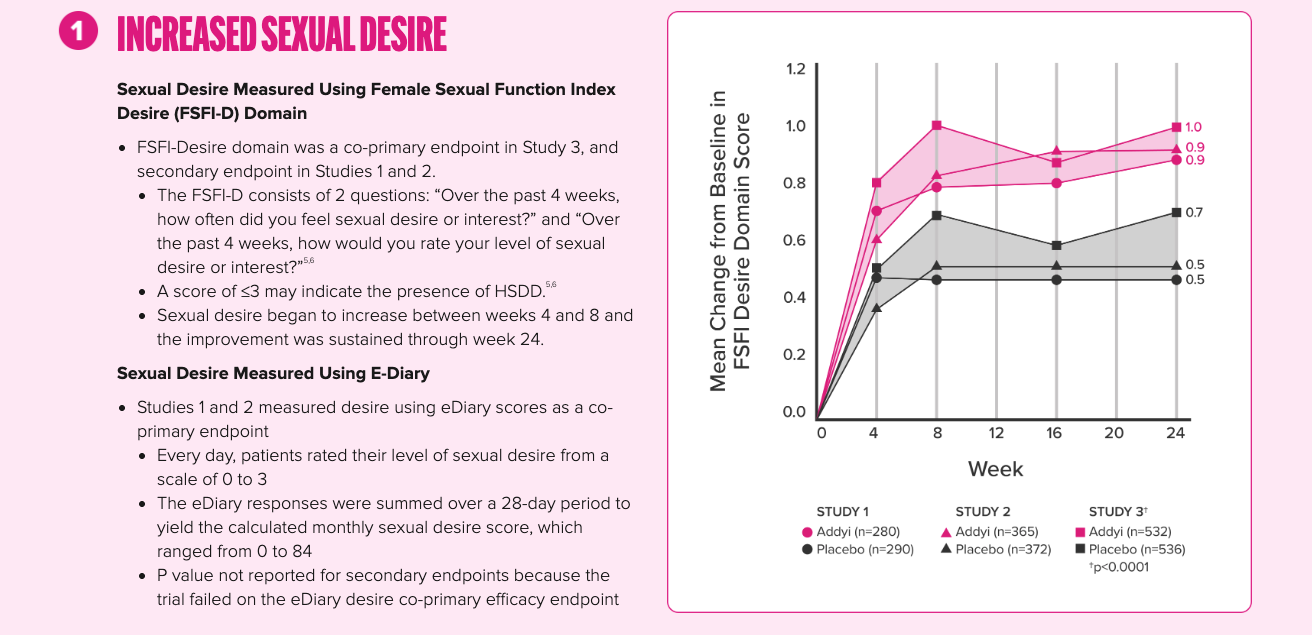
Let's be honest about what the research shows. In clinical trials involving over 2,000 women, approximately 46-60% reported meaningful improvement. That means it works for a little more than half of the women who try it, but not everyone.

Women who benefited from Addyi reported:

  • Increased sexual desire
  • More satisfying sexual events per month
  • Decreased distress about their low desire

Improvements typically start around four weeks, though they can be subtle at first and build gradually. Some women notice changes earlier, while others need more time. If you haven't seen any benefit after several months, it may not be the right treatment for you.

What About the Alcohol Restriction?

This is probably the most talked-about aspect of Addyi, and understandably so. Here's the straightforward answer:

Combining Addyi with alcohol can cause severe low blood pressure and fainting. The rules are clear:

  • If you have 1-2 standard drinks in the evening, wait at least 2 hours before taking your bedtime dose
  • If you have 3 or more drinks, skip that night's dose entirely
  • After taking Addyi at bedtime, don't drink alcohol until the following day

A standard drink is one 12-ounce beer, 5 ounces of wine, or 1.5 ounces of spirits.

Is this manageable? That depends on your lifestyle. If you rarely drink or can plan around the timing, it may not be an issue. If you regularly enjoy evening cocktails or wine with dinner, you'll need to adjust your habits or consider whether this medication fits your life.

What Are the Side Effects?

The most common side effects, occurring in more than 2% of women in trials, include:

  • Dizziness (11.4%)
  • Sleepiness (11.2%)
  • Nausea (10.4%)
  • Fatigue (9.2%)
  • Insomnia (4.9%)
  • Dry mouth (2.4%)

Most of these effects begin within the first two weeks of starting the medication and often improve over time. This is why Addyi must be taken at bedtime, taking it during waking hours increases the risk of these side effects significantly.

Some women also report anxiety, constipation, or abdominal discomfort, though these are less common.

In clinical trials, women did not typically gain weight on Addyi. In fact, there was a slight tendency toward weight loss.

Who Shouldn't Take Addyi?

Addyi isn't safe for everyone. You should not take it if you:

  • Have liver problems (it's contraindicated)
  • Are taking certain medications, particularly moderate or strong CYP3A4 inhibitors (like some antifungal medications)
  • Drink alcohol regularly and can't modify this habit
  • Are taking medications that increase flibanserin levels in your blood

You should discuss Addyi carefully with your doctor if you:

  • Have low blood pressure or take blood pressure medications
  • Have a history of depression or other mental health conditions
  • Take other CNS depressants (medications that cause drowsiness)
  • Are pregnant, planning to become pregnant, or breastfeeding

Important Update: Now Approved for More Women

In December 2024, the FDA expanded Addyi's approval to include postmenopausal women under age 65. Previously, it was only approved for premenopausal women. This is significant because many women experience changes in desire during and after menopause, and now there's an approved treatment option for this broader population.

Isn't Low Desire Just a Hormone Problem?

Not always. While hormonal changes particularly during menopause, after childbirth, or due to certain medical conditions can contribute to low desire, HSDD is often more complex. The brain's neurotransmitter balance plays a significant role in sexual desire, which is why a non-hormonal medication like Addyi can be effective.

That said, some women do benefit from hormone therapy, particularly testosterone therapy in postmenopausal women. Your doctor can help determine whether hormonal factors are contributing to your low desire and whether hormone therapy might be appropriate for you.

Understanding Your Hormone Patterns

Because hormonal fluctuations can significantly impact sexual desire, understanding your unique hormone patterns is valuable. Tools like Oova's at-home hormone tracking can help you and your healthcare provider see the full picture of what's happening with your progesterone, estrogen, and other key hormones throughout your cycle. This data can help determine whether hormonal factors are contributing to changes in your libido and guide treatment decisions, whether that's Addyi, hormone therapy, or a combination approach. Knowledge is power, and having concrete data about your body's hormone levels can lead to more targeted, effective treatment.

Are There Alternatives?

Yes. Addyi isn't the only option:

Other medications:

  • Vyleesi (bremelanotide) is an injection you give yourself at least 45 minutes before sexual activity
  • Testosterone therapy (off-label use in women, more established for postmenopausal women)
  • Bupropion (an antidepressant that may help, especially if your low desire is related to SSRI use)

Non-medication approaches:

  • Sex therapy or counseling to address psychological factors
  • Couples therapy for relationship issues
  • Lifestyle changes: managing stress, improving sleep, regular exercise
  • Addressing underlying medical conditions or medication side effects

Many experts recommend a combined approach medication along with therapy or lifestyle modifications for the best results.

How Do I Know If I Should Try Addyi?

Ask yourself these questions:

  1. Did I used to have normal sexual desire that has now decreased significantly?
  2. Does my low desire occur regardless of the situation or partner?
  3. Am I distressed about my lack of sexual desire?
  4. Have I ruled out other causes (medications, relationship problems, untreated medical or mental health conditions)?
  5. Can I commit to taking a daily medication and following the alcohol restrictions?

If you answered yes to these questions, it's worth having a conversation with your healthcare provider.

Talking to Your Doctor

Many women feel uncomfortable bringing up sexual concerns, and many doctors don't routinely ask about them. But this is a legitimate medical issue, and you deserve to have your concerns addressed.

You might say something like:

  • "I've noticed a significant decrease in my sexual desire over the past [timeframe], and it's causing me distress. I'd like to explore what might be causing this and discuss treatment options."
  • "I think I might have HSDD. Can we talk about whether Addyi might be appropriate for me?"

Your doctor should take a complete medical history, ask about your symptoms, rule out other causes, and discuss whether you're a good candidate for Addyi or other treatments.

The Bottom Line

Addyi is a legitimate treatment option for women with HSDD, backed by clinical trials and FDA approval. It doesn't work for everyone, and it comes with important restrictions and side effects to consider. But for many women, it has made a meaningful difference in reclaiming an important part of their lives.

Low sexual desire that causes you distress is not something you need to just accept or feel ashamed about. It's a medical condition with treatment options available. Whether Addyi is right for you depends on your individual situation, but knowing the facts empowers you to have an informed conversation with your healthcare provider.

You're not broken. You're not alone. And you have options.

About the author

Amy Divaraniya
Dr. Aparna (Amy) Divaraniya is the Founder and CEO of Oova. She has over 10 years experience working in data science and a PhD in Biomedical Sciences. In 2017, Amy pivoted to women's healthcare after facing her own fertility struggles. Amy started Oova to give women control over their fertility by making high-quality hormone testing more accessible.

Sources

perimenopause-periods
Should I still see my gynecologist if my periods are just "weird" but not painful?
Yes. Annual visits remain important during perimenopause. Your provider can help determine if your "weird" periods are typical perimenopause changes or something requiring attention. They can also discuss management options to improve your quality of life.
perimenopause-periods
How long do irregular periods last before menopause?
Irregular perimenopause periods typically last 4 to 8 years before your final period, though this varies greatly. Some women experience irregularity for just a few months, while others have irregular periods for over a decade before reaching menopause.
perimenopause-periods
Is it normal to have two periods in one month during perimenopause?
Yes, this can happen, especially in early perimenopause when cycles shorten. You might have a 21 day cycle, meaning you could have a period at the beginning and end of the same calendar month. Track these patterns to distinguish between short cycles and abnormal bleeding.
perimenopause-periods
Why are my periods suddenly so heavy in my 40s?
Heavy perimenopause periods often result from estrogen dominance. When progesterone drops but estrogen remains high, your uterine lining builds up more than usual, causing heavier bleeding when it sheds. This is common in perimenopause but should be evaluated if it affects your daily life.
perimenopause-periods
Can I still get pregnant if my periods are irregular during perimenopause?
Yes. As long as you're having periods, even irregular ones, you may still be ovulating. Pregnancy is possible until you've gone 12 full months without any period. If you don't want to become pregnant, continue using contraception throughout perimenopause.
perimenopause-and-weight-gain
Can you prevent perimenopause weight gain completely?
While you may not prevent all weight changes during perimenopause, you can minimize gain through proactive strategies. Starting strength training before perimenopause, maintaining consistent sleep habits, and managing stress can help your body adapt to hormonal changes more smoothly. Remember, some body changes during this transition are normal and healthy.
perimenopause-and-weight-gain
At what age does perimenopause weight gain typically start?
Perimenopause weight gain can begin in your late 30s or early 40s, often coinciding with the first hormonal changes. Many women notice gradual changes starting 5 to 10 years before their final period. The timing varies greatly based on genetics, lifestyle, and overall health.
perimenopause-and-weight-gain
Does everyone gain the same amount during perimenopause?
No. Perimenopause weight gain varies significantly. Some women gain 5 pounds, others 20 or more, and some maintain their weight. Factors include genetics, starting weight, activity level, stress, sleep quality, and how dramatically hormones fluctuate. Your experience is unique to your body.
Is perimenopause weight gain different from regular aging weight gain?
Yes. While metabolism naturally slows with age, perimenopause weight gain has distinct characteristics. The hormonal shifts cause fat redistribution to the midsection, even if overall weight doesn't change dramatically. This abdominal weight gain pattern is specifically linked to declining estrogen and progesterone, not just aging.
perimenopause-and-weight-gain
Will the weight come off after menopause?
Perimenopause weight gain often stabilizes after menopause when hormones level out, but the weight doesn't automatically disappear. The metabolic and body composition changes that occur during perimenopause tend to persist. However, with consistent healthy habits, weight management becomes more predictable post menopause than during the fluctuating perimenopause years.
https://www.oova.life/blog/progesterone-supplementation-guide
Can I take progesterone if I'm breastfeeding?
Yes, progesterone is generally safe while breastfeeding and doesn't significantly affect milk supply. However, always discuss with your healthcare provider before starting any hormone supplementation while nursing.
https://www.oova.life/blog/progesterone-supplementation-guide
Is it safe to take progesterone throughout pregnancy?
Yes, when prescribed by your healthcare provider. Progesterone supplementation in early pregnancy is safe and can reduce miscarriage risk in women with low progesterone or a history of pregnancy loss. Most providers continue supplementation through the first trimester (weeks 10-12) when the placenta takes over.
https://www.oova.life/blog/progesterone-supplementation-guide
Can progesterone supplementation cause weight gain?
Progesterone can cause temporary water retention and bloating, which may show up as a few pounds on the scale, but it doesn't cause true fat weight gain. Most women don't experience significant weight changes from progesterone supplementation.
https://www.oova.life/blog/progesterone-supplementation-guide
Can I switch from pills to suppositories or vice versa?
Yes, but only under your doctor's guidance. The dosing and timing may need adjustment when switching between forms since they're absorbed differently. Never switch on your own, especially if you're pregnant or undergoing fertility treatment.
https://www.oova.life/blog/progesterone-supplementation-guide
Will progesterone supplementation delay my period?
Yes, progesterone keeps the uterine lining intact, so if you're not pregnant and continue taking progesterone, your period will be delayed. Once you stop taking it, your period should start within 2-10 days. If you are pregnant, progesterone helps maintain the pregnancy and you won't get a period.
https://www.oova.life/blog/progesterone-supplementation-guide
Should I take progesterone pills orally or vaginally?
For fertility and pregnancy support, vaginal progesterone is usually preferred because it delivers higher concentrations directly to the uterus. For perimenopause or general hormone balance, oral progesterone often works well and is more convenient. Your doctor will recommend the best route based on your specific needs.
https://www.oova.life/blog/progesterone-supplementation-guide
When should I start taking progesterone after ovulation?
Typically, progesterone supplementation for luteal phase support starts 2-3 days after ovulation (confirmed by LH surge or temperature rise). Your doctor will give you specific timing based on your protocol. Some women start immediately after a positive ovulation test.
https://www.oova.life/blog/progesterone-supplementation-guide
What's better: progesterone cream or pills?
Pills (oral micronized progesterone) are generally more effective and reliable than creams because absorption from creams is inconsistent. For medical conditions like fertility issues, low progesterone, or HRT, prescription pills or suppositories are strongly recommended over over-the-counter creams.
https://www.oova.life/blog/low-vs-high-progesterone-symptoms
How can I tell if I have low or high progesterone?
The only definitive way to know is through hormone testing via blood tests or at-home urine tests that measure progesterone metabolites. However, symptom patterns can provide clues: anxiety and irregular periods suggest low progesterone, while bloating and extreme fatigue suggest high progesterone.
https://www.oova.life/blog/low-vs-high-progesterone-symptoms
When during my cycle should I test progesterone levels?
Test progesterone levels during the luteal phase, typically 7 days after ovulation or around day 21 of a 28-day cycle. This is when progesterone should be at its peak, making it easier to identify if levels are too low or too high.
https://www.oova.life/blog/low-vs-high-progesterone-symptoms
What are the main differences between low and high progesterone symptoms?
Low progesterone typically causes irregular or heavy periods, anxiety, hot flashes, and sleep issues. High progesterone causes bloating, fatigue, intense breast tenderness, and depression-like mood changes. Low progesterone symptoms persist throughout your cycle, while high progesterone symptoms are most intense during the luteal phase.
https://www.oova.life/blog/low-vs-high-progesterone-symptoms
Can you have symptoms of both low and high progesterone?
Some symptoms like breast tenderness and mood changes can occur with both low and high progesterone, making it confusing. However, the timing, intensity, and accompanying symptoms differ. Hormone testing is the best way to determine which imbalance you're experiencing.
https://www.oova.life/blog/10-dpo
Can stress affect 10 DPO symptoms?
Yes, stress can worsen or mimic 10 DPO symptoms. Stress increases cortisol, which can cause cramping, fatigue, and mood changes similar to both PMS and early pregnancy. During the two-week wait, try stress-reduction techniques like gentle exercise, meditation, or spending time with loved ones.
https://www.oova.life/blog/10-dpo
Is it better to test at 10 DPO or wait?
It's better to wait until 12–14 DPO for more accurate results. Testing at 10 DPO often leads to false negatives because hCG levels may still be too low. If you absolutely can't wait, use a sensitive early detection test with first morning urine, and be prepared to retest in 2–3 days if negative.
https://www.oova.life/blog/10-dpo
What does implantation bleeding look like at 10 DPO?
Implantation bleeding at 10 DPO is typically light pink or brown, much lighter than a period, and lasts 1–2 days. It's often just spotting when you wipe or a few drops on a panty liner. However, only 15–20% of pregnant women experience implantation bleeding—most don't have any bleeding at all.
https://www.oova.life/blog/10-dpo
Why am I cramping at 10 DPO?
Cramping at 10 DPO can be caused by elevated progesterone (whether you're pregnant or not), implantation (if you're pregnant), or premenstrual cramping. Unfortunately, cramping alone can't tell you if you're pregnant since progesterone causes similar symptoms in both scenarios.
https://www.oova.life/blog/10-dpo
What are the chances of a BFP at 10 DPO?
If you're pregnant, you have about a 50–60% chance of getting a positive test at 10 DPO. This means there's a 40–50% chance of a false negative even if you conceived. Chances improve significantly by 12–14 DPO.
https://www.oova.life/blog/10-dpo
What DPO is most accurate for pregnancy testing?
14 DPO (the day of your missed period) is the most accurate time to test, with 99% accuracy. 12 DPO offers 80–90% accuracy. 10 DPO has only 50–60% accuracy. For best results, wait as long as you can—ideally until 12–14 DPO.
https://www.oova.life/blog/10-dpo
Is 10 DPO too early to test?
10 DPO is considered early for pregnancy testing. While some women get positives at 10 DPO, accuracy is only 50–60% if you're pregnant. For best results, wait until 12 DPO (80–90% accuracy) or 14 DPO/missed period (99% accuracy).
https://www.oova.life/blog/10-dpo
Can you have implantation at 10 DPO?
Yes, implantation can still occur at 10 DPO, though 84% of women have already implanted by this point. Late implantation at 10–12 DPO is normal. If implantation happens at 10 DPO, you won't get a positive pregnancy test for another 2–3 days.
https://www.oova.life/blog/10-dpo
What does a negative test at 10 DPO mean?
A negative test at 10 DPO does not mean you're not pregnant. It's very common to get negatives at 10 DPO even if you conceived. Your hCG levels may still be too low, or implantation may have occurred later. Wait until 12–14 DPO to retest for more accurate results.
https://www.oova.life/blog/10-dpo
Can you get a positive pregnancy test at 10 DPO?
Yes, but only about 50–60% of pregnant women will get a positive at 10 DPO. The other 40–50% have hCG levels that are still too low to detect. If you test negative at 10 DPO, wait 2–3 days and test again.
https://www.oova.life/blog/high-progesterone-symptoms
Can high progesterone cause weight gain?
Yes, elevated progesterone can cause temporary weight gain through water retention and bloating. This is a normal part of the luteal phase and early pregnancy.
https://www.oova.life/blog/how-to-increase-estrogen
Does stress affect estrogen levels?
Yes, chronic stress elevates cortisol, which can suppress estrogen production and disrupt hormonal balance. Stress reduction through meditation, yoga, adequate sleep, and self-care practices helps maintain optimal estrogen levels.
https://www.oova.life/blog/how-to-increase-estrogen
When should I consider medical treatment for low estrogen?
Consider medical intervention if natural methods don't improve symptoms after 3 months, if symptoms severely impact quality of life, if you're experiencing early menopause (before 40), or if you have fertility concerns. Hormone replacement therapy may be appropriate in these cases.
https://www.oova.life/blog/how-to-increase-estrogen
What are the signs that my estrogen is increasing?
Signs of rising estrogen include more regular menstrual cycles, reduced hot flashes, improved vaginal lubrication, better mood stability, increased energy, and improved skin elasticity. You may also notice reduced symptoms that originally indicated low estrogen.
https://www.oova.life/blog/how-to-increase-estrogen
Can exercise increase estrogen levels?
Yes, moderate exercise stimulates estrogen release and helps maintain hormonal balance. Aim for 150 minutes of moderate cardio weekly plus strength training twice per week. However, excessive exercise can actually lower estrogen, so balance is key.
https://www.oova.life/blog/how-to-increase-estrogen
How long does it take to increase estrogen naturally?
With consistent dietary and lifestyle changes, you may notice improvements in symptoms within 4-8 weeks. However, significant hormonal changes typically take 2-3 months. Tracking your cycle and symptoms can help you monitor progress.
https://www.oova.life/blog/how-to-increase-estrogen
What foods increase estrogen levels naturally?
Foods high in phytoestrogens can help increase estrogen naturally. The best options include flax seeds (high in lignans), soy products (tofu, tempeh, edamame), lentils, chickpeas, whole grains (oats, quinoa, brown rice), and garlic. These plant compounds mimic estrogen's effects in the body.
https://www.oova.life/blog/perimenopause
What helps relieve hot flashes quickly?
Cool environments, layered clothing, herbal teas, and medical treatments like gabapentin or HRT may help—depending on severity. Lifestyle changes like reducing caffeine and alcohol can also provide relief.
https://www.oova.life/blog/perimenopause
Are there tests to confirm perimenopause?
Yes. Tests measuring estradiol, LH, and FSH levels can indicate hormonal shifts—but diagnosis is often symptom-based since hormone levels fluctuate widely during perimenopause.
https://www.oova.life/blog/perimenopause
How do I know it's perimenopause and not something else?
A doctor may recommend hormone testing (like LH, E3G, and PdG) and track symptom timing. Diagnosis is often based on symptoms combined with age and menstrual pattern changes.
https://www.oova.life/blog/perimenopause
What's the earliest age perimenopause can start?
Some women begin experiencing symptoms as early as their mid-30s, though perimenopause typically starts between ages 38-45.
https://www.oova.life/blog/perimenopause
Does perimenopause affect mental clarity?
Yes. Brain fog and difficulty concentrating are common during hormone fluctuations in perimenopause.
https://www.oova.life/blog/TBD-10-symptoms-and-how-to-get-relief
What happens after the last sign of perimenopause?
After your final period, you enter postmenopause. You'll need 12 consecutive months without a period to confirm menopause. Many symptoms gradually improve, though some like vaginal dryness may persist without treatment.
https://www.oova.life/blog/TBD-10-symptoms-and-how-to-get-relief
When do perimenopause symptoms finally stop?
Some symptoms like brain fog improve after menopause, while others like hot flashes may continue for up to 10 years post-menopause. Vaginal symptoms often persist or worsen without treatment. Each person's timeline is different.
https://www.oova.life/blog/high-progesterone-symptoms
Is high progesterone a sign of pregnancy?
Yes, high progesterone is one of the earliest indicators of pregnancy. Progesterone levels rise significantly after conception to support the developing embryo and reach their peak during the third trimester.
https://www.oova.life/blog/TBD-10-symptoms-and-how-to-get-relief
Can you still get pregnant in late perimenopause?
Yes, you can still get pregnant during perimenopause as long as you're having periods, even if they're infrequent. Continue using birth control until you've gone 12 consecutive months without a period and have officially reached menopause.
https://www.oova.life/blog/TBD-10-symptoms-and-how-to-get-relief
Do symptoms get worse before perimenopause ends?
Yes, most perimenopause symptoms intensify in the final 1-2 years before menopause. Hot flashes peak around your final period, vaginal symptoms worsen, and mood changes increase. However, brain fog typically improves in late perimenopause.
https://www.oova.life/blog/TBD-10-symptoms-and-how-to-get-relief
How long does late perimenopause last?
Late perimenopause typically lasts 1-3 years before your final period. However, the exact duration varies significantly from person to person. You've reached menopause after 12 consecutive months without a period.
https://www.oova.life/blog/high-progesterone-symptoms
What are the symptoms of high progesterone?
High progesterone symptoms include fatigue, bloating, breast tenderness, weight gain, anxiety, depression, headaches, and food cravings. During pregnancy, you may also experience increased nipple sensitivity and muscle aches.
https://www.oova.life/blog/TBD-10-symptoms-and-how-to-get-relief
What are the first signs that perimenopause is ending?
The earliest signs include longer gaps between periods (60+ days), intensifying hot flashes that peak around your final period, and worsening vaginal dryness. These symptoms typically increase in late perimenopause before you reach official menopause.
https://www.oova.life/blog/high-progesterone-symptoms
When should I be concerned about high progesterone?
Consult a healthcare provider if you experience high progesterone symptoms outside your luteal phase when not pregnant, or if symptoms include severe pelvic pain, abnormal vaginal bleeding, or rapid weight gain while on hormone therapy.
https://www.oova.life/blog/high-progesterone-symptoms
How do you test progesterone levels?
Progesterone can be measured through blood tests at your doctor's office or at-home urine tests that measure PdG (a progesterone metabolite). Testing is typically done during the luteal phase, about 7 days after ovulation.

About the Oova Blog:
Our content is developed with a commitment to high editorial standards and reliability. We prioritize referencing reputable sources and sharing where our insights come from. The Oova Blog is intended for informational purposes only and is never a substitute for professional medical advice. Always consult a healthcare provider before making any health decisions.