
Still getting periods but struggling with perimenopause symptoms? The new 2026 menopause guidelines support earlier treatment for eligible women. Learn how HRT works while you're still cycling, what happens to your periods and ovulation, and why understanding your natural hormone patterns before treatment may help.

Still getting periods but struggling with perimenopause symptoms? The new 2026 menopause guidelines support earlier treatment for eligible women. Learn how HRT works while you're still cycling, what happens to your periods and ovulation, and why understanding your natural hormone patterns before treatment may help.
Yes, you can start hormone replacement therapy (HRT) while you're still having periods. In October 2026, the American College of Physicians (ACP) recommended estrogen-based hormone therapy as a first-line treatment for eligible perimenopausal and postmenopausal women experiencing hot flashes and night sweats. The American College of Obstetricians and Gynecologists (ACOG) also updated its guidance for managing menopause-related symptoms.
That means you don't necessarily need to wait until your periods become irregular, or stop altogether, before discussing treatment.
Maybe you're 42 and still getting a period every month, but suddenly waking up drenched in sweat. Or you're 46, your cycles have become unpredictable, and your sleep has changed dramatically.
If you're still menstruating, it's reasonable to wonder whether HRT is an option or whether you need to wait until menopause is complete.
Here's what the latest guidelines say, how HRT works when your ovaries are still active, and what you should understand before starting treatment.
What Do the New 2026 Menopause Guidelines Say About Starting HRT?
October 2026 brought important updates from two major medical organizations.
On October 15, ACOG published Clinical Practice Guideline No. 13, addressing menopause-related hot flashes, night sweats, sleep disturbances, and mood symptoms.
ACOG strongly recommends systemic menopausal hormone therapy for eligible women experiencing bothersome hot flashes, night sweats, and associated sleep disturbances. ACOG Clinical Practice Guideline, 2026.
Earlier in October, ACP released its own guideline recommending estrogen-based hormone therapy as a first-line treatment for perimenopausal and postmenopausal women seeking relief from hot flashes and night sweats. ACP Clinical Guideline, 2026.
What does this mean if you're still getting periods?
- You don't automatically have to wait until menopause. Having regular or irregular periods doesn't, by itself, rule out HRT.
- Hormone therapy can be a first-line treatment. Eligible women with bothersome hot flashes or night sweats don't necessarily need to try multiple other treatments first.
- Your health history matters. Age, risk factors, contraindications, and preferences all influence whether hormone therapy is appropriate.
- Treatment should be individualized. The type of HRT, dose, and follow-up plan should reflect your symptoms and medical needs.
ACOG recommends initiating systemic hormone therapy before age 60 or within 10 years of natural menopause onset when treatment is appropriate and no contraindications are present.
That doesn't mean HRT is right for everyone, or that it treats every symptom associated with perimenopause.
The takeaway: your menstrual period alone isn't the deciding factor in whether HRT is an option.
Can You Take HRT If Your Periods Are Still Regular?
Yes. Regular periods don't necessarily mean your reproductive hormones are behaving exactly as they did five or ten years ago.
During the years leading up to menopause, estrogen production can become increasingly variable. Ovulation may continue, but hormone patterns can begin shifting before obvious changes appear in menstrual cycle length.
You might still have a period every 28 days while experiencing:
- Night sweats or hot flashes
- New sleep disturbances
- Changes in menstrual flow or premenstrual symptoms
- Symptoms that fluctuate noticeably throughout your cycle
These symptoms don't automatically mean you're in perimenopause. Thyroid conditions, medication effects, sleep disorders, and other medical issues can produce similar changes.
But a regular menstrual cycle also doesn't mean your concerns should be dismissed.
For more on what can happen before cycle changes become obvious, read Can You Be in Perimenopause With Regular Periods?.
What if you're under 40?
If you're under 40 and experiencing symptoms that suggest declining ovarian function, it's especially important to seek an evaluation rather than assume you're experiencing typical perimenopause.
Premature ovarian insufficiency (POI) and other medical conditions may need to be considered.
Women aged 40–45 with suspected early menopause may also need a more targeted evaluation.
The updated treatment recommendations don't eliminate the need to investigate symptoms that begin unusually early.
What Type of HRT Can You Take While You're Still Having Periods?
Because your ovaries may still be producing estrogen and progesterone, and you may still be ovulating, the type of hormone therapy you use matters.
Your clinician will consider your symptoms, medical history, whether you have a uterus, your bleeding patterns, and whether you need contraception.
Sequential or cyclical HRT
Sequential HRT typically involves taking estrogen regularly and adding a progestogen for part of each month.
This approach may be considered for women who are still menstruating because it can produce a more predictable withdrawal bleed.
Importantly, withdrawal bleeding isn't the same as a natural menstrual period. It occurs in response to changes in the prescribed hormone regimen and doesn't necessarily indicate whether you ovulated.
Sequential regimens are well established, particularly in UK clinical practice. In the United States, clinicians may use different hormone schedules depending on the patient and available formulations.
Continuous combined HRT
Continuous combined HRT involves taking estrogen and a progestogen every day.
It's commonly used after menopause, with the goal of avoiding scheduled monthly bleeding.
It can sometimes be used during the transition, depending on individual circumstances, but unpredictable spotting or bleeding may occur, especially when someone is still cycling.
Estrogen-only HRT
Women who have had a hysterectomy may be able to use systemic estrogen without a progestogen.
For women with a uterus, systemic estrogen generally needs to be paired with adequate endometrial protection to reduce the risk of endometrial hyperplasia and cancer.
A clinician can help determine which approach is appropriate.
What about estrogen patches versus pills?
Estrogen can be administered through patches, gels, sprays, or oral tablets.
The delivery method matters because benefits and risks can differ. For example, transdermal estrogen may carry a lower blood-clot risk than oral estrogen for some patients.
Neither route is universally best. Your medical history, symptoms, preferences, and other medications all influence the decision.
Will HRT Stop Your Periods or Prevent Ovulation?
Not necessarily. Standard menopausal HRT does not reliably suppress ovulation, and it is not contraception.
During perimenopause, your ovaries may continue releasing eggs even if ovulation becomes less predictable. HRT may change when or how much you bleed, but changes in bleeding don't necessarily mean your ovaries have stopped functioning.
Pregnancy can still occur during perimenopause. If you don't wish to conceive, discuss contraception with your clinician rather than relying on HRT.
For a closer comparison of treatment options, read HRT Versus Birth Control for Perimenopause: Which Is Right for You?.
What if you start bleeding unexpectedly?
Some spotting or irregular bleeding can occur when starting or changing HRT, particularly during the initial adjustment period.
However, heavy, persistent, or new unexpected bleeding should be discussed with your clinician. The appropriate evaluation depends on your medical history, treatment regimen, and how long the bleeding has been happening.
If bleeding is soaking through protection rapidly, or you're experiencing significant dizziness, weakness, or severe pain, seek urgent medical assessment.
Do You Need a Hormone Test Before Starting HRT?
For most women aged 45 or older with typical perimenopause symptoms, routine hormone testing isn't required before discussing or starting HRT.
That's because hormone production during perimenopause can fluctuate considerably.
Estrogen levels can rise and fall over the course of a menstrual cycle, and those fluctuations may become more variable as reproductive aging progresses.
A single blood test may capture a value within the normal range even when someone's overall hormonal pattern is changing.
For this reason, clinicians generally assess typical perimenopause using age, symptoms, menstrual history, and medical evaluation rather than requiring a particular estradiol or FSH result. NICE Menopause Guideline NG23.
But there's an important difference between needing a hormone test to qualify for treatment and wanting to understand your own hormonal patterns before starting it.
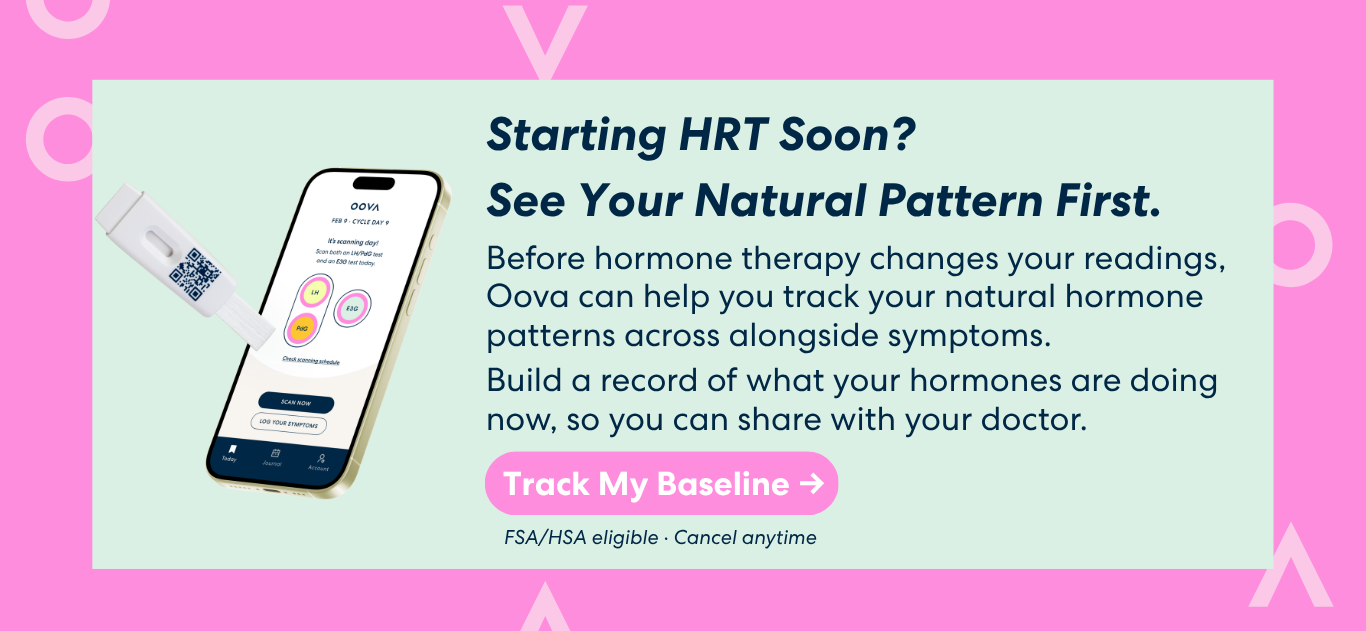
Why track your hormones before starting HRT?
Tracking before HRT can provide a record of your natural hormone patterns and symptom timing before prescribed hormones begin influencing your readings.
Oova measures three urinary biomarkers:
- E3G (estrone-3-glucuronide): A metabolite of estrogen that helps show changes in estrogen-related activity.
- LH (luteinizing hormone): A hormone involved in triggering ovulation.
- PdG (pregnanediol glucuronide): A progesterone metabolite that can help identify patterns consistent with ovulation.
Following these markers over multiple days and cycles can help you observe estrogen-related fluctuations, identify LH surges and subsequent PdG rises, and understand how your patterns differ from one cycle to another.
Paired with symptom tracking, this information may give you and your clinician more context about what you're experiencing.
For example, you might notice that sleep disruption repeatedly occurs around a particular point in your cycle, or that your hormone patterns have become more variable across consecutive cycles.
This doesn't establish why a symptom is happening or prove that HRT will help. But it can help document your experience.
Once you start estrogen or progesterone therapy, prescribed hormones can contribute to the urinary metabolites measured by hormone-tracking tests. Results may then reflect a combination of natural ovarian activity and medication effects.
That's why readings taken before and during HRT aren't directly interchangeable. A pre-treatment baseline documents your starting pattern, but it cannot be used by itself to determine whether treatment is working or what dose you need.
Your healthcare provider can help determine whether longitudinal hormone tracking would be useful in your situation.
What If HRT Isn't Right for You?
Not everyone wants hormone therapy, and some women have medical conditions that make systemic HRT inappropriate.
Fortunately, there are evidence-based nonhormonal approaches for managing menopausal symptoms.
ACOG's 2026 clinical practice guideline provides several recommendations:
- SSRIs and SNRIs: Certain antidepressant medications are strongly recommended as nonhormonal options for vasomotor symptoms.
- Neurokinin receptor antagonists: These medications are also strongly recommended as nonhormonal treatment options for eligible patients with hot flashes and night sweats.
- Gabapentin: ACOG suggests this medication when other recommended nonhormonal treatments are ineffective or poorly tolerated.
ACOG also conditionally recommends several non-drug approaches, including exercise, cognitive behavioral therapy (CBT), acupuncture, mindfulness-based interventions, and clinical hypnosis for certain menopause-related symptoms.
These approaches don't all have the same level of evidence or benefit for every symptom, so treatment should be individualized. ACOG Clinical Practice Guideline, 2026.
Some symptoms may also benefit from targeted treatments, such as local vaginal estrogen for vaginal dryness or painful sex, or evaluation and treatment of sleep or mood disorders.
The goal is meaningful symptom relief that fits your medical needs and preferences, not HRT at any cost.
What Should You Ask Your Doctor Before Starting HRT?
You don't need to decide which hormone formulation or dose is right for you before your appointment.
Instead, focus on questions specific to the fact that you're still menstruating:
- Can I start HRT while I'm still having regular or irregular periods?
- Which hormone regimen makes sense while I'm still cycling, and what bleeding changes should I expect?
- Do I still need contraception, and how would that work alongside treatment?
- Would a record of my cycle and symptoms before I start help us judge how treatment is working?
- What bleeding patterns or side effects should prompt me to contact you?
Your clinician should also review relevant medical history, medication use, and factors that affect hormone therapy safety.
For a broader discussion of symptom severity, timing, and treatment eligibility, see How Do You Know When It's Time to Start HRT?.
What Happens After You Start HRT?
Once treatment begins, you may notice changes in your symptoms, bleeding pattern, or both.
Hot flashes and night sweats may improve over the first several weeks, although the response varies by person.
Your clinician will typically reassess symptoms, side effects, bleeding, and overall treatment response, often around three months after initiation.
Some women need adjustments to their regimen, while others respond well to their initial treatment.
Keep a record of your symptoms, bleeding, and medication schedule so you can discuss changes at follow-up appointments.
Remember that hormone measurements obtained during treatment may reflect prescribed medication as well as natural hormone production. They shouldn't be used independently to determine whether your dose is correct.
Frequently Asked Questions
Can I start HRT if I still get a period every month?
Yes. Having a monthly period doesn't automatically rule out HRT. Eligible women experiencing bothersome perimenopausal hot flashes or night sweats may consider treatment based on their symptoms, health history, and individual risk factors.
Do I have to wait until menopause to take HRT?
No. ACP's 2026 guideline explicitly includes perimenopausal and postmenopausal women seeking treatment for hot flashes and night sweats. You don't necessarily have to wait until you've gone 12 consecutive months without a menstrual period to discuss HRT.
What is sequential HRT?
Sequential, or cyclical, HRT generally involves taking estrogen regularly and adding a progestogen for part of each month. It can produce predictable withdrawal bleeding and may be considered for women who are still menstruating. Your clinician can determine whether it is appropriate for you.
Can you take HRT and birth control at the same time?
Sometimes, depending on the contraceptive method and HRT regimen. For example, clinicians may use certain 52 mg levonorgestrel intrauterine devices to provide contraception and endometrial protection alongside systemic estrogen. This approach is supported in UK guidance, but using these devices for HRT endometrial protection is not a U.S. FDA-approved indication. Discuss the appropriate options with your prescribing clinician.
Will HRT make my periods stop?
Not necessarily. Some HRT regimens cause scheduled withdrawal bleeding, while others may produce lighter bleeding, spotting, or irregular periods. A change in bleeding doesn't necessarily mean ovulation has stopped.
Can you still get pregnant while taking HRT?
Yes. Standard menopausal HRT is not a reliable contraceptive. Pregnancy remains possible during perimenopause if ovulation continues, so reliable contraception is important if you don't wish to conceive.
Do I need low estrogen on a blood test before starting HRT?
No. For most women aged 45 or older with typical perimenopause symptoms, a low estradiol result isn't required. Hormone levels fluctuate throughout the cycle, making one measurement an unreliable way to determine whether HRT is appropriate.
What if I can't or don't want to take HRT?
Nonhormonal prescription treatments are available for hot flashes and night sweats, including certain SSRIs, SNRIs, neurokinin receptor antagonists, and gabapentin. Behavioral interventions may also help with specific menopause-related symptoms. Your clinician can help determine which approaches are appropriate.
Is hormone tracking helpful before starting HRT?
Tracking your natural hormone patterns can help you understand changes across your cycle and document them alongside symptoms. Once treatment begins, estrogen or progesterone medications may contribute to measured urinary hormone metabolites, making your natural ovarian patterns harder to distinguish. Hormone tracking is not required to start HRT and does not determine treatment dosing.
The Bottom Line
You don't have to stop having periods to start HRT.
The October 2026 ACOG and ACP guidelines reinforce the importance of evidence-based treatment for bothersome menopause-related symptoms. ACP explicitly recommends estrogen-based hormone therapy as a first-line option for eligible women with hot flashes or night sweats during perimenopause as well as after menopause.
What matters is finding the right treatment for your symptoms, health history, and personal needs.
And if you're still naturally cycling, this can be an opportunity to understand your hormone patterns before treatment changes the picture.
See My Natural Cycle Before HRT →
You don't have to wait for your periods to disappear to have a meaningful conversation about your health.
About the author
Sources
- American College of Obstetricians and Gynecologists (ACOG). Management of Menopause-Related Vasomotor, Sleep, and Mood Symptoms. Clinical Practice Guideline No. 13. Obstet Gynecol. 2026;148(5)–e369. doi:10.1097/AOG.0000000000006428.
- Qaseem A, Mackey K, Yost J, et al. Pharmacologic Treatments for Females With Menopausal Vasomotor Symptoms: A Clinical Guideline From the American College of Physicians. Ann Intern Med. Published online October 6, 2026. doi:10.7326/ANNALS-26-01205.
- The Menopause Society. The 2022 Hormone Therapy Position Statement of The North American Menopause Society Advisory Panel. Menopause. 2022;29(7):767–794. PubMed.
- National Institute for Health and Care Excellence (NICE). Menopause: Identification and Management. NICE Guideline NG23. Published November 12, 2015; updated April 15, 2026. NICE NG23.
- Faculty of Sexual & Reproductive Healthcare (FSRH). Contraception for Women Aged Over 40 Years. Published 2017; amended July 2023, with subsequent updates. FSRH Clinical Guideline.
About the Oova Blog:
Our content is developed with a commitment to high editorial standards and reliability. We prioritize referencing reputable sources and sharing where our insights come from. The Oova Blog is intended for informational purposes only and is never a substitute for professional medical advice. Always consult a healthcare provider before making any health decisions.
