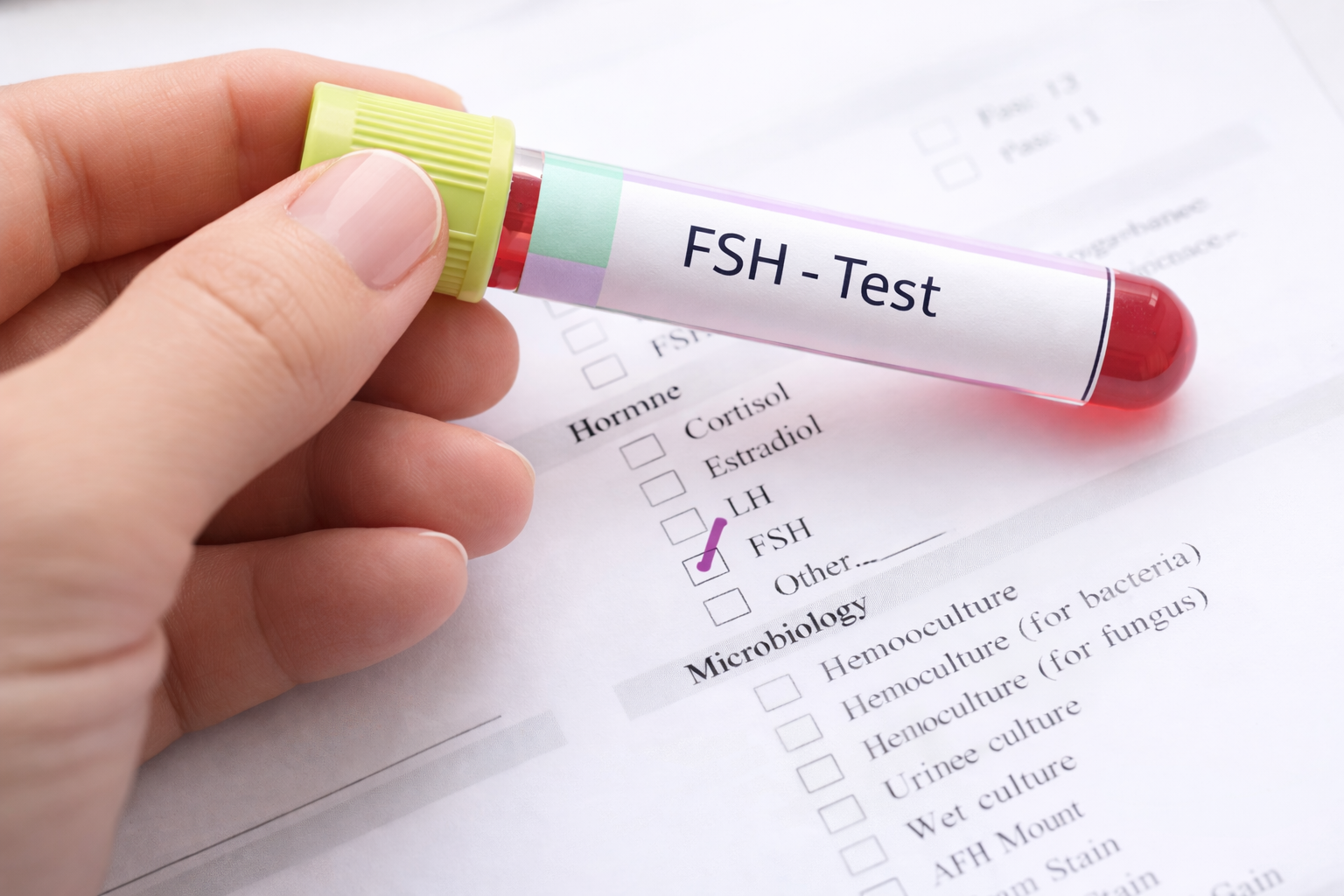
A comprehensive guide comparing FSH, AMH, and estradiol tests for perimenopause diagnosis. Learn which perimenopause blood test healthcare providers recommend, why hormone testing alone isn't enough, and how at-home monitoring can help track your transition.

A comprehensive guide comparing FSH, AMH, and estradiol tests for perimenopause diagnosis. Learn which perimenopause blood test healthcare providers recommend, why hormone testing alone isn't enough, and how at-home monitoring can help track your transition.
If you're experiencing irregular periods, hot flashes, or sleep disruptions in your 40s, you've probably wondered whether a simple blood test could confirm you're in perimenopause. The short answer? It's more complicated than a single test result.
While FSH, AMH, and estradiol tests can provide valuable information about your hormonal status, none of them alone can definitively diagnose perimenopause. Understanding what each test measures and their limitations is essential for anyone navigating this transitional phase.
What Is Perimenopause and Why Is Testing So Tricky?
Perimenopause is the transitional period leading up to menopause, typically beginning in a woman's 40s but sometimes starting as early as the mid-30s. During this time, your ovaries gradually produce less estrogen, and your hormone levels fluctuate wildly from day to day and even hour to hour.
This hormonal variability is exactly what makes testing challenging. Unlike conditions with stable biomarkers, perimenopause is characterized by unpredictable hormone fluctuations. You might have elevated FSH one week and normal levels the next. Your estradiol could be high one day and low three days later. Additionally, there are times in a woman’s cycle when it is normal to have low estrogen levels and times when they are supposed to be higher. Same with FSH, for menstruating women the fsh level naturally spikes mid cycle as part of natural, healthy ovulation. Thus if we check either the estrogen or FSH level on a single day in the cycle, that’s unlikely to be consistent with levels throughout the rest of the month.
The clinical diagnosis of perimenopause relies primarily on your symptoms and menstrual pattern changes rather than laboratory values. According to the North American Menopause Society (NAMS), perimenopause is typically diagnosed based on:
- Age (usually over 40)
- Menstrual cycle changes (irregular periods, skipped cycles, changes in flow)
- Characteristic symptoms (hot flashes, night sweats, mood changes, sleep disturbances)
However, perimenopause blood tests can still play a supportive role in your healthcare journey, particularly when symptoms are unclear or when ruling out other conditions.
The FSH Test for Perimenopause: The Traditional Standard
What Is FSH and What Does It Measure?
Follicle-stimulating hormone (FSH) is produced by your pituitary gland to stimulate egg development in your ovaries. As your ovarian reserve diminishes and egg quality declines during perimenopause, your ovaries become less responsive to FSH. In response, your pituitary gland releases more FSH in an attempt to stimulate ovulation.
This is why FSH levels tend to rise during perimenopause and menopause. An FSH test perimenopause can show whether your body is producing higher levels of this hormone in response to declining ovarian function.
FSH Levels: What's Normal, What's Elevated?
FSH is typically measured on day 2-3 of your menstrual cycle (if you're still having relatively regular periods). During this time of your cycle, general guidelines include:
- Premenopausal: Less than 10 mIU/mL
- Early perimenopause: 10-20 mIU/mL (though levels fluctuate)
- Late perimenopause: Often above 25 mIU/mL
- Postmenopausal: Consistently above 30-40 mIU/mL
However, these ranges are not diagnostic cutoffs for perimenopause. The key word is "fluctuate."
The Major Limitation of FSH Testing
Here's the critical limitation: FSH levels in perimenopause are notoriously unstable. You could test with an FSH of 35 mIU/mL one month (suggesting perimenopause or menopause) and then have a level of 8 mIU/mL the next month (appearing premenopausal). This happens because your ovaries can still have occasional surges of activity.
A single elevated FSH test doesn't confirm perimenopause, and a single normal FSH test doesn't rule it out. This is why most gynecologists don't rely solely on FSH testing for diagnosis in women who are experiencing classic perimenopausal symptoms.
When FSH Testing Is Most Useful
Despite its limitations, FSH testing can be helpful in specific scenarios:
- Women under 40 with irregular periods: To assess for premature ovarian insufficiency (POI)
- Confirming postmenopause: When combined with amenorrhea (no periods for 12 months)
- Ruling out other conditions: When symptoms could indicate thyroid dysfunction or other hormonal disorders
- Baseline assessment: When considering hormone therapy or fertility treatments
AMH and Perimenopause: Measuring Ovarian Reserve
What Is AMH?
Anti-Müllerian hormone (AMH) is produced by the small follicles in your ovaries. Unlike FSH, which is made by your pituitary gland, AMH comes directly from your ovarian follicles. It's considered a marker of ovarian reserve, reflecting how many eggs you have remaining.
How AMH Changes During Perimenopause
AMH levels naturally decline with age as your egg supply diminishes. This decline accelerates during perimenopause:
- Peak reproductive years (20s-early 30s): 1.5-4.0 ng/mL
- Mid-30s to early 40s: 1.0-2.5 ng/mL
- Late reproductive years (mid-40s): Less than 1.0 ng/mL
- Perimenopause and menopause: Often undetectable (less than 0.1 ng/mL)
Why AMH Isn't a Perimenopause Diagnostic Tool
While AMH perimenopause levels are lower than in younger women, AMH testing was originally developed to assess fertility potential, not to diagnose perimenopause. Low AMH indicates diminished ovarian reserve, but it doesn't tell you when perimenopause will begin or how severe your symptoms will be.
Some women with very low AMH continue to have regular periods and minimal symptoms, while others with moderate AMH experience intense perimenopausal symptoms. There's no validated AMH cutoff that says "you're in perimenopause."
When AMH Testing Makes Sense
AMH testing is most useful for:
- Fertility assessment: If you're considering pregnancy in your late 30s or 40s
- Evaluating fertility preservation options: Before egg freezing or IVF
- Predicting menopausal timing: Very low AMH may suggest menopause is approaching within several years, but does not give a timeline.
- Infrequent period evaluation: Is your declining ovarian reserve (less active ovaries) the reason for your infrequent periods? In which case your AMH level is typically very low. Or… Might you have PCOS as the cause of your irregular periods? In which case your AMH level is typically elevated.
- Tracking over time: Serial AMH measurements can show the trajectory of ovarian aging
However, for the average woman experiencing perimenopausal symptoms, AMH testing typically doesn't change one’s treatment options, thus it isn't necessary for diagnosis.
Estradiol: The Fluctuating Hormone
What Is Estradiol and Why Does It Matter?
Estradiol is the primary form of estrogen produced by your ovaries during reproductive years. It regulates your menstrual cycle, supports bone health, affects mood and cognition, and influences many other body systems. During perimenopause, estradiol production becomes increasingly erratic.
The Rollercoaster Pattern of Estradiol in Perimenopause
What makes perimenopause so symptomatically challenging is that estradiol doesn't simply decline gradually. Instead, you experience:
- Wild fluctuations: Estradiol can spike to very high levels during some cycles
- Sudden drops: Followed by precipitous declines that trigger hot flashes
- Irregular patterns: No predictable cycle of highs and lows
Early in perimenopause, you might actually have higher estradiol levels at times due to abnormal follicle development. These surges can cause breast tenderness, bloating, mood changes, and heavy periods. Later in perimenopause, estradiol levels trend lower overall, though fluctuations continue.
Estradiol Testing: Why One Test Doesn't Tell the Story
A single estradiol test provides only a snapshot of your hormone levels at that specific moment. Given the hour-to-hour and day-to-day variability during perimenopause, one test result has limited clinical value.
Estradiol reference ranges:
- Follicular phase: 30-120 pg/mL
- Mid-cycle: 130-370 pg/mL
- Luteal phase: 70-250 pg/mL
- Postmenopausal: Less than 30 pg/mL
In perimenopause, your estradiol could fall anywhere in these ranges depending on when you test.
When Estradiol Testing Is Clinically Useful
Estradiol testing becomes valuable when:
- Monitoring hormone therapy: If your symptoms have not yet resolved after starting hormone therapy. Checking an estradiol level can help you know if your levels are sufficient or not.
- Evaluating severe symptoms: persistently low estradiol levels and missed periods could be a sign of early ovarian insufficiency.
- Combination testing: When evaluated alongside FSH and clinical presentation to help determine reproductive and or menopausal transition status.
- Serial monitoring: Multiple tests over time can reveal patterns. Those patterns linked with one’s symptoms can often help guide understanding and a therapy plan. Recurrent hormone testing is rarely done in routine practice.
Which Test for Perimenopause? Comparing Your Options
FSH Test
- What it Measures: Pituitary hormone stimulating ovaries
- Perimenopause Pattern: Rises as ovarian function declines, near the period and near ovulation; highly variable
- Limitations: Fluctuates dramatically; one test insufficient
- Best Use Case: Confirming postmenopause; ruling out POI in younger women
AMH Test
- What it Measures: Ovarian follicle hormone; ovarian reserve
- Perimenopause Pattern: Declines with age; very low in perimenopause
- Limitations: Doesn't correlate with symptoms; designed for fertility
- Best Use Case: Fertility assessment; determining presence of menopause
Estradiol Test
- What it Measures: Primary estrogen from ovaries
- Perimenopause Pattern: Erratic fluctuations then overall decline
- Limitations: Extreme variability makes single test unreliable
- Best Use Case: Monitoring hormone therapy; serial testing for patterns
The Clinical Reality: Symptoms Trump Testing
As an OBGYN, I've seen countless patients come to appointments with questions about which test for perimenopause they should request. The truth is that your symptoms and menstrual history provide more diagnostic information than any single hormone test.
The Stages of Reproductive Aging Workshop (STRAW+10) criteria, which clinicians use to stage reproductive aging, relies primarily on menstrual cycle changes:
- Early perimenopause: Variable cycle length (more than 7 days different from normal)
- Late perimenopause: Amenorrhea intervals of 60 days or more
Blood tests are considered supportive data, not diagnostic requirements.
When Hormone Testing Actually Matters
While routine perimenopause blood tests aren't necessary for most women with classic symptoms, there are important exceptions where testing provides crucial information:
Premature Ovarian Insufficiency (POI)
If you're under 40 and experiencing perimenopausal symptoms, testing is essential. POI affects about 1% of women under 40 and 0.1% of women under 30. Early diagnosis matters because:
- POI has significant health implications (bone loss, cardiovascular risk)
- You may need higher doses of hormone therapy
- Fertility options should be discussed
- Additional testing for autoimmune conditions may be warranted
In this scenario, FSH testing (with levels typically above 25-40 mIU/mL on two occasions at least one month apart) combined with estradiol testing is diagnostically important.
Unclear Clinical Picture
Testing can help when:
- Your symptoms don't match your age or menstrual pattern
- Symptoms could indicate thyroid disease, anemia, or other conditions
- You have a history of gynecologic surgery affecting your periods (hysterectomy)
- You're not having periods because you have a progestin IUD and you’re not sure if you’re menopausal
- You’re still having symptoms despite starting or adjusting hormone therapy
Fertility Considerations
If you're still hoping to conceive in your 40s, comprehensive testing including FSH, AMH, and estradiol can help assess your chances and guide treatment decisions.
Monitoring Treatment
Once you begin hormone therapy for perimenopausal or menopausal symptoms, estradiol testing is not the standard. Guidelines from ACOG (American College of Obstetrics and Gynecology) recommend adjusting the dosage to resolve one’s symptoms. However, there are some providers that check estradiol to confirm you're receiving adequate estrogen replacement for symptom relief and health benefits.
The At-Home Testing Revolution: Pros and Cons
The rise of at-home hormone testing kits has made perimenopause blood tests more accessible than ever. Companies offer convenient tests that measure FSH, estradiol, and other hormones from home.
Advantages of At-Home Testing
- Convenience: Test on your schedule without office visits
- Serial monitoring: Easier to track patterns over multiple cycles
- Empowerment: Access to your own health data
- Starting point for conversations: Results can guide discussions with your healthcare provider
At Oova, we recognize the value of longitudinal hormone tracking. Our at-home hormone testing platform allows you to monitor FSH, estradiol, and LH trends over time, providing a more complete picture than single-point testing. This serial data can help identify patterns that a single blood draw would miss.
Limitations to Consider
- Interpretation challenges: Results still require clinical context
- Variable accuracy: Quality varies among testing companies
- Finger-prick vs. venous blood: May yield different results
- Cost: Not always covered by insurance
- No diagnosis: Tests alone don't diagnose perimenopause
Making At-Home Testing Work for You
If you choose at-home testing:
- Test multiple times: Don't rely on a single result
- Track your symptoms: Correlate hormone data with how you feel
- Share results with your provider: Bring data to appointments
- Understand limitations: Know that testing is one piece of the puzzle
Consider using Oova's comprehensive approach, which combines hormone tracking with symptom monitoring to give you and your healthcare provider a complete view of your perimenopausal transition.
Beyond Blood Tests: What Actually Helps with Diagnosis
Given the limitations of hormone testing, what should you focus on instead?
Comprehensive Symptom Tracking
The most valuable diagnostic tool is detailed tracking of:
- Menstrual patterns: Cycle length, flow changes, skipped periods
- Vasomotor symptoms: Hot flashes and night sweats (frequency, severity, triggers)
- Sleep quality: Insomnia, night awakening patterns
- Mood changes: Anxiety, irritability, depression symptoms
- Cognitive symptoms: Brain fog, memory issues, concentration difficulties
- Physical symptoms: Joint pain, vaginal dryness, changes in libido
Tools like Oova's symptom tracker help you identify patterns and provide concrete data for healthcare conversations.
Medical History and Physical Exam
Your gynecologist will typically consider:
- Your age and family history of menopause timing
- Previous gynecologic surgeries or treatments
- Medications that might affect hormones or cause similar symptoms
- Other medical conditions (thyroid disease, mood disorders, sleep apnea, diabetes, PCOS)
- Physical examination findings
Ruling Out Other Conditions
Perimenopausal symptoms overlap with many other conditions:
- Thyroid disorders: TSH testing is often more important than hormone testing
- Anemia: Can cause fatigue and affect menstrual bleeding
- Sleep apnea: Can worsen perimenopausal sleep disruption
- Polycystic Ovarian Syndrome: Can present with missed periods
- Depression or anxiety disorders: May be exacerbated by or confused with perimenopause
- Diabetes or prediabetes: Can cause night sweats and mood changes
Complete blood count (CBC), thyroid testing, metabolic panels, and other targeted tests may be more clinically useful than perimenopause-specific hormone panels.
Practical Steps: Getting the Right Testing
If you're experiencing symptoms and want to understand your hormonal status, here's a practical approach:
1. Start with Symptom Documentation
Before requesting any testing, track your symptoms for at least one menstrual cycle (or one month if periods are irregular). Document:
- Menstrual dates, flow, and any changes from your baseline
- Daily symptom severity ratings
- Potential triggers or patterns
- Impact on quality of life
2. Schedule a Comprehensive Visit
Book an appointment specifically focused on your concerns. Bring:
- Your symptom diary
- List of all medications and supplements
- Family history of menopause timing
- Questions about testing and treatment options
3. Discuss Testing Strategically
Ask your provider:
- "Based on my symptoms and age, do you think hormone testing would change our approach?"
- "Are there other conditions we should rule out with testing?"
- “What are my options to evaluate and treat my current symptoms?”
4. Consider Serial Testing if Appropriate
If you and your provider decide testing is valuable, consider:
- Testing FSH and estradiol on cycle day 2-3 (if you're still cycling regularly)
- Repeating tests in 1-3 months to assess variability
- Using at-home monitoring to track trends between office visits
5. Interpret Results in Context
Remember that test results are just one data point. Your symptoms, menstrual pattern, age, and overall health picture matter more than any single hormone value.
Hormone Therapy Decisions: When Testing Influences Treatment
One area where perimenopause blood tests can directly impact clinical decisions is when considering hormone therapy (HT).
Pre-Treatment Baseline
While not always necessary, baseline FSH and estradiol testing before starting hormone therapy can:
- Help confirm you're symptoms may be related to perimenopause or postmenopause as opposed to other conditions
- Provide reference values for future comparison
Monitoring During Treatment
Estradiol testing becomes more useful once you're on hormone therapy:
- Ensuring adequate levels: Target estradiol levels for symptom relief typically range from 40-100 pg/mL. If your symptoms resolve on your current dosage of hormone therapy then there is typically no need to check your estradiol levels. However, if your symptoms do not resolve despite current or adjusted dosing, checking an estradiol level can be useful.
- Adjusting doses: If symptoms persist despite treatment, estradiol testing can reveal if levels are too low or if the estradiol levels are therapeutic then it can indicate non ovarian causes of your symptoms.
- Different delivery methods: Patch, pill, cream, and gel formulations absorb differently for each individual thus they can produce different blood levels.
FSH Testing on Hormone Therapy
FSH levels are mildly suppressed while taking estrogen HT. This means you can't use FSH to confirm menopause once you've started hormone therapy. If you're wondering whether you've reached postmenopause while on HT, you'd need to temporarily stop treatment and retest after 4-6 weeks (which is rarely necessary or recommended).
The Future of Perimenopause Testing
The science of perimenopause assessment continues to evolve. Emerging approaches include:
Multi-Marker Panels
Instead of single hormones, comprehensive panels measuring FSH, estradiol, progesterone, testosterone, DHEA-S, and thyroid function simultaneously may provide better context.
Pattern Recognition Over Time
Serial testing that captures hormone variability over weeks or months may prove more diagnostic than snapshot testing. This is where at-home testing platforms like Oova show promise, allowing frequent monitoring that would be impractical with traditional laboratory testing.
Symptom-Hormone Correlation
Research is exploring how individual hormone levels correlate with specific symptoms. Future testing might identify which hormone patterns predict which symptoms, enabling more targeted treatment.
Novel Biomarkers
Scientists are investigating other potential markers of reproductive aging beyond FSH, AMH, and estradiol, including inhibin B and other ovarian peptides.
Making Peace with Diagnostic Uncertainty
For many women, the lack of a definitive perimenopause blood test feels frustrating. We're accustomed to medical conditions having clear diagnostic criteria and yes-or-no test results. Perimenopause doesn't work that way.
This uncertainty is actually a reminder that perimenopause is a natural life transition, not a disease requiring diagnosis. While the symptoms can certainly be challenging and may benefit from treatment, you don't need a test to validate your experience.
Trust Your Body
If you're in your 40s, experiencing irregular periods and symptoms like hot flashes or sleep disruption, you're very likely in perimenopause regardless of what hormone tests show. Your symptoms are real and deserve attention whether your FSH is 8 or 38 mIU/mL.
Focus on Symptom Management
The goal isn't to get the "right" test result but to find effective strategies for managing symptoms and maintaining quality of life. Whether through:
- Lifestyle modifications
- Hormone therapy
- Non-hormonal medications
- Complementary approaches
Your treatment plan should be based on symptoms, preferences, and overall health picture, not lab values alone.
When to Advocate for Testing
While routine hormone testing isn't necessary for typical perimenopause, there are times when advocating for evaluation is appropriate:
Red Flags That Warrant Evaluation (this may or may not include hormone testing)
- Age under 40: Irregular periods or perimenopausal symptoms in your 30s require evaluation
- Severe symptoms: Debilitating hot flashes, severe mood changes, or symptoms that dramatically impact function
- Unusual bleeding patterns: Very heavy bleeding, bleeding between periods, or postmenopausal bleeding
- Osteoporosis risk factors: Early testing and treatment consideration if you have strong family history or other risk factors
If Your Provider Dismisses Concerns
Unfortunately, perimenopausal symptoms are sometimes dismissed as "just stress" or "normal aging." If your provider isn't taking your concerns seriously:
- Be specific about symptom impact on daily life
- Request testing to rule out other conditions (especially thyroid)
- Ask directly whether perimenopause could explain your symptoms
- Consider seeking a provider with specific menopause expertise
- Request referral to a menopause specialist if needed
The North American Menopause Society maintains a database of certified menopause practitioners who have specialized training in this area.
The Bottom Line: An Integrated Approach
So, which test actually diagnoses perimenopause? The honest answer is: none of them, and all of them together provide incomplete information.
The most accurate "test" for perimenopause is:
- Your age (typically 40s, but can be late 30s to early 50s)
- Your menstrual pattern changes (irregular cycles, skipped periods)
- Your symptom constellation (hot flashes, sleep disruption, mood changes)
- The absence of other explanations (ruled out thyroid disease, anemia, etc.)
Hormone testing serves as:
- Supportive data when the clinical picture is unclear
- Important diagnostic information when symptoms occur before age 40
- Baseline and monitoring tool when using hormone therapy
- Pattern recognition tool when done serially over time
The most empowering approach combines:
- Thorough symptom tracking
- Open communication with knowledgeable healthcare providers
- Strategic use of testing when it adds clinical value
- Recognition that your experience is valid regardless of test results
Your Next Steps
If you're navigating perimenopause and wondering about testing:
Step 1: Start tracking your cycles and symptoms today. Oova's perimenopause tracking tools make this simple and provide data you can share with your healthcare provider.
Step 2: Schedule a dedicated appointment with your gynecologist or primary care provider to discuss your symptoms comprehensively.
Step 3: Ask about testing strategically, focusing on ruling out other conditions first (thyroid, anemia) before pursuing hormone testing unless you have specific indications.
Step 4: Consider serial hormone monitoring if you want to understand your patterns over time. Oova's at-home testing allows frequent monitoring that provides more complete data than one-time laboratory testing.
Step 5: Develop a symptom management plan based on your individual experience, not test results. Your quality of life matters more than any hormone level.
Understanding Your Transition
Perimenopause is a complex transition that varies dramatically from woman to woman. While FSH, AMH, and estradiol testing can provide insights into your hormonal status, no single test or panel of tests can definitively diagnose perimenopause or predict your experience.
Your symptoms, your menstrual patterns, and your quality of life matter far more than any laboratory value. By combining symptom awareness, strategic testing when appropriate, and partnership with knowledgeable healthcare providers, you can navigate this transition with confidence.
Remember that perimenopause is a natural part of reproductive aging, not a disease. Whether your FSH is elevated or normal, whether your AMH is detectable or not, your experience is valid and your symptoms deserve attention and treatment.
For ongoing support and evidence-based information about perimenopause testing, symptom management, and treatment options, explore Oova's comprehensive perimenopause resources.
About the author
Sources
- North American Menopause Society. The 2023 Hormone Therapy Position Statement of The North American Menopause Society. Menopause. 2023.
- Harlow SD, et al. Executive summary of the Stages of Reproductive Aging Workshop + 10: addressing the unfinished agenda of staging reproductive aging. J Clin Endocrinol Metab. 2012.
- American College of Obstetricians and Gynecologists. Committee Opinion No. 698: Hormone Therapy in Primary Ovarian Insufficiency. Obstet Gynecol. 2017.
- Prior JC. Perimenopause: The Complex Endocrinology of the Menopausal Transition. Endocr Rev. 1998.
- Nelson HD, et al. Menopause. Lancet. 2008.
About the Oova Blog:
Our content is developed with a commitment to high editorial standards and reliability. We prioritize referencing reputable sources and sharing where our insights come from. The Oova Blog is intended for informational purposes only and is never a substitute for professional medical advice. Always consult a healthcare provider before making any health decisions.