
Are your periods suddenly heavier in your 40s? Learn why perimenopause can cause flooding and blood clots, which bleeding patterns need medical evaluation, and what your hormones may reveal about your changing cycle.

Are your periods suddenly heavier in your 40s? Learn why perimenopause can cause flooding and blood clots, which bleeding patterns need medical evaluation, and what your hormones may reveal about your changing cycle.
Heavy periods in perimenopause can happen when ovulation becomes irregular and the uterine lining develops without the usual progesterone rise. But flooding, large clots, or bleeding longer than seven days can also signal fibroids, polyps, or other conditions. A significant change in your bleeding deserves medical evaluation rather than being written off as just perimenopause.
If you've suddenly started soaking through menstrual products, passing clots, or having periods that seem much heavier than they used to, you're probably wondering what's happening.
Here's how to recognize heavy menstrual bleeding, what might be causing it, and when to talk to your doctor.
Key takeaways
- Heavy periods can happen during perimenopause, particularly when ovulation becomes less predictable.
- Flooding, large clots, and bleeding that lasts longer than seven days can indicate heavy menstrual bleeding that needs evaluation.
- Fibroids, polyps, adenomyosis, and changes in the uterine lining can also cause heavy bleeding.
- Tracking cycle and ovulation patterns can provide useful context, but it cannot diagnose the cause of heavy bleeding.
What counts as heavy bleeding during perimenopause?
Heavy menstrual bleeding is more than having a period that feels slightly heavier than usual. It means bleeding that may interfere with your everyday activities, sleep, work, or quality of life.
According to the American College of Obstetricians and Gynecologists (ACOG) and the CDC, signs include: [1, 2]
- Soaking through a pad or tampon every hour for several hours.
- Needing to use two menstrual products at once to prevent leaks.
- Waking during the night to change menstrual products.
- Bleeding for longer than seven days.
- Passing blood clots about the size of a quarter or larger.
- Having to cancel activities or avoid leaving home because of your period.
- Feeling unusually tired, weak, or short of breath during or after bleeding.
You don't need to experience every symptom for your bleeding to deserve evaluation.
Heavy menstrual bleeding can substantially affect quality of life, even when there isn't a simple measurement of how much blood you've lost. [5]
If your periods have become noticeably heavier than your usual pattern, that's enough reason to discuss the change with your healthcare provider.
What is perimenopause flooding?
Period flooding describes a sudden, very heavy flow of menstrual blood. You might feel a gush when you stand up, soak through a pad unexpectedly, or need to change protection much more often than usual.
A brief gush after sitting or lying down can sometimes reflect blood that has collected and is released when you move. But repeated flooding, especially when you're soaking through menstrual products quickly, can indicate heavy menstrual bleeding.
What matters is how much you're bleeding, how long it continues, and whether you're experiencing symptoms such as dizziness or weakness.
When should you worry about heavy periods in perimenopause?
Some variation in bleeding can occur during the menopause transition. However, there's an important difference between a heavier-than-usual period and bleeding that needs urgent medical attention.
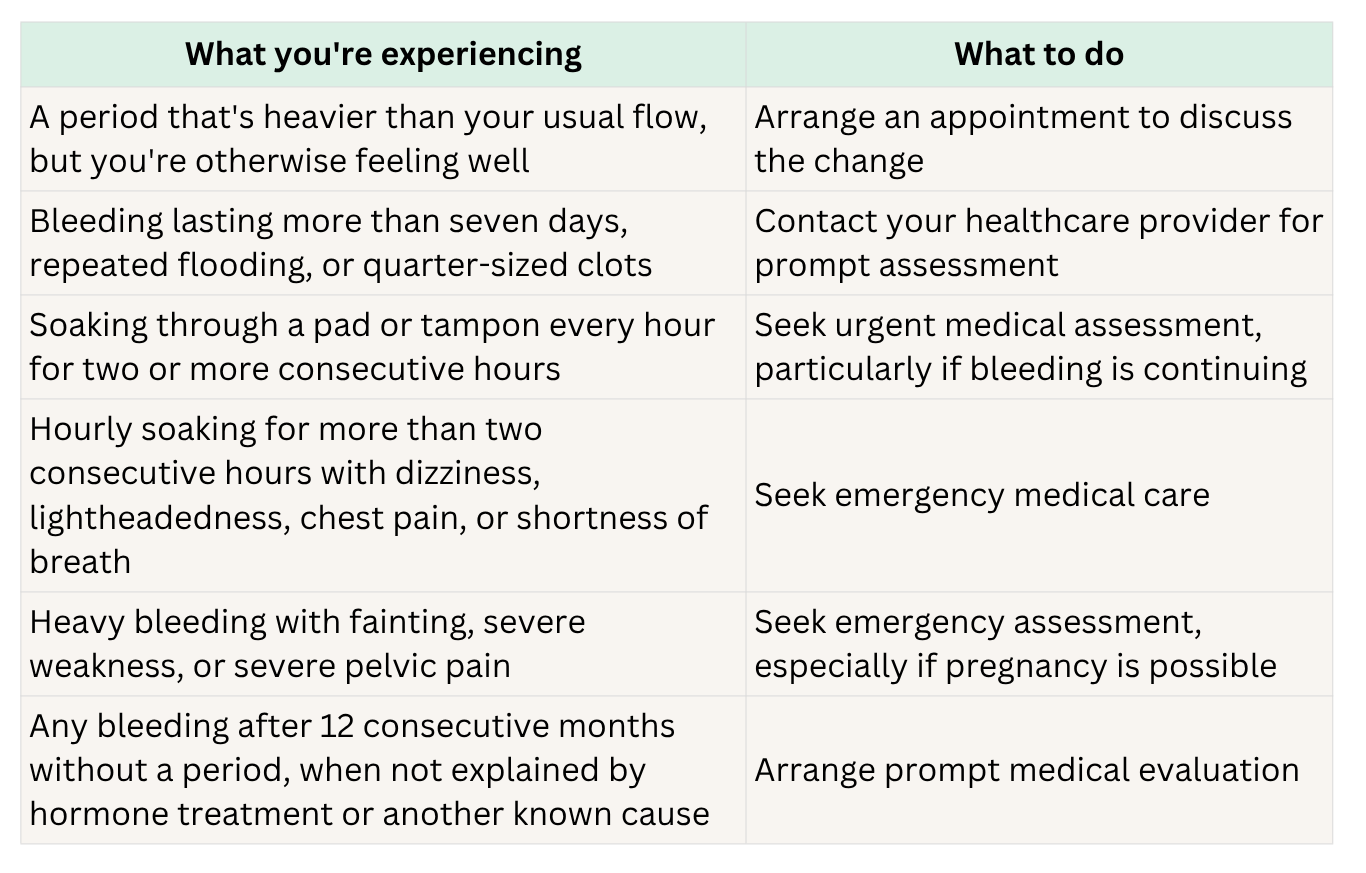
ACOG advises emergency medical care when very heavy bleeding occurs alongside symptoms such as chest pain, shortness of breath, lightheadedness, or dizziness. [1]
Don't wait for another menstrual cycle or hormone test if your bleeding is severe or you're feeling unwell.
Are large blood clots during perimenopause normal?
Small blood clots can occur during menstruation, especially when flow is heavier.
Larger or frequent clots are worth paying attention to. The CDC lists clots about the size of a quarter or larger among the warning signs of heavy menstrual bleeding. [2]
Clots alone cannot tell you whether the cause is hormonal or related to a condition such as fibroids.
If you're passing large clots repeatedly, soaking through menstrual products, or feeling weak or dizzy, contact your healthcare provider.
Why do periods get heavier during perimenopause?
One important reason is that ovulation becomes less predictable during the menopause transition.
In a typical ovulatory cycle, estrogen helps the uterine lining grow during the first part of the cycle. After ovulation, progesterone helps regulate that lining before menstruation.
During perimenopause, the timing of ovulation may change. Some cycles may not include ovulation at all.
Without the usual post-ovulation progesterone rise, the uterine lining may continue developing under estrogen's influence and eventually shed unpredictably. This can contribute to irregular, prolonged, or heavier bleeding. [4]
But hormone changes are only one possible explanation. A woman can be in perimenopause and have fibroids, polyps, or another condition at the same time.
What happens when you skip ovulation?
When ovulation doesn't occur, the normal rise in progesterone afterward may be absent.
The uterine lining may continue developing and eventually shed in a less predictable way.
This can lead to a missed period followed by heavier or prolonged bleeding, although not every cycle without ovulation produces that pattern.
You can still bleed in a cycle where ovulation never happened, which is why a period on its own can't tell you whether you ovulated.
Can estrogen fluctuations cause heavy bleeding?
Estrogen influences the growth of the uterine lining, so changes in estrogen and progesterone signaling can contribute to bleeding variability.
However, it isn't possible to look at heavy bleeding and conclude that your estrogen is too high or your progesterone is too low.
The same bleeding pattern can have several causes, and reproductive hormone measurements alone cannot establish which one is responsible.
This is particularly important during perimenopause, when both hormonal variability and gynecologic conditions may contribute to bleeding changes.
What else can cause heavy periods in your 40s?
Not every heavy period is caused by perimenopause.
Healthcare providers consider several categories of abnormal uterine bleeding, including structural conditions, ovulatory dysfunction, medication effects, and conditions affecting blood clotting. [4, 6]
Uterine fibroids
Fibroids are noncancerous growths in or around the uterus.
Depending on their size and location, they can cause heavy or prolonged bleeding, pelvic pressure, and menstrual pain.
Some fibroids cause no symptoms. Others can significantly affect quality of life.
Uterine polyps
Polyps are growths arising from the lining of the uterus.
They may cause heavier menstrual periods, bleeding between periods, or irregular bleeding.
Most are benign, but your clinician may recommend evaluating or removing a polyp depending on your symptoms and individual risk factors.
Adenomyosis
Adenomyosis occurs when tissue similar to the uterine lining grows within the muscular wall of the uterus.
It can be associated with heavy bleeding, painful periods, and pelvic discomfort.
Endometrial hyperplasia or cancer
Abnormal changes in the uterine lining can cause heavy or irregular bleeding.
Most women with heavy menstrual bleeding do not have endometrial cancer, but new abnormal bleeding should be evaluated rather than automatically attributed to perimenopause.
Age, medical history, and factors such as persistent anovulation, PCOS, and obesity may influence which investigations are recommended. [4, 6]
Other possible causes
Depending on your circumstances, your clinician may consider pregnancy-related bleeding, thyroid conditions, bleeding disorders, and medications such as anticoagulants or hormonal therapies.
If pregnancy is possible, a pregnancy test may be part of the assessment, even if your cycles have become irregular.
Does heavy bleeding mean menopause is getting closer?
Not necessarily.
Heavy periods can occur during perimenopause, but they are not a reliable way to determine how close you are to your final menstrual period.
Early in the menopause transition, some women notice shorter or more variable cycles. Later, the gaps between periods may become longer, and skipped ovulation becomes more common.
Bleeding can become lighter, heavier, shorter, or less predictable along the way.
For a broader explanation of menstrual changes during this transition, see Perimenopause Periods: 6 Changes to Expect.
If you're noticing small amounts of bleeding between periods rather than a heavier menstrual flow, our guide to perimenopause spotting explains that different pattern.
Neither heavy bleeding nor spotting can confirm your perimenopause stage on its own.
Can tracking your hormones help you understand heavy periods?
Hormone tracking can provide context about your menstrual cycle, particularly when ovulation has become less predictable.
If your periods are irregular, it may be useful to understand whether you're seeing an LH surge, whether progesterone rises afterward, and how your reproductive hormone patterns change from one cycle to another.
That information may help you and your provider discuss whether changes in ovulatory patterns could be part of the picture.
However, hormone tracking cannot determine why you're bleeding heavily. It cannot diagnose fibroids, polyps, anemia, endometrial hyperplasia, or cancer. It also cannot tell you whether heavy bleeding is safe to monitor without medical assessment.
What should you track between periods?
If you're preparing for a healthcare appointment, it can help to record:
- When each period starts and ends.
- Which days are heaviest.
- How frequently you're changing pads, tampons, or other products.
- Whether you're passing clots and their approximate size.
- Whether you're experiencing cramps, pelvic pain, fatigue, or dizziness.
- Whether your cycle length is changing.
- Any medication, contraception, or hormone-treatment changes.
- Whether you appear to be ovulating, if you're already tracking reproductive hormones.
You don't need to measure the exact volume of blood lost. Describing how often you change products and how bleeding affects your daily life can provide useful clinical information.
How do doctors investigate heavy periods during perimenopause?
The evaluation depends on your age, bleeding history, symptoms, risk factors, and examination findings.
Your healthcare provider may recommend some of the following.
Blood tests
A complete blood count can check for anemia and provide information about how blood loss may be affecting your health.
Additional testing may be appropriate depending on your symptoms and medical history. For example, a pregnancy test may be necessary if pregnancy is possible, and thyroid testing may be considered when there are other signs of thyroid dysfunction.
NICE recommends a full blood count for women with heavy menstrual bleeding and does not recommend routine female hormone testing as the investigation for heavy bleeding itself. Its July 2026 update also removed an earlier recommendation against routine ferritin testing because of concerns about iron deficiency. [3]
Pelvic ultrasound
An ultrasound may help assess the uterus and identify possible structural causes, including some fibroids or signs of adenomyosis.
The choice of imaging depends on the symptoms and suspected condition.
Hysteroscopy
Hysteroscopy allows a clinician to look inside the uterine cavity using a small camera.
It may be recommended when polyps, certain fibroids, or abnormalities of the uterine lining are suspected.
Endometrial sampling or biopsy
In U.S. guidance, endometrial sampling is commonly recommended for abnormal uterine bleeding in women aged 45 and older, as well as some younger women with persistent bleeding or additional risk factors. [4, 6]
The method and timing of sampling depend on the clinical situation and local guidelines. NICE, for example, recommends targeted sampling in the context of hysteroscopy for women at higher risk of endometrial pathology. [3]
A biopsy recommendation does not mean your clinician believes you have cancer. It is one way of evaluating important causes of abnormal bleeding.
How to stop heavy periods during perimenopause: treatment options
Several effective treatments are available for heavy menstrual bleeding. The best option depends on the cause, your health history, your preferences, and whether you still need contraception.
Non-hormonal treatments
Your clinician may recommend medications such as tranexamic acid, which can reduce menstrual blood loss.
Certain nonsteroidal anti-inflammatory drugs (NSAIDs) may also reduce bleeding and relieve cramps in suitable patients.
These medications are not appropriate for everyone, so treatment choice should account for your medical history and other medicines.
Hormonal treatments
Options may include a levonorgestrel-releasing intrauterine system, combined hormonal contraception, or certain progestogen treatments.
These approaches can reduce bleeding for some women by affecting the uterine lining or menstrual cycle.
The right treatment depends on the suspected cause of bleeding and individual medical considerations.
Procedures and surgical treatment
If medications don't provide enough relief, or if an underlying structural condition is identified, your clinician may discuss procedures such as removing polyps or fibroids, endometrial ablation, or other surgical options.
Treatment should be individualized. Heavy periods during perimenopause are not something you simply have to endure until menopause arrives. [3]
Can heavy periods cause anemia?
Yes. Repeated heavy menstrual bleeding can lead to iron deficiency and anemia.
You may notice unusual fatigue, weakness, reduced exercise tolerance, dizziness, or shortness of breath. Iron deficiency can also occur before anemia develops.
If your periods have become much heavier, ask your healthcare provider whether blood testing, including assessment for iron deficiency, is appropriate.
Dietary changes alone may not be enough to address ongoing blood loss or an established deficiency. Treating the underlying bleeding is also important.
Questions to ask your doctor about heavy bleeding
If your periods have changed significantly, these questions can help guide the conversation:
- Does the amount or duration of my bleeding suggest heavy menstrual bleeding?
- Could this be related to ovulatory changes during perimenopause, or do we need to investigate another cause?
- Should I have a blood count, iron studies, ultrasound, or assessment of the uterine lining?
- Do my age and medical history affect whether I need an endometrial biopsy?
- Which treatments could reduce bleeding while addressing my other perimenopause symptoms?
- Would recording cycle length, symptoms, and ovulation patterns be useful alongside the clinical evaluation?
Frequently asked questions
Is it normal to have very heavy periods during perimenopause?
Periods can become heavier during perimenopause as ovulation and hormone patterns change. However, very heavy bleeding is not something to dismiss as normal. Repeated flooding, large clots, or bleeding that affects daily life deserves medical evaluation.
Why am I flooding during my period at 45?
Flooding can occur with ovulatory dysfunction during perimenopause, but fibroids, polyps, adenomyosis, and other conditions can produce similar symptoms. New abnormal uterine bleeding around age 45 warrants clinical evaluation, which may include assessment of the uterine lining.
Why are my periods heavier after skipping a month?
One possible explanation is that ovulation did not occur during the longer cycle, changing the usual pattern of progesterone exposure and uterine lining shedding. But a heavier period after a missed cycle does not confirm that explanation, and other causes may need to be evaluated.
Are large blood clots a sign of perimenopause?
Large clots can occur during heavy menstrual bleeding, including in perimenopause. Clots about the size of a quarter or larger are a reason to discuss bleeding with your healthcare provider, particularly if they recur or are accompanied by flooding.
How many days is too long for a perimenopause period?
Bleeding that lasts longer than seven days is considered a possible sign of abnormal or heavy menstrual bleeding. If this is happening repeatedly, or the flow is unusually heavy, arrange a clinical assessment.
Can heavy bleeding in perimenopause be a sign of cancer?
Sometimes abnormal bleeding can be associated with endometrial hyperplasia or cancer, although many other causes are more common. The possibility is one reason that new, persistent, or unusually heavy bleeding needs appropriate evaluation, particularly from age 45 onward.
Can I take progesterone to stop heavy periods?
Some progestogen treatments can help manage heavy menstrual bleeding, but they are not suitable for every patient or every cause. Your clinician should assess your symptoms and medical history before recommending a treatment or dose.
Will heavy periods stop after menopause?
Menstrual periods stop after menopause. However, any new bleeding after menopause requires medical evaluation. Do not assume it is simply a delayed period, particularly if you have gone 12 months without menstruation and are not using a treatment that changes bleeding patterns.
Can Oova tell me why my period is so heavy?
No. Oova tracks estrogen, progesterone, and LH patterns across the cycle, which may provide context about ovulation and hormonal changes. It cannot diagnose the cause of heavy bleeding or determine whether you need medical treatment.
The bottom line
Heavy periods, flooding, and blood clots can occur during perimenopause, particularly as ovulation becomes less predictable.
But not every change in bleeding is caused by hormones. Fibroids, polyps, adenomyosis, and abnormalities of the uterine lining can produce similar symptoms.
If your bleeding has become significantly heavier, lasts longer than usual, or is interfering with daily life, speak with your healthcare provider. Severe bleeding accompanied by dizziness, fainting, chest pain, or shortness of breath requires emergency assessment.
Understanding your cycle and hormone patterns can provide useful context, but medical evaluation remains the most important step in determining what is causing heavy bleeding.
Want to better understand your changing cycle? Explore Oova's Perimenopause Kit to track estrogen, progesterone, and LH patterns over time.
About the author
Sources
- American College of Obstetricians and Gynecologists (ACOG). Abnormal Uterine Bleeding. Patient FAQ. ACOG.
- Centers for Disease Control and Prevention (CDC). About Heavy Menstrual Bleeding. CDC.
- National Institute for Health and Care Excellence (NICE). Heavy Menstrual Bleeding: Assessment and Management. Guideline NG88. Published March 14, 2018. Updated July 7, 2026. NICE recommendations.
- American College of Obstetricians and Gynecologists (ACOG). Diagnosis of Abnormal Uterine Bleeding in Reproductive-Aged Women. Practice Bulletin No. 128. July 2012. Reaffirmed 2024. ACOG Practice Bulletin 128.
- American College of Obstetricians and Gynecologists (ACOG). Heavy Menstrual Bleeding. Patient FAQ. ACOG.
- Wouk N, Helton M. Abnormal Uterine Bleeding in Premenopausal Women. American Family Physician. 2019;99(7):435–443. American Family Physician.
About the Oova Blog:
Our content is developed with a commitment to high editorial standards and reliability. We prioritize referencing reputable sources and sharing where our insights come from. The Oova Blog is intended for informational purposes only and is never a substitute for professional medical advice. Always consult a healthcare provider before making any health decisions.
