Your diet and exercise routine may not have changed, but your body’s response can. Learn how hormones, aging, sleep, muscle, insulin sensitivity, and the menopause transition interact, and what to track before assuming your metabolism is broken

Your diet and exercise routine may not have changed, but your body’s response can. Learn how hormones, aging, sleep, muscle, insulin sensitivity, and the menopause transition interact, and what to track before assuming your metabolism is broken
You are eating roughly the same way. Your workouts have not disappeared. You may even be trying harder than before.
Yet something feels different.
The run that used to energize you now wipes you out. Strength takes longer to build. Your appetite feels less predictable. Weight settles in places it did not before. A poor night of sleep affects you for days instead of hours.
It is tempting to conclude that your metabolism is broken or that hormones have made diet and exercise stop working.
Neither is quite right.
Diet and exercise still matter. But your body’s response to them is shaped by more than calories burned or workouts completed. Hormones, age, muscle mass, sleep, stress, medications, health conditions, and daily life all influence how you use energy and recover.
When several of those factors change at once, the same routine can produce a different experience.
First, what does “metabolism” actually mean?
Metabolism is often used as shorthand for how easily someone gains or loses weight. Biologically, it is much broader.
Metabolism includes the processes your body uses to:
- Convert food into usable energy
- Maintain organs and body temperature
- Build and repair tissue
- Store and access fuel
- Regulate blood glucose
- Support movement and exercise
- Recover after physical activity
Your resting energy expenditure is one piece of that system. So are muscle mass, insulin sensitivity, sleep, appetite, physical activity, and numerous hormones.
That means there is rarely one hormone or one metabolic “switch” responsible when your body starts responding differently.
Why can the same routine begin to feel different?
Several changes often overlap during midlife. Some are related to reproductive aging. Others reflect chronological aging, sleep, stress, health conditions, or changes in daily activity that are easy to miss.
1. Body composition can change even when the scale barely moves
One of the most important findings from the Study of Women’s Health Across the Nation is that weight and body composition do not always change in parallel.
In a longitudinal analysis of more than 1,200 women, the rate of fat gain accelerated and lean mass began to decline around the menopause transition. Yet the overall rate of weight gain did not suddenly accelerate at the same point.
In other words, the number on the scale may change slowly while the balance between fat and lean mass changes more meaningfully.
That matters because muscle contributes to strength, mobility, glucose use, and resting energy needs. A body with less lean mass may respond differently to the same training or eating pattern, even if total weight has not changed dramatically.
This is different from saying menopause automatically causes weight gain. Aging is a major driver of midlife weight gain, while the menopause transition appears to have a particular relationship with body composition and abdominal fat distribution.
If your central concern is specifically weight loss becoming more difficult during perimenopause, read why weight loss can suddenly feel harder during the menopause transition. That article owns the weight-loss question; this one focuses on the broader change in response.
2. Estrogen is involved in more than reproduction
Estrogen has effects throughout the body, including in the brain, liver, fat tissue, and skeletal muscle. It is involved in pathways related to insulin sensitivity, fat distribution, appetite, vascular function, and energy use.
During perimenopause, estrogen does not simply decline in a straight line. It can fluctuate substantially before becoming consistently lower after menopause.
Those changes may contribute to differences in:
- Where fat is stored
- How the body responds to insulin
- Hunger or satiety
- Muscle maintenance
- Sleep and temperature regulation
- Exercise recovery
But estrogen should not be treated as a complete explanation for every change in weight, energy, or performance. Its effects overlap with age, genetics, medications, activity, food intake, stress, sleep, and underlying health.
For a more focused explanation, see how estrogen and insulin resistance are connected. Keeping that mechanism on its own page prevents this article from competing with it.
3. Sleep can change the body’s response the next day
Sleep is part of metabolic health, not just recovery time.
In a randomized trial of women, chronic mild sleep restriction reduced insulin sensitivity even without changes in body fat. The effect was more pronounced among postmenopausal participants.
Perimenopause can make sufficient sleep harder to obtain. Hot flashes, night sweats, anxiety, restless legs, changing sleep architecture, and a rising risk of sleep apnea can all contribute.
This can create a frustrating loop:
- Hormone-related symptoms disrupt sleep.
- Poor sleep affects hunger, energy, insulin sensitivity, and recovery.
- Exercise feels more difficult.
- Food choices and activity patterns become harder to maintain.
- The resulting changes are blamed entirely on willpower or metabolism.
A workout plan that felt manageable after seven uninterrupted hours of sleep may feel completely different after weeks of repeated awakenings.
4. Recovery can become the limiting factor
Sometimes the issue is not whether a workout “works.” It is whether you can recover from it consistently.
Poor sleep, insufficient nutrition, illness, high stress, and changes in training volume can all affect recovery. Hormone changes may add another layer, especially when they contribute to disrupted sleep, temperature changes, heavy bleeding, or unpredictable energy.
Signs that recovery may be the problem include:
- Soreness that lasts longer than expected
- Declining performance despite consistent training
- Persistent fatigue
- Irritability or difficulty sleeping
- Needing more time between demanding workouts
- Losing strength while increasing exercise
This does not automatically mean you need to exercise less. It means the training stimulus and your current recovery capacity may no longer be well matched.
For the narrower relationship between activity and reproductive hormones, see how exercise can affect female hormones.
5. Appetite and cravings can shift for multiple reasons
Feeling hungrier does not necessarily mean your body has suddenly lost control.
Appetite is influenced by sleep, meal composition, activity, stress, medications, habit, and the brain’s energy-regulation systems. Menstrual-cycle and menopause-related hormone changes may also influence appetite or the experience of cravings.
A day of stronger appetite after poor sleep is not the same as a persistent pattern developing across several months. This is where tracking context is more useful than judging one meal or one day.
Ask:
- Does appetite change at a particular point in the cycle?
- Does it follow poor sleep?
- Did it begin after starting a medication?
- Is it accompanied by unusual thirst, frequent urination, or energy crashes?
- Has activity changed without you noticing?
- Are meals satisfying and nutritionally adequate?
If your symptoms include cravings, crashes, or fatigue after eating, read more about why blood sugar can feel different during perimenopause.
What about progesterone?
Progesterone is sometimes presented online as either a metabolic hero or a cause of weight gain. The evidence is more complicated.
Progesterone rises after ovulation and acts alongside estrogen throughout the luteal phase. Cycle-phase research suggests that insulin sensitivity, appetite, body temperature, and energy use can vary across the menstrual cycle, but the size and consistency of these effects differ between studies and individuals.
During perimenopause, ovulation may become less predictable. That can make progesterone exposure more variable from one cycle to the next.
For some women, this may contribute to a cycle that feels different in terms of sleep, appetite, bloating, or energy. It does not mean progesterone alone is controlling metabolism, nor does one urinary result explain a change in weight.
The more useful question is whether symptoms repeatedly align with the same part of your hormone pattern.
Does this mean diet and exercise have stopped working?
No.
It means the outcome may no longer be captured by one metric, and the routine may need to account for a different starting point.
A strength program may be supporting muscle even if the scale is not moving. A nutrition change may improve energy or cholesterol before it changes weight. More exercise may not help if inadequate sleep and recovery are already limiting progress.
The current evidence does not support the idea that hormonal changes make healthy behaviors pointless. In fact, movement, adequate nutrition, sleep support, and muscle-preserving activity become particularly important during midlife.
But “try harder” is not a personalized plan.
If the same approach no longer feels sustainable or effective, the next step is not necessarily more restriction or more intense exercise. It is understanding which outcome changed and what may be contributing to it.
What hormones can explain, and what they cannot
Hormone patterns can add useful context, but they do not provide a complete metabolic evaluation.
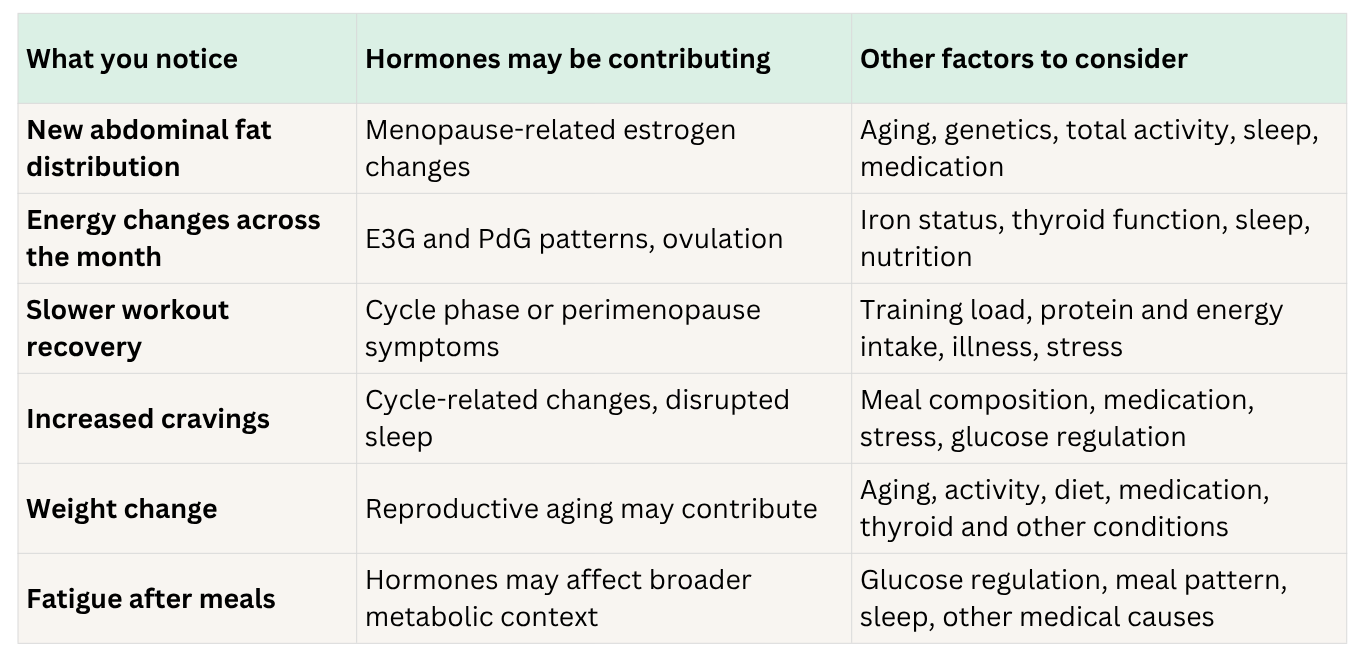
Oova measures E3G, LH, and PdG. It does not measure insulin, glucose, cortisol, thyroid hormones, calorie expenditure, or body composition.
That boundary is important. A reproductive hormone pattern can help organize the story, but it cannot diagnose the full cause.
What should you track before changing everything?
When something stops feeling effective, the instinct is often to overhaul the entire routine at once.
That makes it difficult to learn anything. If you change food, exercise, supplements, sleep habits, and medication simultaneously, you may feel different without knowing why.
Start by documenting the current pattern:
Hormone and cycle context
- Cycle length and variability
- Bleeding changes
- E3G, LH, and PdG patterns
- Whether ovulation appears to occur
- Current contraception or hormone treatment
- Where symptoms occur within the cycle
Symptoms and daily experience
- Energy
- Appetite and cravings
- Sleep duration and quality
- Hot flashes or night sweats
- Mood
- Bloating
- Exercise performance
- Recovery and soreness
Health and routine changes
- Medication or supplement changes
- Training frequency and intensity
- Illness or injury
- Alcohol use
- Major stress
- Changes in meal timing
- Unintentional changes in daily movement
You do not need to track everything forever. You need enough information to identify whether a pattern exists and to create a baseline before testing a change.
Our guide to building a hormone baseline explains how to establish that reference point. If you are unsure how much data is enough, see how long to track hormones before calling something a real pattern.
How to make a useful change
Once you have a baseline, change one meaningful variable at a time when possible.
That might mean adjusting training intensity, adding resistance training, improving sleep treatment, reviewing protein and overall energy intake, or addressing a symptom that is interfering with consistency.
The specific intervention depends on your goal and health history. This article is intentionally not a diet or workout plan.
For those narrower questions:
- Read the perimenopause diet guide for nutrition-specific information.
- Read how exercise affects female hormones for exercise-specific context.
- Read the connection between cortisol, estrogen, and weight for the narrower stress-hormone discussion.
- Read how estrogen relates to insulin sensitivity for the detailed metabolic mechanism.
This structure is deliberate: the current article explains why your response may change, while each linked article answers one narrower question in depth.
When to talk with a provider
Do not assume every change is caused by perimenopause.
Speak with a clinician if weight, appetite, energy, or exercise tolerance changes suddenly or significantly, especially when accompanied by:
- Persistent or severe fatigue
- Very heavy or irregular bleeding
- New heart palpitations
- Shortness of breath or chest pain
- Excessive thirst or frequent urination
- New muscle weakness
- Unexplained weight loss
- Significant depression or anxiety
- Symptoms of sleep apnea
- Changes that interfere with daily functioning
A clinician may consider medication effects, thyroid function, anemia or iron deficiency, glucose regulation, sleep disorders, cardiovascular health, and other possible contributors.
Hormone data can provide additional context, but it should not replace an appropriate medical evaluation.
Your body is not failing you
When a familiar routine stops producing a familiar result, it is easy to interpret the change as personal failure.
But your body is not a static system. Age, hormones, sleep, muscle, health, and daily demands all change over time. A routine that worked in one context may need to evolve in another.
That does not mean nothing works anymore. It means better decisions begin with understanding what actually changed.
Frequently Asked Questions
How do hormones affect metabolism?
Hormones can influence insulin sensitivity, fat distribution, appetite, muscle, sleep, body temperature, and energy use. Their effects interact with aging, genetics, activity, nutrition, medication, stress, and health conditions.
Can hormonal changes slow metabolism?
Hormonal changes can affect some components of metabolic health, but “slower metabolism” is often an oversimplification. Aging, lean mass, activity, sleep, and the menopause transition can all influence how the body uses and stores energy.
Why did my usual diet and exercise stop working?
Your body composition, sleep, recovery capacity, daily activity, medications, health, or hormone patterns may have changed even if the routine did not. Identifying the specific outcome and tracking the surrounding context is more useful than assuming one cause.
Does estrogen affect metabolism?
Yes. Estrogen is involved in pathways related to insulin sensitivity, fat distribution, muscle, appetite, and energy regulation. However, estrogen is not the only factor determining weight or metabolic health.
Does progesterone affect weight or appetite?
Progesterone changes across the cycle and may be one contributor to cycle-related differences in appetite, temperature, sleep, or bloating. The effects vary between individuals, and one progesterone result cannot explain a persistent change in weight.
Does menopause cause weight gain?
Aging is a major driver of midlife weight gain. Research suggests that the menopause transition has a particular effect on body composition and fat distribution, including accelerated fat gain and loss of lean mass, even when the overall rate of weight gain does not suddenly increase.
Can poor sleep affect metabolism?
Yes. Insufficient sleep can affect insulin sensitivity, appetite, energy, and recovery. In one randomized trial, chronic mild sleep restriction reduced insulin sensitivity in women even without a change in body fat.
Can hormone tracking tell me why I am gaining weight?
Not by itself. Hormone tracking can show reproductive hormone and symptom patterns, but it does not measure glucose, insulin, thyroid function, cortisol, calorie expenditure, or body composition. It should be used as context, not as a complete metabolic diagnosis.
What should I track before changing my diet or exercise routine?
Track the outcome you want to change alongside sleep, energy, appetite, exercise, recovery, cycle timing, symptoms, medications, and hormone patterns if you are testing. Establishing a baseline makes it easier to evaluate whether one targeted change helps.
About the author
Sources
- Greendale GA, et al. Changes in body composition and weight during the menopause transition. JCI Insight. 2019;4(5):e124865.
- The Menopause Society. Midlife Weight Gain MenoNote. 2025.
- Lovejoy JC, et al. Increased visceral fat and decreased energy expenditure during the menopausal transition. International Journal of Obesity. 2008;32:949-958.
- Zuraikat FM, et al. Chronic insufficient sleep in women impairs insulin sensitivity independent of changes in adiposity. Diabetes Care. 2024;47(1):117-125.
- El Khoudary SR, et al. Menopause transition and cardiovascular disease risk: Implications for timing of early prevention. Circulation. 2020;142:e506-e532.
About the Oova Blog:
Our content is developed with a commitment to high editorial standards and reliability. We prioritize referencing reputable sources and sharing where our insights come from. The Oova Blog is intended for informational purposes only and is never a substitute for professional medical advice. Always consult a healthcare provider before making any health decisions.