
Removed Mirena, Kyleena, Skyla, or Liletta? Learn when ovulation may return, why you can conceive before your first period, and how to interpret early hormone patterns.

Removed Mirena, Kyleena, Skyla, or Liletta? Learn when ovulation may return, why you can conceive before your first period, and how to interpret early hormone patterns.
Ovulation and fertility can return quickly after a hormonal IUD is removed, sometimes before your first period. You do not have to wait for your menstrual cycle to look regular before pregnancy becomes possible. If you want to conceive, you can generally begin trying after removal unless your clinician advises otherwise. [1, 2]
What often takes longer is learning what your natural cycle looks like. If Mirena, Kyleena, Skyla, or Liletta changed your bleeding, the first few weeks after removal can feel unfamiliar. Here's how to follow ovulation without confusing a returning period, an LH surge, and confirmed ovulation.
Key takeaways
- Fertility may return immediately after hormonal IUD removal, and you can ovulate before your first post-removal period.
- Bleeding or spotting after removal is not reliable proof that ovulation happened.
- An LH rise suggests an approaching fertile window; a subsequent progesterone rise provides additional evidence of ovulation.
- Oova's support guidance recommends waiting approximately two to three months after hormonal IUD removal for the clearest natural hormone baseline. That is a tracking recommendation, not a requirement to delay trying to conceive. [3]
How soon can you ovulate after a hormonal IUD is removed?
Ovulation may occur soon after removal, and the timing differs from person to person. You do not need to wait for the first natural period to become fertile.
In one prospective study of 165 women attempting pregnancy after removal of a 52 mg levonorgestrel IUD, 142 (86.1%) conceived within 12 months. That finding is reassuring but should not be read as an individual prediction. [4]
For a fuller explanation of return-to-fertility timing after contraception, read our related guide. How Long Does It Take to Get Pregnant After Birth Control?
Can you get pregnant before your first period after Mirena removal?
Yes. Ovulation precedes the next menstrual period, so you can conceive before you notice a first post-removal period.
If you are trying to conceive, discuss prenatal preparation with your clinician; if you are avoiding pregnancy, start another effective contraceptive method right away.
Does a hormonal IUD always stop ovulation?
No. Hormonal IUDs release levonorgestrel, but their contraceptive action is primarily local. They thicken cervical mucus and change the uterine lining; many users continue to ovulate even while an IUD is in place. That is different from an implant such as Nexplanon, which predominantly suppresses ovulation. [1]
However, your cycle may still be difficult to read while the IUD is in place. Bleeding can become scant, irregular, or absent. Not having a period on Mirena does not by itself prove that your ovaries stopped functioning. Does Birth Control Stop Ovulation?
Oova's published support guidance takes a conservative approach to interpreting natural hormone patterns with a hormonal IUD and recommends monitoring after removal. [3]
What about a copper IUD?
Copper IUDs contain no hormones and do not normally suppress ovulation, so there is no hormonal recovery period to wait through after removal.
Is bleeding after IUD removal a period?
Not necessarily. Light bleeding or spotting can occur around removal, and changes in bleeding may follow as the endometrium responds to no longer receiving levonorgestrel.
A spontaneous period usually occurs after an ovulatory cycle, but there can be bleeding without ovulation, particularly when cycles are changing. The timing of bleeding alone doesn't confirm that a mature egg was released.
Instead of treating the first bleed as a definitive cycle reset, write down when the IUD came out, the days you bleed, and any pregnancy tests. The dates will help you interpret later cycle patterns and explain your history to a clinician.
What should you expect in the first three months?
A timeline can make it easier to decide what to watch without imposing a fixed schedule your body has to follow.
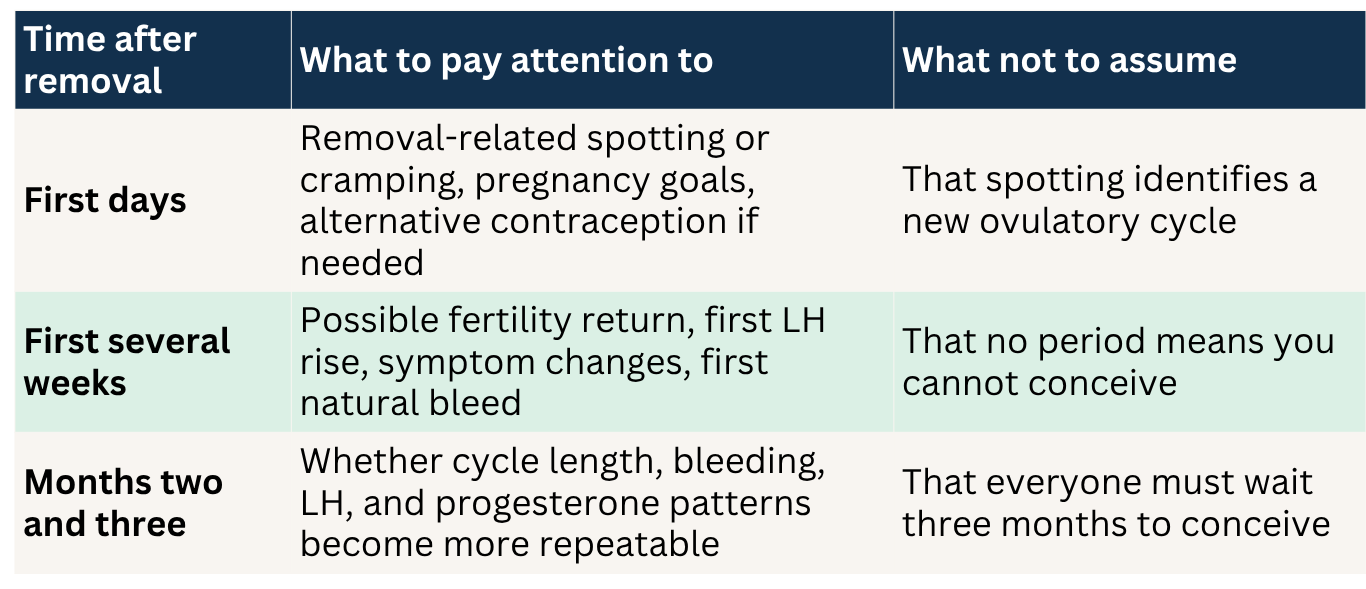
How do you track ovulation after Mirena or another hormonal IUD?
1. Record the removal date and your prior cycle history
Note the type of IUD, when it was removed, and whether your cycles were regular before placement. If you had infrequent periods before Mirena, that history remains important after it is removed.
Also record any bleeding and whether it was light spotting or a true period-like flow. There is no need to invent a cycle day 1 if you're not sure what the bleeding represents.
2. Watch for a possible fertile window
As the ovaries prepare to ovulate, estrogen typically rises. Cervical mucus may become clearer or more slippery, though mucus patterns are not always easy to identify immediately after hormonal contraception. LH may then rise before an ovulatory event.
If you're using ovulation predictor kits, don't assume a single negative result means you didn't ovulate. The surge may fall outside the days you happened to test, especially if you don't yet know your cycle length.
3. Look for evidence afterward
An LH surge predicts that ovulation may be approaching. Progesterone generally rises after an egg is released. Tracking this sequence can provide stronger evidence than a positive LH test alone.
At-home urinary PdG tests measure a progesterone metabolite, not a serum progesterone concentration. Their interpretation depends on the method and sampling schedule. Read How to Confirm Ovulation at Home for a fuller explanation of what each method shows.
4. Compare patterns, not one result
If your cycles remain irregular, How to Track Ovulation With Irregular Periods offers practical strategies without assuming every cycle lasts 28 days.
When is the right time to start using Oova after IUD removal?
There are two separate questions: When can you become pregnant, and when can you collect the clearest picture of a natural hormone baseline?
You may be fertile immediately after removal. Oova's current customer guidance recommends waiting about two to three months to obtain the clearest picture of natural hormone patterns. This is guidance about the interpretation of tracking results, not a reason to delay trying to conceive. [3]
If you want to start tracking earlier, contact Oova support or your clinician to discuss whether early readings would be useful for your situation. Do not assume the first few weeks provide a stable baseline, and do not postpone pregnancy attempts solely for the purpose of establishing one.
What if your period hasn't come back?
If pregnancy is possible, take a pregnancy test rather than assuming your body is still adjusting. A positive test accompanied by significant pelvic pain or bleeding needs urgent assessment.
If you aren't pregnant and periods remain absent, contact your clinician. Evaluation depends on your age, prior menstrual history, recent pregnancy or breastfeeding, medications, and conditions such as PCOS or thyroid disease.
Do not assume a hormonal IUD permanently damages fertility. Equally, do not assume every delay must be caused by the IUD. Your previous cycle pattern may reappear once contraception is stopped.
For practical steps after contraception, see our guide to getting pregnant after birth control. How to Get Pregnant Quickly After Birth Control
When should you seek a fertility evaluation?
For women without a known infertility factor, ASRM's 2026 guidance recommends evaluation after 12 months of regular unprotected intercourse when younger than 35 and after six months when 35 or older. Evaluation may be appropriate sooner for people over 40 or with known factors such as significant ovulatory dysfunction. [5]
You don't need to complete a year of home testing if you already know your cycles are very infrequent or you have another medical concern. Your clinician may assess ovulation, ovarian or uterine factors, and sperm-related factors depending on your history.
Hormone tracking can help you describe what you observed. It is not a substitute for a fertility evaluation when one is indicated.
Questions to ask before or after removal
1. Can I start trying to conceive as soon as the IUD is removed?
2. If I don't want pregnancy, what contraception should start immediately?
3. Does my prior cycle history suggest that ovulation may be irregular?
4. What bleeding after removal should prompt an examination?
5. When would home hormone tracking become useful for my specific situation?
6. At what point should we investigate if my period hasn't returned or pregnancy hasn't occurred?
The bottom line
You may ovulate and conceive soon after hormonal IUD removal, even before your first period. The bigger challenge is that bleeding alone doesn't reliably tell you whether ovulation occurred.
Record removal and bleeding dates, watch for an LH rise, and use post-ovulation progesterone-related information thoughtfully. If you'd like a fuller hormone pattern once an appropriate testing window has passed, explore Oova Fertility. And if your cycles remain absent or you have known risk factors, discuss evaluation with your clinician rather than waiting for a perfect-looking chart.
Frequently asked questions
How quickly does ovulation return after Mirena removal?
It can return promptly, and fertility may resume before your first period. The exact day varies. Do not assume you are protected from pregnancy after removal.
Do I have to wait three months to get pregnant after an IUD?
No. The two-to-three-month suggestion in Oova's support guidance relates to obtaining a clearer natural hormone baseline for tracking. It is not a medical instruction to wait before trying to conceive.
Can I use an LH test right after IUD removal?
You can use one, but the result may be harder to interpret if you don't know your cycle timing. An LH rise alone doesn't prove ovulation, and a negative test doesn't rule it out.
Is it normal to have spotting after IUD removal?
Some spotting or mild cramping can happen around removal. Contact a clinician for severe pain, fever, persistent heavy bleeding, or other concerning symptoms.
Does Mirena affect fertility after it's removed?
Evidence generally supports a prompt return of fertility after removal. Individual outcomes still depend on age and other reproductive factors. [1, 4]
Can Oova confirm when my hormones are back to normal?
Oova can show patterns in urinary reproductive hormone metabolites, but it cannot define a universal 'back to normal' date or prove that the IUD was responsible for a particular pattern. Interpretation is most useful in clinical context.
About the author
Sources
- American College of Obstetricians and Gynecologists. Long-Acting Reversible Contraception (LARC): Intrauterine Device and Implant. https://www.acog.org/womens-health/faqs/long-acting-reversible-contraception-iud-and-implant.
- Planned Parenthood. How Does IUD Removal Work? https://www.plannedparenthood.org/learn/birth-control/iud/how-does-iud-removal-work.
- Oova Support Center. Can I use Oova while I have an IUD? Updated November 21, 2025. https://support.oova.life/hc/en-us/articles/46741182575507-Can-I-use-Oova-while-I-have-an-IUD.
- Conception rates in women desiring pregnancy after levonorgestrel 52 mg intrauterine system discontinuation. Contraception. 2021. https://pubmed.ncbi.nlm.nih.gov/33038303/.
- American Society for Reproductive Medicine. Fertility evaluation of infertile women: a committee opinion. 2026. https://www.asrm.org/practice-guidance/practice-committee-documents/fertility-evaluation-of-infertile-women-a-committee-opinion-2026.
About the Oova Blog:
Our content is developed with a commitment to high editorial standards and reliability. We prioritize referencing reputable sources and sharing where our insights come from. The Oova Blog is intended for informational purposes only and is never a substitute for professional medical advice. Always consult a healthcare provider before making any health decisions.
