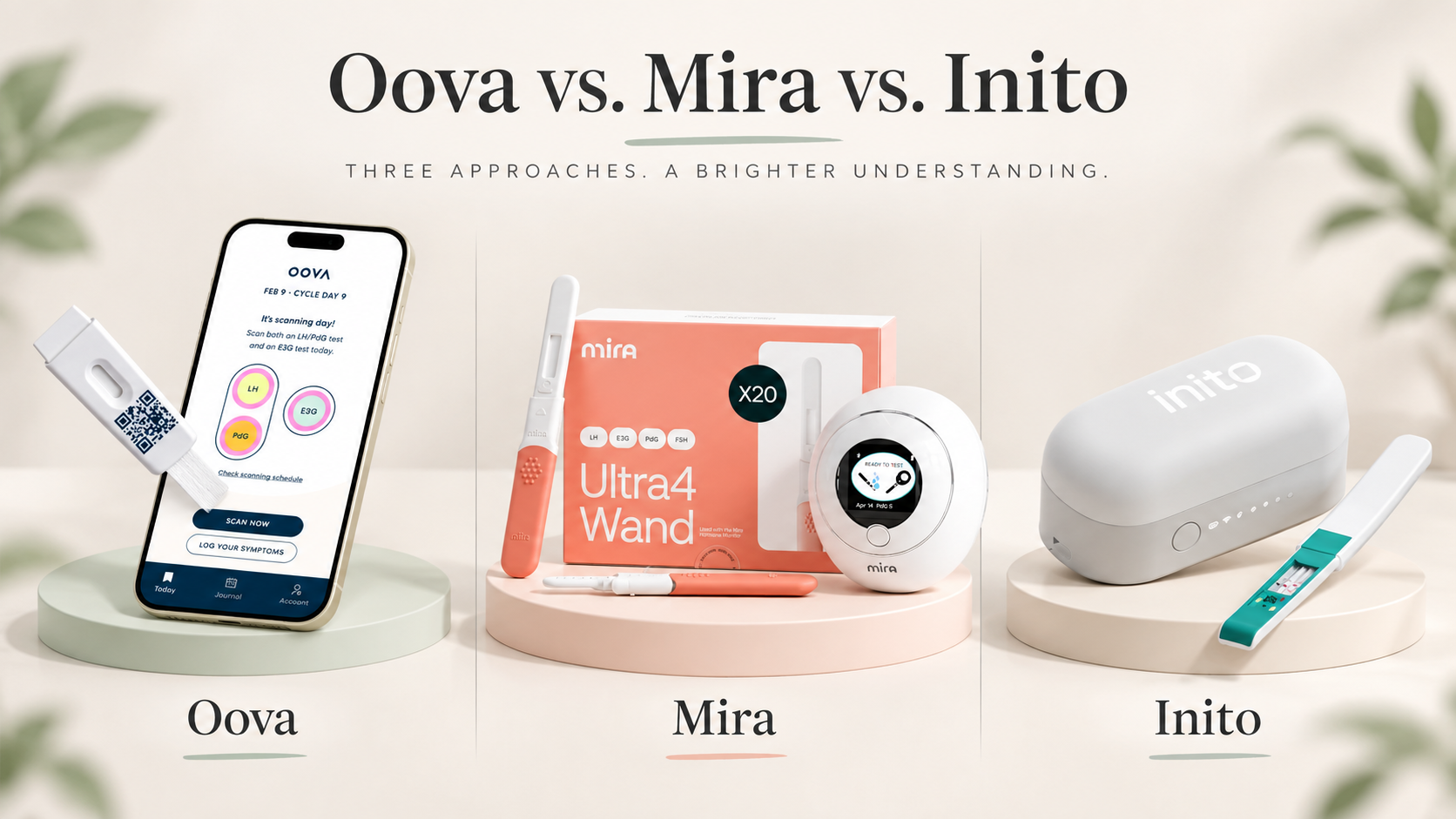
For years, women with PCOS were told to eat less, move more, and manage their weight. What the new name PMOS, polyendocrine metabolic ovarian syndrome, finally confirms: this was never just an ovarian problem. It's a whole-body metabolic and endocrine condition, and the weight piece has always been hormonal. This guide breaks down exactly why weight loss is so difficult with PCOS/PMOS, what's happening hormonally, and how daily hormone tracking changes what's possible.

For years, women with PCOS were told to eat less, move more, and manage their weight. What the new name PMOS, polyendocrine metabolic ovarian syndrome, finally confirms: this was never just an ovarian problem. It's a whole-body metabolic and endocrine condition, and the weight piece has always been hormonal. This guide breaks down exactly why weight loss is so difficult with PCOS/PMOS, what's happening hormonally, and how daily hormone tracking changes what's possible.
If you've been told to "just lose weight" to manage your PCOS, you're not alone,and you're not imagining how impossible that advice feels.
Still trying to figure out what's actually happening in your body? Oova measures LH, estrogen, and progesterone daily, so you can finally see the hormone patterns driving your symptoms, not just a single number from a one-time blood draw. Start tracking →
Researchers recently proposed renaming PCOS to PMOS: polyendocrine metabolic ovarian syndrome. The name change isn't cosmetic. It's a long-overdue acknowledgment that this condition was never just about your ovaries. It's a full-body endocrine and metabolic disorder,and the weight connection that so many women were gaslit about for years? It was always real.
This post explains why weight is so hard to manage with PCOS/PMOS, what's actually happening in your hormones, and what changes when you can finally see the data.
What the Name Change Actually Means
Polycystic ovary syndrome implied the problem was structural,cysts on the ovaries. But the ovarian changes are a downstream effect, not the root cause. The root cause is hormonal and metabolic dysregulation: elevated androgens, disrupted insulin signaling, dysregulated LH pulses, and a cascade of effects that touch nearly every system in the body.
Polyendocrine metabolic ovarian syndrome names what clinicians and researchers have understood for years: this is a condition of the entire endocrine and metabolic system. The ovaries are involved. So is your pancreas, your adrenal glands, your thyroid axis, and your body's ability to regulate blood sugar and store fat.
For the millions of women who were told their weight gain was a lifestyle problem,the name change is a vindication. The biology was always stacked against you.
Why Losing Weight With PCOS/PMOS Is Genuinely Harder
1. Insulin Resistance: The Core Driver
The majority of women with PCOS/PMOS have some degree of insulin resistance,estimates range from 50–80%, including those who are not overweight. When your cells don't respond to insulin properly, your pancreas produces more of it. Chronically elevated insulin:
- Directly signals fat cells to store more fat, particularly visceral (abdominal) fat
- Suppresses fat-burning
- Stimulates the ovaries to produce more androgens (including testosterone), which further disrupts metabolism
- Increases hunger signals, making caloric restriction harder to sustain
This is why the standard "eat less, move more" advice so often fails. When insulin is chronically elevated, your body's signals are working against you regardless of what's on your plate.
2. Androgen Excess Changes Where and How You Store Fat
Elevated androgens,a hallmark of PCOS/PMOS,shift fat storage from the hips and thighs to the abdomen. Visceral (belly) fat is metabolically active in ways that subcutaneous fat is not: it produces inflammatory signals, further impairs insulin sensitivity, and amplifies the hormonal dysfunction driving your symptoms.
This is why PCOS/PMOS weight tends to concentrate in the midsection even in women who are otherwise lean,and why it often doesn't respond to the same interventions that work for women without the condition.
3. Cortisol Dysregulation Compounds the Problem
Many women with PCOS/PMOS have dysregulated cortisol patterns,either chronically elevated or with abnormal daily rhythms. As we cover in Cortisol + Estrogen: The Hidden Weight Gain Connection in Perimenopause, visceral fat has 4x more cortisol receptors than fat elsewhere. High cortisol signals the body to store fat centrally, raises blood sugar, and further impairs insulin sensitivity,creating a cycle that is very difficult to interrupt without understanding your individual hormone pattern.
4. Irregular or Absent Ovulation Disrupts Progesterone
When ovulation doesn't happen, progesterone isn't produced in the luteal phase. Low progesterone relative to estrogen,sometimes called estrogen dominance,contributes to water retention, bloating, and mood changes that can feel indistinguishable from weight gain. It also affects thyroid function and sleep quality, both of which directly impact metabolism.
For women trying to understand their cycle, PCOS Ovulation Patterns: Why You Need Daily Tracking (Not Just LH Tests) explains exactly why a standard OPK will often give you false positives,and why progesterone confirmation is the only way to know ovulation actually occurred.
5. LH Dysregulation Keeps the Cycle Broken
Women with PCOS/PMOS typically have elevated baseline LH, with erratic pulses throughout the cycle rather than the clean, single surge of a typical cycle. This disrupts follicular development, makes ovulation unpredictable, and,critically,makes standard ovulation tests unreliable. An LH stick reads your elevated baseline as a "surge," when no ovulation is imminent. This is one of the most frustrating and underexplained features of the condition.
What Standard Testing Misses
A typical hormone panel checks a few values at a single moment in time. But PCOS/PMOS is a pattern condition,the problem is not in any single number, it's in the relationship between hormones across your cycle, and how those relationships shift week to week and month to month.
As we explain in What Your Doctor Orders vs. What You Actually Need: The Gap in Standard Hormone Testing, a single-draw FSH or estradiol test captures one data point in a system that fluctuates constantly. It can't tell you whether you ovulated. It can't tell you whether your progesterone rose and fell appropriately. And it definitely can't tell you how your cortisol, LH, and estrogen patterns interact on a daily basis.
For women with PCOS/PMOS specifically, How to Confirm Ovulation with PCOS (When OPKs Don't Work) is required reading,because the standard tools are designed for typical cycles and they routinely mislead women with this condition.
What Actually Helps: The Evidence
Blood Sugar and Insulin Management First
This is the most evidence-backed intervention for PCOS/PMOS-related weight. Approaches that consistently show benefit:
- Low glycemic eating,reducing the glucose load that drives insulin spikes, rather than just reducing calories
- Protein at every meal,slows gastric emptying, reduces post-meal glucose spikes, supports satiety signals that are often blunted in insulin resistance
- Inositol supplementation,myo-inositol and D-chiro-inositol are among the most studied supplements for PCOS/PMOS, with evidence for improving insulin sensitivity, reducing androgens, and restoring ovulation in some women. For a full breakdown of what the evidence actually shows for hormone-targeted supplements, see Do Supplements Actually Change Your Hormones? How to Know If They're Working
- Resistance training,muscle tissue is the primary site of insulin-mediated glucose uptake; building it directly improves insulin sensitivity in ways that cardio alone does not
Address Cortisol, Not Just Calories
If your cortisol pattern is dysregulated,and many women with PCOS/PMOS have elevated evening cortisol or a blunted morning peak,caloric restriction can actually raise cortisol further, worsening fat storage patterns. Sleep quality, stress management, and timing of eating all interact with cortisol in ways that are invisible without data.
Know Whether You're Actually Ovulating
This matters for weight more than most people realize. Progesterone has direct anti-estrogenic and metabolic effects. When ovulation doesn't occur, you don't produce progesterone,and the estrogen-dominant state that follows affects fluid retention, thyroid function, and appetite regulation. If you have PCOS/PMOS and you're not sure whether you're ovulating, Anovulatory vs. Ovulatory PCOS: The Difference That Changes Everything When You're TTC walks through what the distinction means and how to tell the difference.
Why Hormone Tracking Changes the Picture
Every one of the mechanisms above,insulin resistance, androgen excess, cortisol dysregulation, anovulation,produces its own hormone fingerprint. But that fingerprint is only visible if you're measuring the right hormones at the right frequency.
A one-time blood test shows you a single frame of a film. PCOS/PMOS is the whole movie.
Daily at-home hormone tracking with Oova measures LH, estrogen (E3G), and progesterone (PdG) across your full cycle,giving you the pattern data that standard testing is designed to miss. For women with PCOS/PMOS, this means:
- Seeing whether LH surges are real or elevated baseline noise
- Confirming whether ovulation actually occurred via progesterone rise
- Understanding the estrogen-to-progesterone ratio throughout the luteal phase
- Building a longitudinal picture that you can bring to your provider,data they have to take seriously
As the research on Irregular Cycles: More Normal Than You Think shows from real-world Oova data across nearly 5,000 women, hormonal variability is far more common than previously understood,and far more often missed by standard testing.
The Bottom Line
PCOS,now more accurately called PMOS,is a metabolic and endocrine condition. The weight connection was never in your head, and the difficulty losing it was never a failure of willpower. It's the predictable result of a system with multiple interlocking dysfunctions, each of which requires a different intervention.
Understanding your specific hormone pattern is where you start to get answers. Not a reference range,a pattern, across time, that shows you what's actually happening in your body.
About the author
Sources
- Dumesic DA, et al. "Scientific Statement on the Diagnostic Criteria, Epidemiology, Pathophysiology, and Molecular Genetics of Polycystic Ovary Syndrome." Endocrine Reviews. 2015.
- Stepto NK, et al. "Women with polycystic ovary syndrome have intrinsic insulin resistance on euglycaemic-hyperinsulaemic clamp." Human Reproduction. 2013.
- Lim SS, et al. "Overweight, obesity and central obesity in women with polycystic ovary syndrome." Human Reproduction Update. 2012.
- Moghetti P. "Insulin Resistance and Polycystic Ovary Syndrome." Current Pharmaceutical Design. 2016.
- Unfer V, et al. "Myo-inositol and D-chiro-inositol clinical use in assisted reproduction." Journal of Ovarian Research. 2017.
- Teede HJ, et al. "Recommendations from the international evidence-based guideline for the assessment and management of polycystic ovary syndrome." Human Reproduction. 2018.
- Escobar-Morreale HF. "Polycystic ovary syndrome: definition, aetiology, diagnosis and treatment." Nature Reviews Endocrinology. 2018.
- Chang RJ. "A practical approach to the diagnosis of polycystic ovary syndrome." American Journal of Obstetrics and Gynecology. 2004.
About the Oova Blog:
Our content is developed with a commitment to high editorial standards and reliability. We prioritize referencing reputable sources and sharing where our insights come from. The Oova Blog is intended for informational purposes only and is never a substitute for professional medical advice. Always consult a healthcare provider before making any health decisions.