
The standard Day 21 progesterone blood test only fits certain cycles. Learn how to choose the right day, interpret a low result and track what happens after ovulation.

The standard Day 21 progesterone blood test only fits certain cycles. Learn how to choose the right day, interpret a low result and track what happens after ovulation.
A Day 21 progesterone test is not the right test day for everyone. The usual goal is to measure progesterone roughly seven days before your next period is expected, during the middle of the luteal phase. Day 21 makes sense mainly for someone with a fairly predictable 28-day cycle. If you ovulate late or your cycles run longer, testing on day 21 may catch progesterone before it has risen. [1]
That distinction is easy to miss if your lab order simply says “Day 21 progesterone.” A result marked low can be concerning, but the first question should be whether the sample was taken at the right time.
Why do doctors order a Day 21 progesterone test?
Progesterone rises after ovulation because the corpus luteum, the temporary structure formed after the follicle releases an egg, begins producing it. A properly timed blood test can provide evidence that ovulation occurred. [1] The World Health Organization (WHO) also places reproductive testing in the context of individualized infertility evaluation. [3]
The Day 21 convention assumes ovulation took place around day 14 of a 28-day cycle. That is a useful classroom example, not a universal schedule. Real cycles vary, and the first half of the cycle is often especially variable.
In January 2026, the American Society for Reproductive Medicine (ASRM) published an updated fertility evaluation committee opinion. It states that serum progesterone is generally best measured about a week before the expected next period rather than on one fixed cycle day. [1]
When should you test progesterone instead of on Day 21?
Count back approximately seven days from the start of your next expected period. That is the practical rule for a mid-luteal progesterone blood test when the aim is to provide evidence of ovulation. [1]
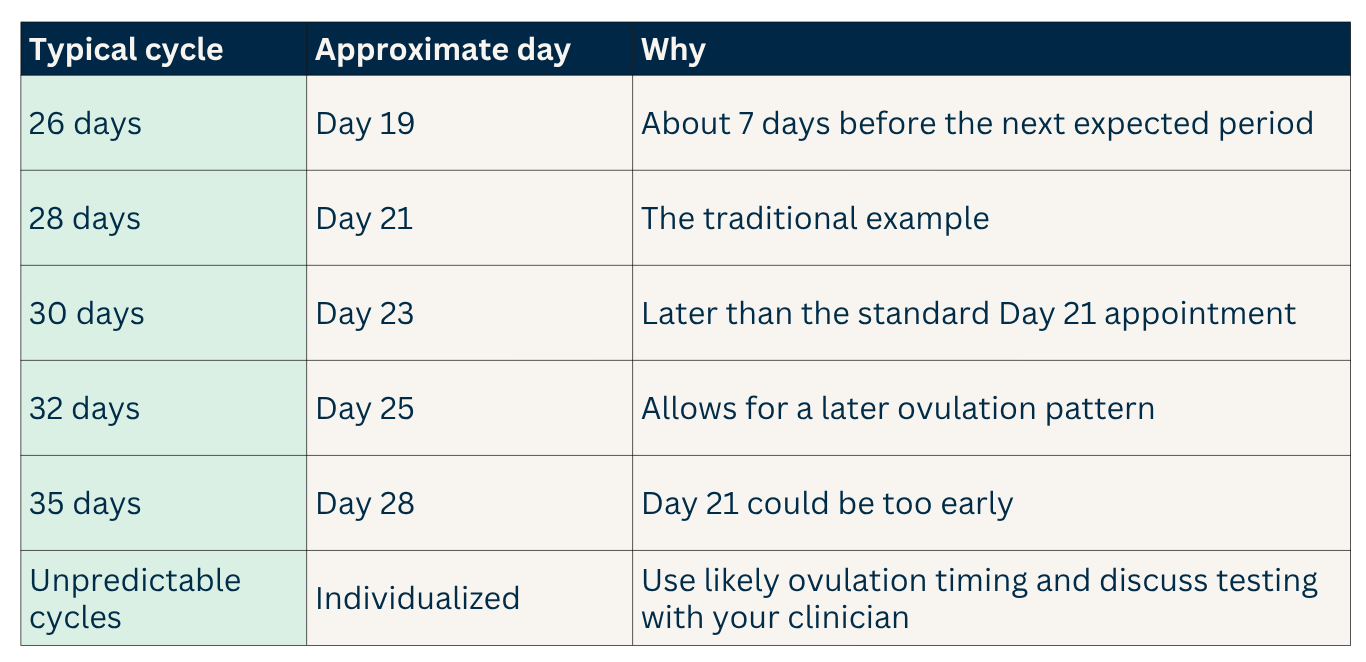
These are estimates based on the expected next period, not proof of the exact ovulation day. If you have variable cycles, you may not know in advance when that period will arrive. Your clinician may recommend a different approach.
What if your cycles are 35 days long?
A test on day 21 of a 35-day cycle is roughly 14 days before the next expected period. If ovulation has not yet happened, or has only recently occurred, progesterone may still be low. That result can reflect timing rather than an inability to ovulate.
What if you ovulate on Day 18?
A test only three days after ovulation may miss the mid-luteal period when progesterone tends to be higher. A more useful test date is around seven days after ovulation, with adjustments based on the expected next period and clinical advice.
Can a low Day 21 progesterone result be misleading?
Yes. A low result may mean that the sample was collected too early, that ovulation happened later than expected, or that ovulation did not occur. A single number cannot distinguish those possibilities without information about the cycle. [1, 2]
Progesterone is also released in pulses. ASRM notes that serum progesterone can fluctuate markedly over a matter of hours, even in an ovulatory cycle. This is why a single well-timed value can provide evidence of recent ovulation but cannot reliably grade the “quality” of your luteal phase. [1, 2]
If you received a low Day 21 result, ask your clinician whether it should be interpreted using your actual cycle dates and whether another measurement is appropriate. Do not start progesterone treatment solely on the basis of one mistimed test.
If you're trying to understand several cycles rather than one blood draw, our guide to progesterone patterns and fertility explains what a post-ovulation rise may show, and what it cannot establish about conception.
What progesterone level confirms ovulation?
ASRM's 2026 fertility evaluation guidance states that a serum progesterone value above 3 ng/mL provides presumptive evidence of recent ovulation. [1]
That is an interpretation threshold for a serum blood test. It is not a promise about pregnancy, implantation, egg quality or the adequacy of a luteal phase. In addition, that number cannot be transferred directly to a urinary progesterone-metabolite result.
For a broader explanation of testing, see our guide to progesterone levels and when to test.
How do you know when you ovulated?
An ovulation predictor kit (OPK) measures luteinizing hormone, or LH. An LH surge usually comes before ovulation, but the surge itself is not proof that an egg was released. For people with PCOS or variable LH patterns, interpretation may be especially difficult. [1]
A subsequent progesterone rise provides another piece of information. Urinary PdG, a metabolite of progesterone, can be monitored repeatedly to see whether an expected post-ovulation pattern appeared. That is a different measurement from the serum progesterone test your clinician may order.
Our article on how to confirm ovulation at home explains the difference between identifying a surge and looking for evidence of what happened afterward.
What if your period arrives even though you did not ovulate?
Bleeding can occur in a cycle without ovulation. A period or period-like bleed alone does not prove a preceding progesterone rise occurred. That matters for people with irregular cycles, including some women with PCOS. See signs of a cycle without ovulation for more on this distinction.
Can daily progesterone tracking help with timing?
If you have irregular ovulation, an isolated blood-test appointment can be hard to schedule. Tracking estrogen, LH and urinary progesterone metabolites over several days can help you identify when LH rose and whether a later progesterone pattern appeared.
This does not mean daily testing is medically required for everyone. In many women with regular cycles and a reassuring menstrual history, additional confirmation of ovulation may not be necessary. ASRM recommends tailoring the evaluation to the clinical question. [1]
Oova measures urinary PdG, not serum progesterone. It is a way to understand patterns over time, not a replacement for a clinically indicated blood test or fertility assessment.
If you're comparing a lab result with an at-home measurement, our guide to PdG versus progesterone explains why their values cannot be interpreted using the same thresholds.
What should you ask when ordering a progesterone test?
- Is this test intended to confirm ovulation or answer a different question?
- Should the blood draw be scheduled about seven days before my next expected period?
- What if I have no reliable prediction for when my period will begin?
- Should I record the date of my LH surge or other ovulation signs?
- Could medication, recent pregnancy or fertility treatment change interpretation?
- Would repeating the measurement or evaluating other causes of irregular cycles be more useful?
Frequently asked questions
Is progesterone supposed to be low on Day 21?
It may be low if you have not ovulated yet, if ovulation occurred recently, or if the cycle was anovulatory. Without knowing when ovulation likely occurred, a Day 21 value can be difficult to interpret.
When is the best day to test progesterone in a 30-day cycle?
About day 23 is a reasonable estimate if the next period is expected on day 30. Your actual ovulation timing and the clinician's instructions matter more than a fixed day.
What if my Day 21 progesterone is low but my period comes on Day 35?
The sample may have been taken too early. Ask your clinician to interpret it against your full cycle and whether retesting at a better time would help.
Can progesterone confirm ovulation?
A properly timed serum progesterone test can provide presumptive evidence of recent ovulation. ASRM uses greater than 3 ng/mL as its serum threshold, but says a single result cannot judge luteal-phase quality. [1, 2]
Does a positive OPK mean I can skip progesterone testing?
Often, additional testing is not needed when cycles are regular and the clinical history is clear. But an LH rise is not confirmation by itself, and your clinician may recommend additional testing for irregular cycles or other concerns. [1]
Is testing progesterone every day better than one blood test?
They answer different questions. A serum blood test can support a clinical evaluation at a specific point in time. Repeated urinary metabolite tracking can show a pattern. Neither test alone explains every cause of infertility.
The bottom line
The right progesterone-test date depends on your cycle, not the calendar's assumption that everyone ovulates on day 14. If Day 21 was chosen automatically, check whether it actually corresponded to your mid-luteal phase.
If you're trying to understand LH and progesterone patterns over a longer or unpredictable cycle, see how Oova tracks ovulation. Keep your clinician involved when deciding which tests you need.
About the author
Sources
- ASRM Practice Committee. Fertility Evaluation of Infertile Women: A Committee Opinion. 2026.
- ASRM Practice Committee. Diagnosis and Treatment of Luteal Phase Deficiency: A Committee Opinion. Fertil Steril. 2021.
- World Health Organization. Guideline for the Prevention, Diagnosis and Treatment of Infertility. Geneva: WHO; 2025. ISBN 978-92-4-011577-4.
About the Oova Blog:
Our content is developed with a commitment to high editorial standards and reliability. We prioritize referencing reputable sources and sharing where our insights come from. The Oova Blog is intended for informational purposes only and is never a substitute for professional medical advice. Always consult a healthcare provider before making any health decisions.