
PdG and progesterone are related, but their test results are not interchangeable. Learn what a urinary progesterone metabolite can show after ovulation, how it differs from a serum progesterone measurement, and how to compare results without confusing the units or timing.

PdG and progesterone are related, but their test results are not interchangeable. Learn what a urinary progesterone metabolite can show after ovulation, how it differs from a serum progesterone measurement, and how to compare results without confusing the units or timing.
PdG is a metabolite of progesterone measured in urine. A blood progesterone test measures the hormone itself in serum. Both can provide information about changes after ovulation, but the results use different units and reflect different sampling processes. You cannot convert an at-home PdG value into a blood progesterone result using a universal formula. [1,2]
That distinction matters when you have two results in front of you. Your doctor may have ordered progesterone bloodwork, while your home monitor reports PdG. You might wonder why the numbers look different, whether one is more accurate, or which one explains your cycle.
Start with the name of the substance being measured. Related tests can support the same clinical question without being the same measurement.
What is progesterone?
Progesterone is a hormone produced by the corpus luteum after ovulation. Its rise is part of the transition into the luteal phase, the portion of the cycle after ovulation and before the next period. Clinicians can measure it in a blood sample when investigating whether ovulation recently occurred. [3]
A lab report may call it progesterone, serum progesterone, or P4. The report should include units, the laboratory reference range, and the date the sample was collected.
Those details belong together. A number without its timing or units is not enough to interpret, especially when the question is about a change across the menstrual cycle.
What is PdG?
PdG stands for pregnanediol glucuronide, often written more fully as pregnanediol-3-glucuronide. It is a major urinary metabolite of progesterone. Your body processes progesterone and excretes metabolites in urine, allowing urinary PdG to provide information about progesterone-related activity. [1,4]
Some studies use the abbreviation P3G. Product names and abbreviations vary, so check the analyte named in your test instructions rather than assuming every “progesterone” test measures the same substance.
With Oova, PdG is measured in urine alongside LH and E3G. The word “progesterone” may be used conversationally to describe the pattern, but PdG is the specific marker the urine test measures.
PdG and progesterone at a glance
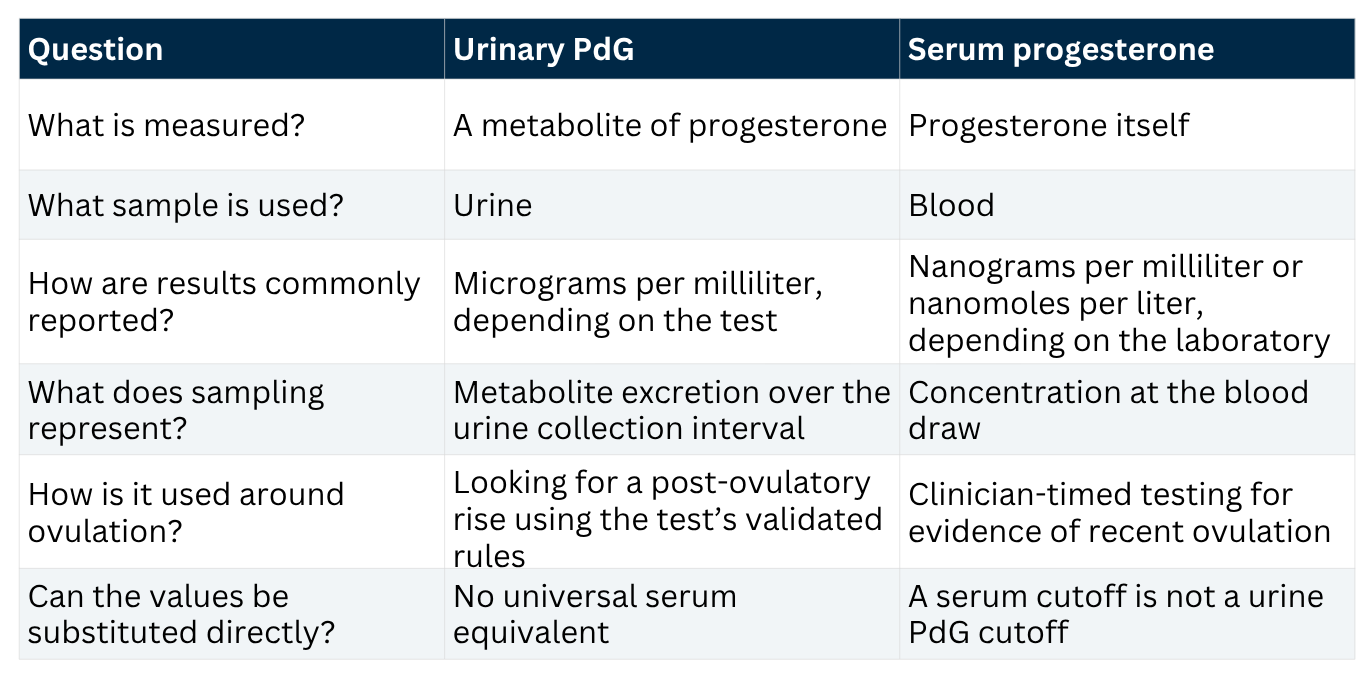
The table compares measurement methods, not the accuracy of every product or laboratory. For the broader choice across hormones, see our guide to urine hormone testing versus blood tests. [1–3]
Why can urine and blood results look different?
They measure different substances
Progesterone and its urinary metabolite are biologically related. They are not two names for the same laboratory analyte. A lower-looking number on one report does not mean it detected less of the same substance.
A prospective study of 40 normally menstruating women compared urinary and serum reproductive hormones with ultrasound-observed ovulation. The profiles showed agreement, including post-ovulatory progesterone-related changes. That supports the relationship between the markers; it does not make their numerical values interchangeable. [2]
When you share results with your clinician, include the complete report or app record. Writing “my progesterone was 8” without saying whether the result came from urine or blood can create avoidable confusion.
The samples capture different intervals
A blood draw measures a concentration at a particular time. Urinary PdG reflects a downstream metabolite excreted over the collection interval. A 2026 study explicitly distinguishes this from a contemporaneous serum progesterone concentration. [1]
You do not need to make the curves line up point for point. If you are comparing them, record the blood draw time and the urine collection time separately. Ask your clinician whether the comparison answers the question they are evaluating.
The sampling conditions also matter
Urinary concentration can be affected by collection conditions. Research comparing urine and serum measures has examined the influence of urine volume and hydration, underscoring the importance of a consistent protocol. [5]
Follow your product’s collection instructions. Do not deliberately restrict fluids to make a value higher, and do not borrow a different brand’s sampling schedule. If you collected an unusual sample or missed a day, annotate the record instead of treating it as a perfectly comparable measurement.
What can a PdG rise tell you after an LH surge?
LH is used to anticipate ovulation; progesterone-related changes are evaluated afterward. Urinary PdG research supports using post-ovulatory changes as evidence that ovulation occurred when the measurement method and interpretation rule are appropriate. [4]
For example, a study of 107 women across 326 cycles compared urine hormone measurements with ultrasound timing and examined consecutive positive PdG results after a fertility signal. It provided evidence for an ovulation-confirmation approach under the study’s specific conditions. It did not validate every home test or establish one universal threshold for all users. [4]
That is the distinction to keep in mind when reading advice online. “PdG can help confirm ovulation” is not the same as “any isolated value above this number confirms every cycle.”
If you are trying to understand the sequence after your surge, Oova lets you follow LH, E3G, and urinary PdG across the cycle.
Track your PdG pattern after the LH surge with Oova.
Use the testing plan provided for your kit. If the pattern is unclear, share the record with your clinician rather than choosing a cutoff from a social media post.
When should progesterone or PdG be tested?
The timing should follow the question and the test. For a clinical blood progesterone check, ASRM recommends sampling approximately one week before the next expected period, rather than automatically on cycle day 21. [3]
Home PdG systems have their own protocols, which may use repeated samples or changes relative to earlier measurements. Follow the specific instructions rather than moving a blood-testing recommendation directly onto a urine-testing routine.
Before testing, clarify three details: which marker you are measuring, what event anchors the timing, and how the result will be interpreted. “Seven days after my app’s predicted date” and “seven days after a measured LH event” are not identical records.
If the LH pattern is unclear or there are several rises, preserve that uncertainty in your notes. A calendar date is useful for organizing information, but it should not be relabeled as a confirmed ovulation date without supporting evidence.
Can you convert PdG to a blood progesterone level?
There is no universal conversion that turns a home PdG measurement into your serum progesterone concentration. Converting units does not solve the difference in analyte or sampling. The 2026 timing study specifically warns against assuming a urinary threshold corresponds to a particular blood progesterone value. [1]
This is why a reference range on a blood report cannot be pasted onto an app’s urine chart. A formula found online may create a precise-looking answer without validating the biological comparison.
If a clinician needs a serum result for your treatment plan, ask whether that blood test is still required. Do not substitute a urine measurement simply because both tests relate to progesterone.
Does a low PdG result mean low progesterone?
One low urinary result does not, on its own, establish progesterone deficiency. Timing, sample conditions, the expected pattern, and any medications all belong in the interpretation.
Instead of asking whether one number is “good,” start with what was actually recorded. Was the sample collected before or after the suspected ovulation event? Was there a comparable earlier measurement? Is this an isolated result, a repeated pattern, or a gap in testing?
You can bring that context to a provider without having to diagnose the pattern yourself. Our guide to progesterone patterns after ovulation addresses the broader pattern question.
Can either test measure egg quality or predict pregnancy?
Evidence of ovulation does not establish egg quality, implantation, or a future pregnancy outcome. ASRM cautions that a single progesterone result can support recent ovulation but cannot establish the quality of the luteal phase. Its luteal-phase guidance also describes limitations in diagnosing luteal phase deficiency. [3,6]
A PdG chart should not become a daily score of whether you are doing enough to conceive. Higher is not a universal synonym for more fertile, and a changing value is not a stand-alone prediction of pregnancy loss.
Use a pregnancy test according to its instructions to assess pregnancy. If you are already being monitored after a positive result, follow the clinic’s plan rather than using a home hormone graph to decide whether care is needed.
What changes if you take progesterone or other hormones?
Tell your clinician about any prescribed progesterone and other hormone products before interpreting a home chart. Research has shown that progesterone treatment can affect urinary measurements. The route, schedule, and clinical purpose matter. [7]
A result during supplementation cannot simply be assumed to represent your own ovarian production. A PdG test is also not a universal assay for synthetic progestogens. Your clinician needs the exact drug name rather than the general term “progesterone.”
Record the product, route, prescribed schedule, and recent changes. Do not change medication to obtain a different chart shape. When treatment decisions depend on laboratory testing, use the test and timing ordered for that purpose.
How to bring urine and blood results to an appointment
Make a short record with the sample type beside every result. Include the units, collection date, and any suspected LH or ovulation event. Keep the original laboratory reference range attached to the blood report.
Then explain the question in one sentence. For example: “My home chart showed a PdG rise, but my blood sample was taken several days later. Do these results answer the same question?” This is a hypothetical discussion prompt, not a diagnosis of that pattern.
For a broader overview of confirmation methods, read how to confirm ovulation at home. The goal is to choose information that helps resolve your uncertainty, not to accumulate numbers without knowing how they will be used.
Frequently asked questions
Is PdG the same thing as progesterone?
No. PdG is a progesterone metabolite measured in urine. A serum progesterone test measures the hormone in blood. The markers are related but their values are not directly interchangeable. [1,2]
Is blood progesterone always better than urinary PdG?
The useful test depends on the question. A clinician may need a blood sample at a specified time, while a home urine test can provide repeated measurements. Neither method answers every question about fertility or symptoms by itself.
Does Oova measure progesterone or PdG?
Oova measures urinary PdG, the progesterone metabolite, along with LH and E3G. It does not report a serum progesterone concentration.
Can I diagnose luteal phase deficiency from my PdG chart?
No. A home chart alone does not establish that diagnosis. Clinical interpretation has important limitations and should include your history and the reason for testing. [6]
Follow the pattern with the right measurement
Understanding what your test measures makes the next result easier to place in context. If your goal is to follow the hormone sequence around ovulation, explore Oova’s fertility tracking. You can collect LH, E3G, and PdG information at home and bring the record to your provider when questions remain.
About the author
Sources
- Leiva and colleagues on timing urinary PdG relative to ultrasound ovulation. 2026. Metabolite timing and limits of extrapolation to serum.
- Monitoring the menstrual cycle through urinary and serum reproductive hormones. 2015. Prospective comparison with ultrasound in 40 normally menstruating women.
- ASRM fertility evaluation committee opinion. Progesterone timing and limits of single measurements.
- Ecochard and colleagues on urinary PdG to confirm ovulation. 2013. Observational analysis using ultrasound and urinary measurements; not product-specific Oova validation.
- Ovarian Monitor research on PdG, BBT, and cervical mucus and research on hydration and urinary PdG. Urine sampling context; hydration study population was early pregnancy.
- ASRM luteal phase deficiency committee opinion. Diagnostic limitations.
- Urinary progesterone and pregnanediol during progesterone treatment. Primary study of treatment effects on urinary and serum measurements.
About the Oova Blog:
Our content is developed with a commitment to high editorial standards and reliability. We prioritize referencing reputable sources and sharing where our insights come from. The Oova Blog is intended for informational purposes only and is never a substitute for professional medical advice. Always consult a healthcare provider before making any health decisions.