
Estrogen typically rises as a follicle develops and ovulation approaches, but the timing and shape of that rise can vary. Learn what E3G patterns may show before ovulation, how estrogen relates to the LH surge, and what it may mean when no clear rise appears.

Estrogen typically rises as a follicle develops and ovulation approaches, but the timing and shape of that rise can vary. Learn what E3G patterns may show before ovulation, how estrogen relates to the LH surge, and what it may mean when no clear rise appears.
You expected a clear climb.
Instead, your estrogen graph went up, dropped back down, and then flattened out. Or perhaps your ovulation test turned positive without the estrogen rise you thought you were supposed to see.
When you are trying to conceive, every hormone reading can feel consequential. A number that looks “wrong” can quickly turn into a much bigger question: Is my body actually preparing to ovulate?
Usually, one unusual estrogen result cannot answer that.
Estrogen generally rises as a follicle develops before ovulation. But the rise is not always smooth, it does not happen on the same cycle day for everyone, and the urinary form measured by at-home trackers can look different from the clean curve shown in a textbook.
The most useful information comes from how estrogen changes alongside LH before ovulation and progesterone afterward, not from judging one estrogen result in isolation.
The short answer: Should estrogen rise before ovulation?
Yes, estrogen generally rises during the follicular phase as an ovarian follicle grows and prepares to release an egg.
When estrogen remains elevated, it helps trigger the hormonal signaling that leads to the LH surge. The LH surge then precedes ovulation, although an LH surge alone does not prove that the egg was released.
At-home hormone trackers usually do not measure estradiol directly. They measure estrone-3-glucuronide, or E3G, which is a metabolite of estrogen found in urine.
A rising E3G pattern can therefore provide earlier context that the body may be moving toward ovulation. But it should be interpreted as one part of a sequence:
- E3G rises as the follicle develops.
- LH surges as the body prepares to release the egg.
- Progesterone, measured in urine as PdG, rises after ovulation.
Not every cycle follows this sequence in a perfectly smooth or obvious way.
What estrogen is doing before ovulation
The first part of the menstrual cycle is called the follicular phase. It begins on the first day of your period and continues until ovulation.
During this phase, several follicles begin developing in the ovaries. Usually, one becomes dominant. As that follicle develops, it produces increasing amounts of estradiol, the primary form of estrogen during the reproductive years.
That estrogen supports several important changes:
- It helps build the uterine lining.
- It contributes to fertile cervical mucus.
- It signals that a follicle is developing.
- When sufficiently elevated, it contributes to the LH surge that precedes ovulation.
If you want a broader explanation of this part of the cycle, read what happens during the follicular phase.
The important point is that estrogen is not simply “high” or “low.” It is moving, and the direction, timing, and relationship to other hormones provide more context than one absolute number.
Estradiol and E3G are related, but they are not the same measurement
A blood test typically measures estradiol directly in serum. Most at-home urine trackers measure E3G, one of the metabolites produced as the body processes estrogen.
E3G gives you a practical way to follow estrogen-related changes at home without daily blood draws. But an E3G result should not be treated as if it were the same number you would receive from a serum estradiol test.
Urinary measurements can also be affected by factors such as:
- Urine concentration
- Hydration
- Collection timing
- How consistently you follow the testing instructions
- Normal biological variation from one day to the next
Research comparing daily urinary and serum hormone patterns has found that their overall configurations can align, while urinary E3G shows meaningful variation during the follicular phase. That is one reason a single E3G result is less informative than a trend collected under reasonably consistent conditions.
It is also why comparing your number with someone else’s screenshot is rarely useful. Their baseline, urine concentration, cycle timing, and individual hormone pattern may all be different from yours.
For broader questions about estrogen across the full menstrual cycle, see what estrogen levels may look like during your cycle.
What should an estrogen pattern look like before ovulation?
In broad terms, E3G is often lower earlier in the follicular phase and rises as ovulation approaches.
But there is no single curve that every ovulatory cycle must follow.
For some people, the rise is gradual. For others, it appears closer to the LH surge. Some cycles show a step-like pattern, with an increase, a dip, and then another increase. The timing can also shift from one cycle to another, even when both cycles are ovulatory.
Instead of asking whether your chart looks “textbook,” look at the sequence:
- Did E3G rise above your earlier-cycle pattern?
- Did an LH surge follow?
- Did PdG rise afterward?
- Did the pattern occur around the same time as changes in cervical mucus or other fertile signs?
- Is this similar to your previous cycles, or meaningfully different?
The complete sequence is more informative than whether estrogen rose on a particular cycle day.
Five estrogen patterns you may see before ovulation
1. A clear E3G rise followed by an LH surge
This is the easiest pattern to recognize. E3G rises above its earlier baseline, and an LH surge follows.
That sequence suggests that a follicle was developing and the body initiated the hormonal signal associated with ovulation.
The next question is whether progesterone rises afterward. An LH surge predicts that ovulation may occur, but the post-ovulatory progesterone pattern provides stronger evidence that it actually did.
2. A later estrogen rise than you expected
A later E3G rise may simply mean that follicular development is taking longer during that cycle and ovulation will occur later.
Stress, illness, travel, changes in sleep, energy availability, medications, and normal cycle variation can all affect cycle timing. One late cycle is not automatically a sign that something is wrong.
If your estrogen rise and ovulation repeatedly occur later than usual, or your cycle lengths vary substantially, the pattern may be worth sharing with a provider.
3. More than one estrogen rise
Estrogen does not always move upward in one uninterrupted climb.
A follicle may begin developing without reaching ovulation, followed by another period of follicular activity later in the cycle. You may then see more than one E3G rise, more than one LH surge, or both.
Multiple rises do not tell you by themselves whether ovulation occurred. The later PdG pattern matters.
If your chart also shows repeated LH surges, read why multiple LH surges can happen in one cycle.
4. An LH surge without an obvious E3G rise
This can happen for several reasons.
The E3G rise may have been brief, gradual, or difficult to distinguish from your baseline. Testing conditions may also have made the pattern less visible. Alternatively, your body may have produced an LH surge without ultimately releasing an egg.
Do not assume that a positive LH test automatically confirms ovulation. Look for the expected progesterone or PdG response afterward.
5. An E3G rise without a clear LH surge
An E3G rise suggests estrogen activity and possible follicular development, but it does not guarantee that an LH surge or ovulation will follow.
The LH surge may have occurred between tests, may have been difficult to capture, or may not have occurred during that attempt at ovulation.
If you repeatedly see estrogen activity without a recognizable LH surge or post-ovulatory PdG rise, bring the complete pattern to your provider rather than trying to diagnose the cause from estrogen alone.
What does low estrogen before ovulation mean?
One low E3G result may mean very little.
It could reflect where you are in the cycle, urine concentration, testing conditions, or ordinary daily variation. A number that is low compared with an online reference range may still fit your personal pattern.
Repeatedly low or flat E3G patterns may deserve further evaluation when they occur alongside:
- Very irregular or absent periods
- Repeated cycles without a recognizable LH surge
- No post-ovulatory PdG rise
- Very short cycles
- Symptoms that may suggest an endocrine concern
- Difficulty conceiving
A home E3G pattern cannot diagnose diminished ovarian reserve, PCOS, hypothalamic amenorrhea, thyroid disease, or another fertility condition. Those questions require a broader clinical history and, when appropriate, laboratory testing or ultrasound.
This is also why learning how to read hormone results as a connected pattern is more useful than labeling one result “good” or “bad.”
Can you ovulate without seeing a clear estrogen rise?
Yes, it is possible to ovulate without seeing an obvious E3G rise on an at-home chart.
The rise may have been too brief to capture clearly, may have blended into a variable baseline, or may have appeared differently from what you expected. Collection timing and urine concentration may also affect how obvious the pattern looks.
That does not mean estrogen was absent. It means the urinary signal did not produce a clean, recognizable curve.
The most useful next step is to look at the other parts of the cycle:
- Was there an LH surge?
- Did PdG rise afterward?
- Did your period arrive within the expected luteal-phase timeframe?
- Does the same pattern repeat in future cycles?
Can one estrogen test tell you that ovulation is approaching?
No. One estrogen result is a snapshot.
The same E3G value could represent the beginning of a rise, the top of a rise, a temporary fluctuation, or the decline after a peak. Without the surrounding days, you do not know which part of the pattern you are seeing.
Daily testing under similar conditions helps turn an isolated result into a trend. That trend becomes more informative when interpreted alongside LH and PdG.
What this means when you are trying to conceive
When you are trying to conceive, the goal is not simply to identify ovulation after it has happened. It is to recognize the fertile window early enough to act on it.
The fertile window includes the five days before ovulation and the day of ovulation. The highest probability of conception is generally during the one to two days before ovulation.
An estrogen-related rise may provide earlier context that the fertile window is developing. The LH surge offers a closer signal that ovulation may be approaching. A progesterone or PdG rise comes later and helps assess whether ovulation likely occurred.
This creates three different questions:
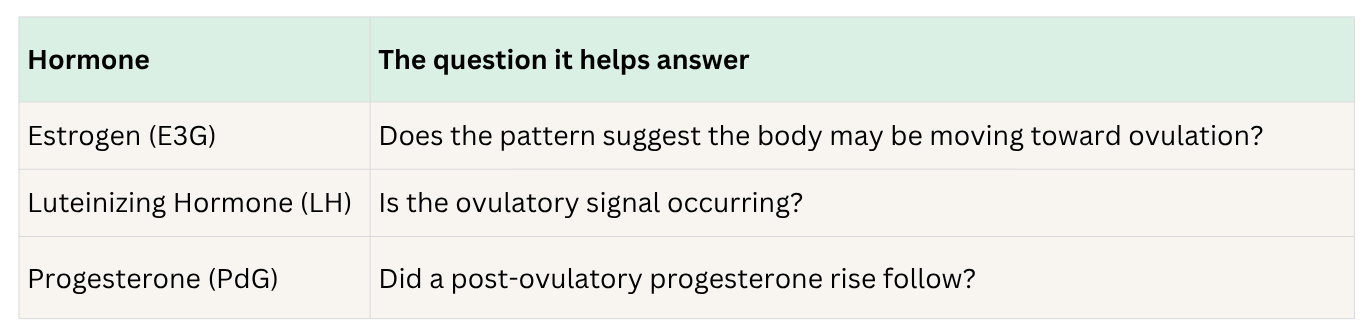
No single hormone answers all three.
This is one reason an LH-only ovulation test can leave you with unanswered questions, particularly if you have irregular cycles, multiple LH surges, or well-timed intercourse without conception.
Oova helps you see the sequence across your cycle rather than reducing ovulation to one positive or negative result. Your results can also be shared with your provider when a pattern raises questions.
Start tracking your complete hormone pattern with Oova.
When should you speak with a fertility provider?
A different-looking cycle does not always require a fertility evaluation. Some variation is normal.
According to the American Society for Reproductive Medicine, an infertility evaluation may be appropriate:
- After 12 months of regular, unprotected intercourse if you are younger than 35
- After 6 months if you are 35 or older
- More immediately if you are older than 40
- Without delay when there is a known condition or history associated with infertility
Reasons to seek evaluation sooner can include irregular or absent periods, cycles shorter than 25 days, bleeding between periods, suspected endometriosis or tubal disease, a history associated with diminished ovarian reserve, or known or suspected male-factor infertility.
An evaluation should consider both partners when sperm contributes to the pregnancy. An estrogen chart is only one small part of the complete fertility picture.
If you are waiting for an appointment, use this guide to understand what to track before seeing a fertility specialist.
What to bring to your appointment
If your E3G pattern concerns you, bring more than one isolated screenshot.
Helpful information may include:
- Several complete cycles, if available
- E3G, LH, and PdG patterns
- Cycle lengths and how much they vary
- Bleeding or spotting patterns
- Whether you consistently detect an LH surge
- Whether PdG rises afterward
- Relevant symptoms
- Medications and supplements
- How long you have been trying to conceive
- Any previous pregnancies, losses, testing, or treatment
- Information about the sperm-contributing partner when applicable
The goal is not to prove that one hormone is “wrong.” It is to give your provider enough context to decide whether further evaluation is appropriate.
The pattern matters more than the perfect curve
It is easy to look at a hormone chart and assume every dip means something went wrong.
Usually, the more useful question is not, “Was my estrogen perfect?” It is, “What happened across the full sequence?”
Estrogen provides information about the lead-up to ovulation. LH provides information about the ovulatory signal. Progesterone provides information about what happened afterward.
Your pattern may be gradual, late, stepped, or different from the one shown in an app illustration. That does not automatically make it abnormal.
One result is a moment. A cycle is a pattern.
Frequently Asked Questions
Should estrogen rise before ovulation?
Yes. Estrogen generally rises as a follicle develops before ovulation. This rise usually occurs before the LH surge, but the timing and shape vary between people and cycles.
What is E3G?
E3G, or estrone-3-glucuronide, is a urinary metabolite of estrogen. At-home hormone trackers may measure E3G as a practical way to follow estrogen-related changes across the cycle.
How many days before ovulation does estrogen rise?
There is no fixed number that applies to everyone. The rise may develop gradually or become clearer closer to the LH surge. Your pattern across multiple days is more useful than expecting a rise on one specific cycle day.
Does estrogen rise before the LH surge?
Generally, yes. Rising estrogen contributes to the hormonal signaling that leads to the LH surge. An at-home E3G curve may not always display that rise as a smooth or obvious line.
What does low estrogen before ovulation mean?
A single low E3G reading is not diagnostic. It may reflect cycle timing, urine concentration, collection conditions, or normal variation. Repeatedly flat patterns alongside irregular cycles or difficulty conceiving are more appropriate to discuss with a provider.
Can you ovulate without a clear E3G rise?
Yes. The urinary pattern may not capture the estrogen rise clearly. Look at the complete sequence, including the LH surge and whether PdG rises afterward.
What does more than one estrogen rise mean?
It may reflect more than one period of follicular activity before ovulation. The pattern is not necessarily abnormal, but repeated rises are best interpreted alongside LH, PdG, cycle history, and symptoms.
Does an estrogen rise confirm ovulation?
No. An estrogen rise may indicate follicular development, but it does not confirm that an egg was released. An LH surge provides a closer predictive signal, while a progesterone or PdG rise afterward provides stronger evidence that ovulation occurred.
Can low E3G diagnose low ovarian reserve?
No. A home E3G result cannot diagnose diminished ovarian reserve. Ovarian reserve assessment may involve age, medical history, AMH, early-cycle FSH and estradiol, and antral follicle count, interpreted in the appropriate clinical context.
About the author
Sources
- American Society for Reproductive Medicine. Fertility evaluation of infertile women: A committee opinion. Fertility and Sterility. 2021;116:1255-1265.
- American Society for Reproductive Medicine. Optimizing natural fertility: A committee opinion. Fertility and Sterility. 2022.
- Newman MR, et al. Comparison of day-specific serum LH, estradiol, and progesterone with urinary LH, E3G, and PdG levels in ovulatory cycles. 2024. Small exploratory comparison involving four serum-tracked cycles and three urine-tracked cycles.
- Blackwell LF, et al. Variability of normal menstrual-cycle profiles measured through urinary estrone glucuronide and pregnanediol glucuronide. Human Reproduction. 2013;28(12):3306-3315.
- Zeleznik AJ, Pohl CR. The neurosteroid progesterone underlies estrogen positive feedback of the LH surge. Endocrinology. 2012.
About the Oova Blog:
Our content is developed with a commitment to high editorial standards and reliability. We prioritize referencing reputable sources and sharing where our insights come from. The Oova Blog is intended for informational purposes only and is never a substitute for professional medical advice. Always consult a healthcare provider before making any health decisions.



.jpg)