
Does Nexplanon stop ovulation? What about the mini pill? Learn how different progestin-only contraceptives work and what hormone tracking can and cannot show.
Does Nexplanon stop ovulation? What about the mini pill? Learn how different progestin-only contraceptives work and what hormone tracking can and cannot show.
Nexplanon usually prevents ovulation. The mini pill is more complicated: some progestin-only pills allow ovulation in a substantial share of cycles, while others suppress it more consistently. That difference matters if you've noticed bleeding, cramping, or what feels like an ovulation symptom while using birth control.
Nexplanon and the mini pill are often grouped together because both use a progestin without estrogen. But they're not interchangeable medications. Their active ingredients, how consistently they block ovulation, and the instructions for missed doses differ. [1, 2]
Key takeaways
- Nexplanon's main contraceptive action is to suppress ovulation; bleeding while using it is not proof that an egg was released.
- Traditional norethindrone and norgestrel mini pills do not consistently stop ovulation in every cycle.
- Drospirenone-only pills primarily work by suppressing ovulation and have different missed-pill instructions.
- Ovulation testing is not a reliable way to check whether your birth control is working. Oova is not a contraceptive.
Does Nexplanon stop ovulation?
Usually, yes. Nexplanon is a small implant placed under the skin of the upper arm. It releases etonogestrel, a progestin that helps prevent pregnancy primarily by suppressing ovulation. It also thickens cervical mucus, making it harder for sperm to reach an egg, and changes the endometrium. [1] The FDA expanded the approved duration of Nexplanon from three to five years in January 2026. Do not assume ovulation resumes at the old three-year mark; ask your clinician about replacement timing and use within the approved five-year period. [1]
That also explains why your symptoms may not fit a familiar 28-day pattern. Hormonal contraception can change hormone signaling and bleeding without producing the sequence of follicular growth, LH surge, ovulation, and post-ovulation progesterone rise seen in an untreated cycle.
If I'm bleeding on Nexplanon, does that mean I ovulated?
No. Spotting, prolonged bleeding, irregular bleeding, and sometimes no bleeding are recognized patterns with the implant. These changes do not, by themselves, establish whether ovulation took place. [1]
If bleeding is new, very heavy, painful, or accompanied by pregnancy symptoms, speak with your clinician. A change in bleeding should not automatically be blamed on the implant.
Can you ovulate on the mini pill?
Yes, depending on which mini pill you take. In the United States, progestin-only pills include norethindrone, norgestrel, and drospirenone formulations. All are used for pregnancy prevention, but they differ in how they work. [2]
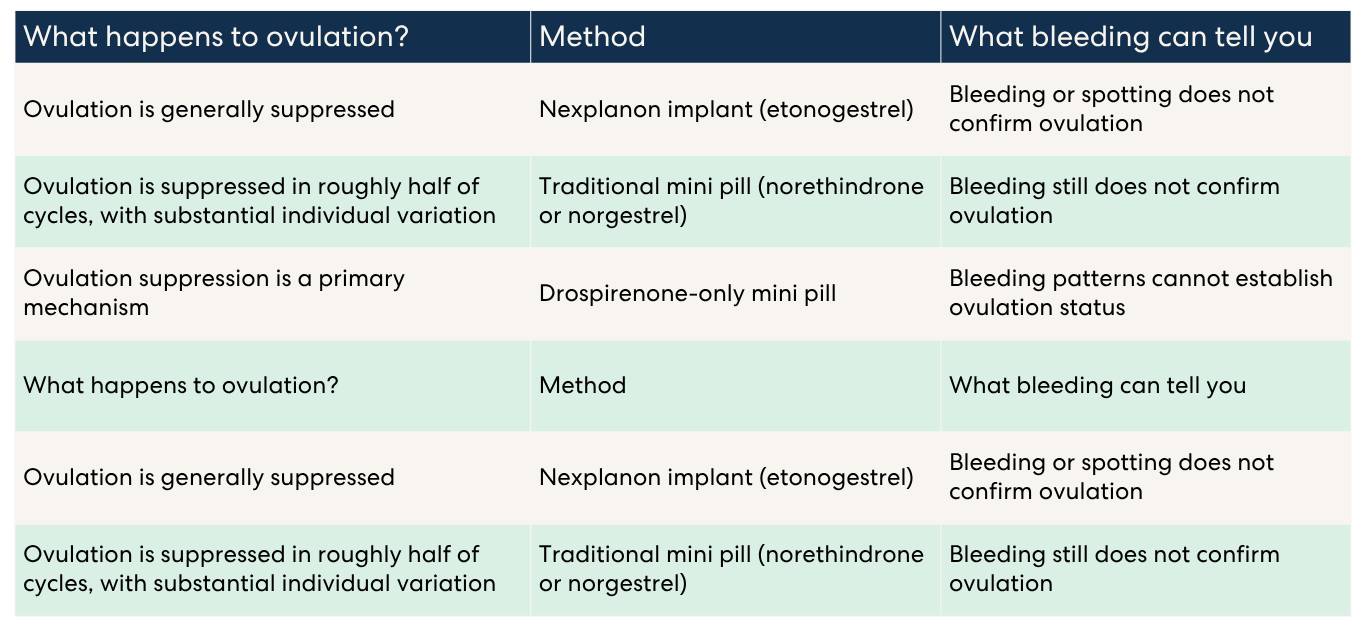
The CDC explains that traditional norethindrone and norgestrel pills inhibit ovulation in approximately half of cycles, though this varies from person to person. These formulations also depend on making cervical mucus less favorable to sperm. Drospirenone-only pills work more like combined pills in their emphasis on ovulation suppression. [2]
This is why the phrase 'the mini pill' can lead to confusing answers online. A statement that is reasonable for one formulation may be wrong for another.
Does the type of mini pill matter if you miss a dose?
Yes. Timing recommendations are medication-specific. For traditional norethindrone and norgestrel pills, a pill taken more than three hours late is considered missed under CDC guidance. Drospirenone has different instructions. [2]
Do not use a positive ovulation test, the absence of cervical mucus, or a period-tracking app to decide whether you need backup contraception. Follow the instructions for your exact medication and ask a pharmacist or clinician about emergency contraception when relevant.
Why can you have ovulation-like symptoms on birth control?
Breast tenderness, cramps, bloating, changes in discharge, and mood shifts can occur for many reasons. Some overlap with sensations people associate with ovulation. That does not mean the sensations identify a released egg.
On a traditional mini pill, some people may indeed ovulate. On Nexplanon, ovulation is usually suppressed, yet fluctuations in symptoms and irregular bleeding can still occur.
A person might also notice a one-sided pelvic twinge or think they see fertile cervical mucus. Neither provides dependable confirmation of ovulation, and neither tells you that contraception has failed.
For the broader explanation of how different contraceptive methods change ovulation, see Does Birth Control Stop Ovulation?.
Can an LH or ovulation test tell you whether you're ovulating on Nexplanon?
Not reliably. An ovulation predictor kit detects a rise in LH, which normally helps trigger ovulation. But hormone patterns can be altered by hormonal contraception, and an LH reading by itself does not prove that an egg was released.
The same limitation applies to cycle-prediction apps. Most predictions depend on patterns from previous menstrual cycles, and those patterns may be disrupted or absent while using a contraceptive method that suppresses ovulation.
Even outside contraceptive use, a positive LH test is a prediction signal, not confirmation. The post-ovulation progesterone rise provides additional information, but any hormonal test must be interpreted in context. [3]
Do not use Oova or any ovulation tracker to check whether Nexplanon or the mini pill is protecting you from pregnancy. That is not what these products are designed to determine.
What if you want to understand your natural cycle?
This becomes a different question when you're planning to stop hormonal contraception. You may want to know when ovulation returns, whether your periods settle into a predictable pattern, or how to identify a fertile window while trying to conceive. How to Track Ovulation After Removing a Hormonal IUD
Once you're no longer using a method that alters your reproductive hormone pattern, following LH and progesterone-related changes may provide more useful information. For what to expect after stopping oral contraception, read Signs of Ovulation After Stopping the Pill.
How can you tell whether ovulation has returned?
Start with the basics: record bleeding dates, notice whether cycles become more regular, and discuss any persistently absent periods with a clinician. Ovulation testing can then help identify an LH rise, while tracking a progesterone rise afterward can add evidence that ovulation occurred.
Not every cycle will look the same immediately. A single unfamiliar result is less informative than a repeatable pattern, particularly if you had irregular cycles before starting contraception.
Our guide to confirming ovulation at home explains the difference between predicting ovulation and looking for evidence afterward.
Can Nexplanon affect future fertility?
Fertility can return soon after the implant is removed, and pregnancy can occur before the first natural period. Read our guide to how long it takes to get pregnant after birth control for the broader timeline. How Long Does It Take to Get Pregnant After Birth Control?
For practical steps when you are ready to try, see our guide to getting pregnant after stopping birth control. How to Get Pregnant Quickly After Birth Control
If you do not want to become pregnant, plan your next contraceptive method before removal.
When should you see a doctor about bleeding or symptoms?
Talk to your clinician if you have prolonged or disruptive bleeding, sudden changes in bleeding, significant pelvic pain, or symptoms suggesting pregnancy. Severe pain, fainting, or heavy bleeding with weakness needs urgent medical assessment.
If you're considering stopping a method because you dislike its effects, you have options. A clinician can help compare contraceptive choices based on your health history and what matters most to you, including whether you want regular bleeding, fewer periods, or pregnancy in the near future.
Questions to ask your clinician
1. Which active ingredient is in my contraceptive, and how does it prevent pregnancy?
2. Does this method usually suppress ovulation, or can ovulation still happen?
3. What should I do if I miss a pill or have a medication interaction?
4. Are my current bleeding changes expected, or should we investigate another cause?
5. If I stop, when should I arrange an alternative contraceptive or start trying to conceive?
6. When would cycle and ovulation monitoring become informative for me?
The bottom line
Nexplanon generally suppresses ovulation. Traditional mini pills may allow it in some cycles. Drospirenone-only pills are different again. That is why the method and active ingredient matter more than the umbrella term 'progestin-only contraception.'
Bleeding, cramps, or a positive LH test cannot tell you whether contraception is effective. If you're planning to stop birth control, that's when a conversation about cycle tracking, fertility goals, and the return of natural ovulation becomes useful.
Frequently asked questions
Can you get a positive ovulation test on Nexplanon?
An LH test result can occur while using hormonal contraception, but it does not confirm ovulation or mean that Nexplanon failed. Do not base contraceptive decisions on an ovulation test.
Can you get pregnant if you ovulate on the mini pill?
Pregnancy is possible with any contraceptive method, though these pills are designed to reduce that risk. Traditional mini pills can allow ovulation in some cycles, but protection also depends on effects on cervical mucus and correct use. Follow medication-specific missed-pill guidance.
Is spotting on Nexplanon a real period?
It may be bleeding related to the implant's effects on the uterine lining rather than bleeding that follows a typical ovulatory cycle. Spotting does not establish that ovulation occurred.
Does a drospirenone mini pill stop ovulation?
Suppressing ovulation is its primary contraceptive mechanism. It is not equivalent to older norethindrone or norgestrel mini pills, which inhibit ovulation less consistently. [2]
Should I use Oova while on Nexplanon?
Oova is not a good fit for interpreting natural ovulation patterns during Nexplanon use. The medication can suppress the hormonal changes Oova is designed to follow. Consider tracking once you've stopped the method and discussed the appropriate timing with your clinician.
About the author
Sources
1. Organon. Nexplanon (etonogestrel implant), U.S. Prescribing Information. FDA label, January 2026. https://www.accessdata.fda.gov/drugsatfda_docs/label/2026/021529s027lbl.pdf.
2. CDC. Progestin-Only Pills. U.S. Selected Practice Recommendations for Contraceptive Use, 2024. https://www.cdc.gov/contraception/hcp/usspr/progestin-only-pills.html.
3. American Society for Reproductive Medicine. Fertility evaluation of infertile women: a committee opinion, 2026. https://www.asrm.org/practice-guidance/practice-committee-documents/fertility-evaluation-of-infertile-women-a-committee-opinion-2026.
About the Oova Blog:
Our content is developed with a commitment to high editorial standards and reliability. We prioritize referencing reputable sources and sharing where our insights come from. The Oova Blog is intended for informational purposes only and is never a substitute for professional medical advice. Always consult a healthcare provider before making any health decisions.
