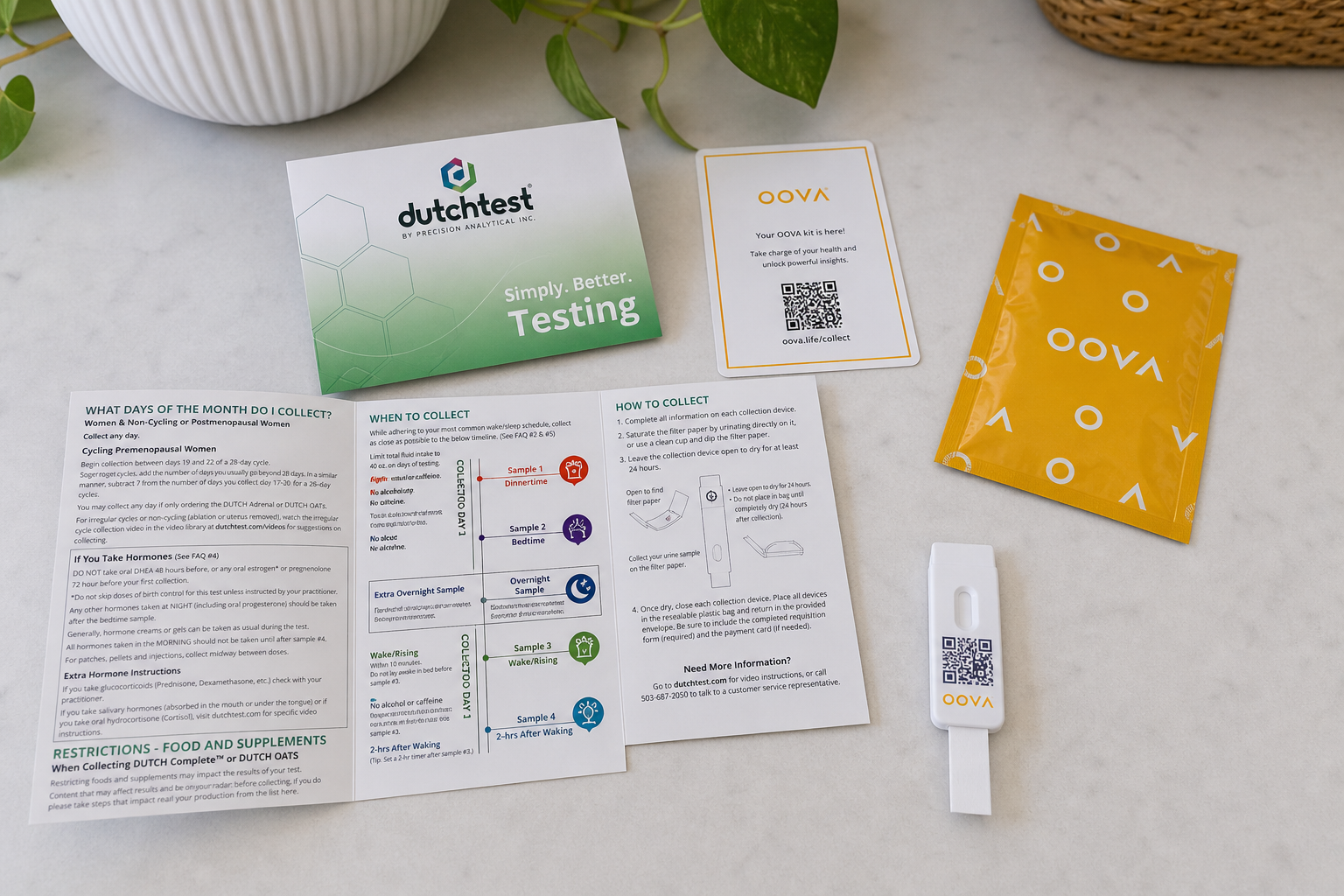
Urine and blood hormone tests aren't competing versions of the same test; they answer different questions. This guide explains what each actually measures, how accurate urinary metabolite testing really is, where a single blood draw still matters, and when daily tracking reveals a pattern that either kind of one-time test would miss.

Urine and blood hormone tests aren't competing versions of the same test; they answer different questions. This guide explains what each actually measures, how accurate urinary metabolite testing really is, where a single blood draw still matters, and when daily tracking reveals a pattern that either kind of one-time test would miss.
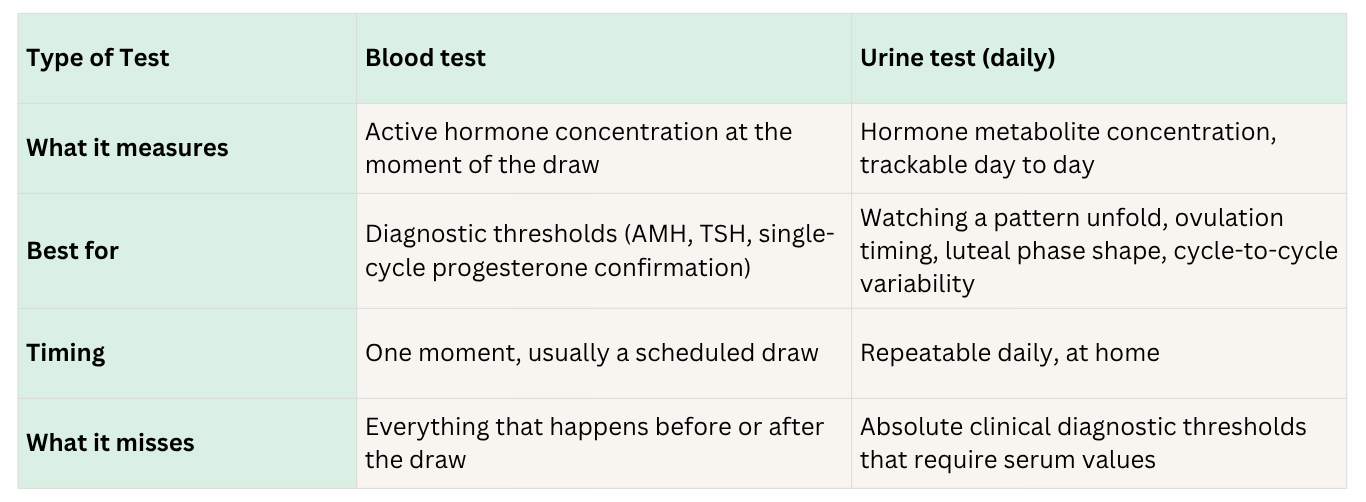
Urine and blood hormone tests aren't two versions of the same test, they measure different things, on different timescales, for different purposes. A blood draw measures the concentration of a hormone circulating in your bloodstream at one moment. A urine test measures the metabolite your body produces after that hormone has already been processed, and it's built to be repeated daily. Neither one is simply "more accurate" than the other; they answer different questions.
What each test actually measures
Blood tests measure serum hormone levels directly, the active hormone itself, circulating in your bloodstream at the moment of the draw. This is the standard for most clinical diagnostic thresholds: AMH for ovarian reserve, TSH for thyroid function, a mid-luteal progesterone draw to check for ovulation.
Urine tests measure hormone metabolites, what your body produces as it breaks hormones down for excretion. Estrogen becomes E3G (estrone-3-glucuronide). Progesterone becomes PdG (pregnanediol glucuronide). LH is excreted largely unchanged and shows up directly in urine. These metabolites rise and fall in a pattern that tracks the hormone that produced them, which is what makes daily urine testing useful for watching a trend rather than capturing a single value.
How well urine metabolites actually track blood levels
This is worth being precise about, because the honest answer is "it depends on which hormone."
For progesterone and PdG, the correlation is strong. Research validating urinary hormone monitors has found high agreement between urinary PdG measurements and standard lab assays, with one study reporting the ability to distinguish ovulatory from anovulatory cycles with 100% specificity using consecutive daily PdG readings. This is part of why what your progesterone pattern may reveal about fertility leans on daily PdG tracking rather than a single serum draw, the metabolite tracks the hormone's behavior closely enough to be genuinely useful.
For estrogen and E3G, the picture is more nuanced. Laboratory comparisons using mass spectrometry have found only moderate correlation between urinary estrogen metabolites and serum estradiol in premenopausal women specifically, with meaningful day-to-day variability in the urine measurement itself. That doesn't mean urinary E3G isn't useful, it's still capable of showing the shape of your estrogen rise across a cycle, which is the whole point of daily tracking, but it's not a substitute for a serum estradiol value when a precise clinical threshold matters. Estrogen before ovulation: what should it do covers what that E3G pattern typically looks like and where its real value lies.
LH in urine is the most straightforward of the three, since it's excreted largely unchanged rather than converted to a different metabolite, which is part of why urine-based LH testing (standard ovulation predictor kits) has been reliable for years. What no LH surge may mean for your fertility goes into what it means when this particular signal doesn't show up as expected.
Where a blood test is still the right tool
There are things only a blood test can do. Diagnostic thresholds for conditions like diminished ovarian reserve (AMH), thyroid dysfunction (TSH, free T4), or a single confirmatory progesterone level still rely on serum values compared against clinically validated reference ranges. If you're navigating perimenopause specifically, FSH vs. AMH vs. estradiol: which test actually helps confirm what's happening walks through what each of those standard blood panels is actually designed to answer, and where their limits are.
Blood testing is also, by nature, a single point in time. A day-3 FSH draw tells you about day 3. It doesn't tell you what your hormones did on day 10, or whether this cycle's pattern looked anything like last cycle's. Day 3 testing vs. continuous monitoring covers this specific gap in more depth if you're weighing the two approaches for a perimenopause workup.
Where daily urine tracking adds something blood testing can't
The advantage of daily urine testing isn't that it's inherently "better", it's that it's repeatable in a way blood testing practically isn't. Nobody is getting daily blood draws to watch how their progesterone rises across a luteal phase, or whether their estrogen pattern looks different this cycle than last cycle. That's the specific gap daily tracking fills: not replacing a diagnostic blood value, but showing the trend around it.
This matters because a lot of what drives real symptoms, fatigue, mood changes, unclear fertility timing, comes from patterns that unfold over days, not moments that show up in a single draw. Research on cycle-to-cycle hormonal variability has found that this kind of fluctuation is common and frequently invisible to single-point testing, regardless of whether that single point came from blood or urine.
When you actually need both
For most people, the two aren't competing choices, they're complementary. A blood panel is often the right starting point for a diagnostic question (is my thyroid working, what's my ovarian reserve). Daily urine tracking is the right tool for an ongoing question (is this cycle following the pattern I'd expect, is my luteal phase behaving consistently, did I actually ovulate this month). How to identify and fix a hormonal imbalance walks through what a combined approach can look like in practice. If you're specifically comparing structured lab-style urine panels to daily tracking, DUTCH test vs. daily hormone tracking covers that particular comparison directly.
Frequently asked questions
Is urine hormone testing as accurate as blood testing?
It depends on the hormone. Urinary PdG correlates strongly with serum progesterone, strongly enough to reliably confirm ovulation. Urinary E3G correlates with serum estradiol only moderately in premenopausal women, which is why it's more useful for showing a pattern than for replacing a specific serum threshold.
Can a urine test replace my blood work?
Not for diagnostic thresholds like AMH or thyroid panels, those require serum values compared to clinical reference ranges. Daily urine tracking is better suited to watching a hormone pattern unfold across a cycle, which a single blood draw isn't designed to do.
What is the difference between PdG and progesterone?
Progesterone is the hormone itself, produced primarily by the corpus luteum after ovulation. PdG (pregnanediol glucuronide) is the metabolite your body produces when it breaks progesterone down for excretion, and it's what's measured in a urine test.
Why would I track hormones daily instead of just getting one blood test?
A single blood test captures one moment. Daily tracking shows the shape of your hormone pattern across a full cycle, which is often where useful information about ovulation timing, luteal phase length, and cycle-to-cycle consistency actually lives.
The bottom line
Blood and urine hormone tests aren't rivals; they measure different things and answer different questions. Blood testing remains the standard for diagnostic thresholds and single-point clinical decisions. Daily urine tracking is built for something blood testing structurally can't do well: showing how a hormone behaves across days and cycles, not just at one moment. The right approach for most people isn't choosing one, it's knowing which question each one is actually answering.
See the pattern a single test can't show you, daily hormone tracking across your whole cycle, not just one moment in it. Get your Oova kit →
About the author
Sources
- Ghosh S, et al. "Validation of Urinary Reproductive Hormone Measurements Using a Novel Smartphone Connected Reader." (Inito Fertility Monitor validation study.) PMC10247788, 2023.
- Comparative analysis of serum, plasma, and urinary estrogen/estrogen metabolite measurements via LC-MS/MS. PMC6447065.
- Bouchard TP, Fehring RJ, Schneider M. "Pilot Evaluation of a New Urine Progesterone Test to Confirm Ovulation in Women Using a Fertility Monitor." Frontiers in Public Health, 7:184, 2019.
About the Oova Blog:
Our content is developed with a commitment to high editorial standards and reliability. We prioritize referencing reputable sources and sharing where our insights come from. The Oova Blog is intended for informational purposes only and is never a substitute for professional medical advice. Always consult a healthcare provider before making any health decisions.