
< Back to the Blog
Perimenopause

PMDD vs Perimenopause: How to Tell the Difference

Amy Divaraniya
Amy Divaraniya

Mood crashes before your period. Anxiety that appears out of nowhere. Rage that feels disproportionate and then disappears. It could be PMDD. It could be perimenopause. Or it could be both, which is why so many women in their late 30s and 40s spend years cycling through the wrong diagnosis. Here's how to tell the difference, what the hormone data actually shows, and what to bring to your next appointment.

Clinically reviewed by
Dr Mary Parman
Modified On:
Published:
Jun 9, 2026
Est. Read Time:
0
Published:
Jun 8, 2026
Est. Read Time:
0

Mood crashes before your period. Anxiety that appears out of nowhere. Rage that feels disproportionate and then disappears. It could be PMDD. It could be perimenopause. Or it could be both, which is why so many women in their late 30s and 40s spend years cycling through the wrong diagnosis. Here's how to tell the difference, what the hormone data actually shows, and what to bring to your next appointment.

Perimenopause
Share to:

Mood crashes before your period. Anxiety that appears out of nowhere. Rage that feels disproportionate and then disappears. It could be PMDD. It could be perimenopause. Or it could be both, which is why so many women in their late 30s and 40s spend years cycling through the wrong diagnosis. Here's how to tell the difference, what the hormone data actually shows, and what to bring to your next appointment.

You know the feeling. A week before your period, something shifts. The anxiety that was manageable becomes overwhelming. Small frustrations become unbearable. You feel like a completely different person, and then, almost as suddenly as it arrived, it lifts the moment your period starts.

For years, you called it bad PMS. Maybe a doctor called it PMDD. You adjusted your schedule, warned people around you, and learned to wait it out.

But now you're in your early 40s and something has changed. The mood crashes are worse. They're happening at different times. Some months the pattern you knew doesn't show up at all, replaced by something more constant, more unpredictable, harder to explain.

Is it still PMDD? Is it perimenopause? Is it both?

This is one of the most common, and most consequential, diagnostic confusions in women's health. And it matters, because PMDD and perimenopause share almost identical surface symptoms but have different hormonal drivers, different trajectories, and different treatment approaches. Getting the diagnosis wrong doesn't just delay relief. It can mean years of treating the wrong thing.

The single clearest distinction between the two: PMDD follows the cycle. Perimenopause disrupts the cycle.

Everything else flows from that.

Why This Gets Confused So Often

PMDD (Premenstrual Dysphoric Disorder) and perimenopause both involve estrogen and progesterone. Both affect mood, sleep, anxiety, and cognitive function. Both are cyclical, or appear to be. And both tend to be dismissed, minimized, or misdiagnosed as generalized anxiety or depression.

The overlap is real. But the mechanism behind the symptoms is different, and that difference changes everything about what helps.

The place to start is understanding what each condition actually is, not just what it feels like.

What PMDD Actually Is

PMDD is not a mood disorder in the traditional sense. It's a sensitivity disorder, specifically, an abnormal neurological response to normal hormonal fluctuations.

Women with PMDD have estrogen and progesterone levels that are, in most cases, within normal range. What's different is how their brain responds to the drop in progesterone that happens in the late luteal phase, the week or two before menstruation. That progesterone drop triggers a cascade that affects serotonin, GABA, and other neurotransmitters, producing the severe mood symptoms that define the condition: dysphoria, anxiety, irritability, and in some cases, suicidal ideation.

The hallmark of PMDD is its predictability and its complete resolution. Symptoms appear in a tight window, typically the 5 to 7 days before menstruation, and disappear within 1 to 2 days of bleeding starting. If you've been tracking your cycle and your worst days are reliably in that late luteal window, and you reliably feel like yourself again once your period arrives, that pattern is strongly suggestive of PMDD.

Low progesterone plays a role in this picture, but the mechanism is more precise than progesterone deficiency alone: when progesterone falls in the luteal phase, it takes with it a neurosteroid called allopregnanolone that acts on GABA receptors in the brain, the same receptors targeted by anti-anxiety medications. In women with PMDD, the brain's sensitivity to this normal progesterone withdrawal is abnormally amplified. The hormone levels themselves may be within range. The neurological response to their fluctuation is not.

What Perimenopause Actually Is

Perimenopause is the hormonal transition that precedes menopause, typically beginning in the early-to-mid 40s though it can start earlier. Unlike PMDD, where hormone levels are often within normal range, perimenopause is defined by actual hormonal change, specifically, the increasing variability and eventual decline of estrogen and progesterone as ovarian function shifts.

The key word is variability. Perimenopausal hormone fluctuations are not predictable. Estrogen can spike dramatically and then crash within the same cycle. Progesterone production becomes less consistent. Cycles that were once regular may shorten, lengthen, or become unpredictable. Mood swings, brain fog, insomnia, and anxiety can appear at any point in the cycle, not just in the luteal phase, because the hormonal fluctuations driving them are no longer on a predictable schedule.

This is the core clinical distinction: PMDD follows the cycle. Perimenopause disrupts the cycle itself.

The Symptom Overlap, and Where They Diverge

Both conditions can cause:

Severe mood shifts, including irritability, rage, sadness, and emotional dysregulation. Sleep disruption, difficulty falling asleep, staying asleep, or waking early. Anxiety that feels disproportionate to circumstances. Brain fog and difficulty concentrating. Physical symptoms like bloating, breast tenderness, and headaches.

The symptoms look identical on paper. In practice, the difference is in the timing and the pattern.
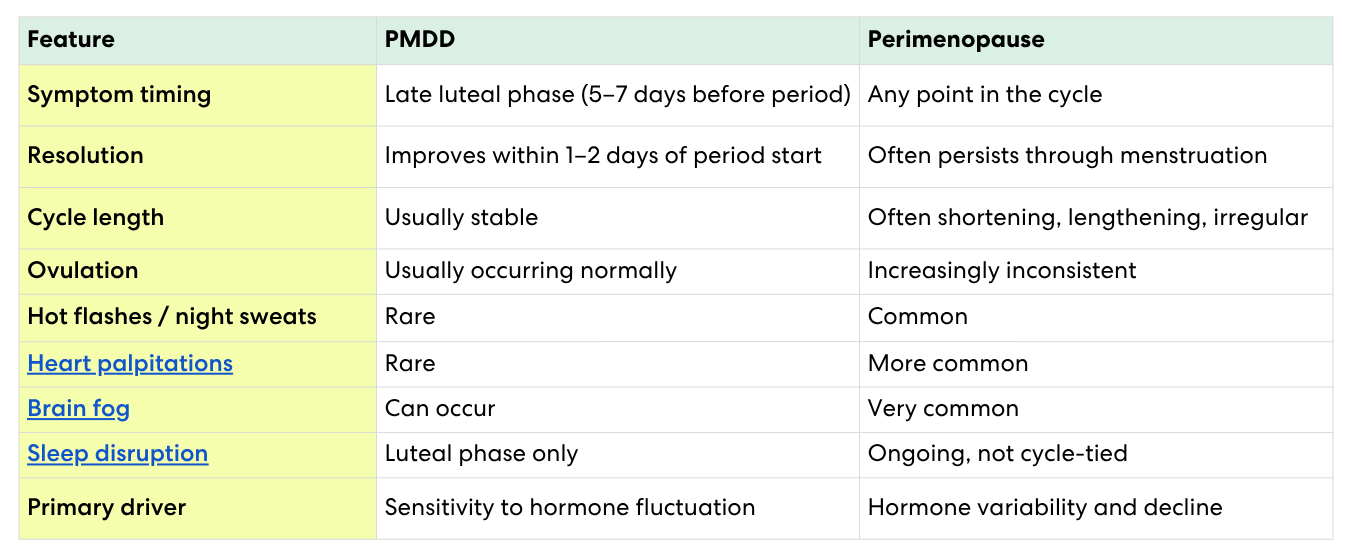
In PMDD: Symptoms cluster reliably in the 5–7 days before menstruation. They resolve within 1–2 days of the period starting. The follicular phase, the first half of the cycle, is typically symptom-free. The cycle itself remains regular.

In perimenopause: Symptoms can occur at any phase of the cycle, including mid-cycle or even in what used to be the "good week." They may not resolve when menstruation begins. The cycle itself begins to change, shorter, longer, heavier, lighter, or skipped entirely. Spotting between periods may appear. Heart palpitations, hot flashes, and night sweats, which are not features of PMDD, may emerge.

One of the most recognizable signs of this shift: many women with PMDD describe having one bad week per cycle, predictable, contained, survivable. Women transitioning into perimenopause often describe something quite different: the disappearance of the good week entirely. Not one bad week. No reliable good week. Just a baseline that used to exist and now doesn't.

That loss of the predictable symptom-free window is one of the clearest clinical signals that perimenopause has entered the picture, regardless of whether PMDD was present before.

Can PMDD Start in Your 40s?

This is one of the most common questions in perimenopause communities, and one of the most important to answer carefully.

True new-onset PMDD beginning for the first time in your 40s is less common than it appears. What's far more likely in most cases is one of three things:

First, mild PMDD that was present for years but manageable is now being amplified by perimenopause's increasing hormone variability. The underlying sensitivity was always there. The worsening hormonal backdrop is making it more visible and more severe.

Second, what feels like new PMDD is actually perimenopause-driven hormone volatility being misread as a luteal-phase condition. Estrogen that spikes and crashes in the follicular phase, for example, can cause symptoms that feel like they're following a cycle even when they're not tied to the luteal phase at all.

Third, a small subset of women do experience genuine late-onset PMDD, typically associated with a significant hormonal trigger like stopping hormonal contraception, postpartum hormone shifts, or the hormonal volatility of early perimenopause itself.

In all three cases, the distinguishing factor is the same: symptom timing relative to cycle phase, tracked across multiple cycles, with hormone data to confirm what the pattern actually is. A woman who thinks she's developing PMDD at 43 may be, but she's more likely entering perimenopause, and the treatment path is different enough that the distinction matters enormously.

Here's what makes this clinically difficult, and what no one tends to explain clearly: PMDD and perimenopause are not mutually exclusive. In fact, women who had PMDD earlier in their reproductive years often experience a significant worsening of their symptoms as they enter perimenopause, because the hormonal variability of the transition amplifies the neurological sensitivity that drove their PMDD in the first place.

This is sometimes called "perimenopausal PMDD" or "PMDD overlap," and it presents as PMDD symptoms that are becoming more severe, less predictable, or longer-lasting than before, as if the condition is expanding beyond its original tight luteal-phase window.

For these women, the trajectory of change is the diagnostic signal. If PMDD symptoms that were manageable for years are suddenly worse, starting earlier in the cycle, lasting longer, or no longer fully resolving with menstruation, that evolution is likely being driven by the hormonal shifts of perimenopause layered on top of pre-existing PMDD sensitivity.

Why Standard Testing Often Fails Both

A single FSH or estradiol blood test is commonly used to evaluate whether a woman is in perimenopause. But as we discuss in our guide to hormone testing, a one-time snapshot has significant limitations in the early transition. Perimenopause is characterized by erratic fluctuation, not consistent elevation or decline. An FSH drawn on the wrong day of a variable cycle can look entirely normal even when the transition is well underway.

The same problem applies to PMDD evaluation. Standard workups don't measure progesterone or allopregnanolone dynamics across the luteal phase, they look for abnormal hormone levels. But PMDD isn't caused by abnormal levels. It's caused by a normal pattern experienced abnormally. A blood panel that comes back "normal" is not a refutation of PMDD. It's a reflection of what single-point testing can and cannot see.

This is why so many women spend years without a clear answer: not because the answer doesn't exist in their hormone data, but because the measurement was never taken at the right resolution or across enough time.

Two Women, Identical Symptoms, Different Diagnoses

Consider two women, both 42, both experiencing severe mood crashes, anxiety, and sleep disruption.

The first tracks her symptoms and notices they arrive like clockwork on day 22 of her 28-day cycle and completely resolve on day 2 of her period. Her cycles are regular, 27–29 days. She has no symptoms mid-cycle. She describes herself as "a different person for 6 days and then completely fine." That pattern, luteal onset, full resolution, cycle regularity, is PMDD.

The second notices that her mood crashes used to be predictable but now seem to happen at different times each month. Last month it was mid-cycle. This month it started on day 18 and still hadn't resolved when her period arrived. Her cycles have shortened from 28 days to 24 days. She's also started waking at 3am and had two episodes of heart palpitations. That pattern, unpredictable onset, incomplete resolution, cycle changes, new physical symptoms, is perimenopause.

Both women are suffering. Both deserve answers. The path to those answers runs through the pattern in their hormone data, not through a single checklist appointment.

Why Symptom Tracking Alone Often Isn't Enough

Symptom journaling is a useful starting point, but it has a ceiling. Two women can have nearly identical symptom logs and completely different hormone patterns driving them.

One may have classic PMDD: symptoms tightly linked to progesterone withdrawal in the luteal phase, a clean hormone curve that follows the cycle precisely, a follicular phase that's entirely symptom-free.

Another may have estrogen volatility characteristic of early perimenopause: symptoms appearing mid-cycle when estrogen spikes and crashes, progesterone rising inconsistently, mood disruption that doesn't map onto any predictable cycle phase at all.

Both women might write in their journals: "terrible anxiety, couldn't sleep, felt like a different person." The symptom description is identical. The hormone pattern tells a completely different story, and points toward a completely different intervention.

This is the gap between tracking how you feel and understanding why. Symptom logs capture the experience. Hormone data captures the mechanism. For a condition where the mechanism determines the treatment, one without the other leaves the most important question unanswered.

What the Hormone Pattern Actually Shows

The clearest way to distinguish PMDD from perimenopause, and to identify the overlap, is to track estrogen, progesterone, and LH across multiple complete cycles.

In PMDD without perimenopause, you'll typically see a recognizable hormonal pattern: estrogen and LH rise and fall on schedule, progesterone rises post-ovulation, and symptoms correlate tightly with the late progesterone decline. The pattern is consistent cycle to cycle.

In perimenopause, the pattern is disrupted. Estrogen may spike unpredictably. Progesterone production becomes less robust, sometimes failing to rise meaningfully after a cycle in which ovulation was incomplete or absent. LH levels may begin to trend higher. Cycle length begins to vary. When you can see these hormone patterns across multiple cycles rather than estimating from a single blood draw, the clinical picture becomes far more legible.

In overlap cases, you'll often see a recognizable PMDD-pattern progesterone sensitivity amplified by increasing estrogen volatility, the late luteal drop is happening against a backdrop of hormones that are no longer stable the rest of the month.

Understanding what progesterone is actually doing across your cycle, not just what a single number says, is what transforms this from a diagnostic guess into a clinical answer.

What to Bring to Your Provider

Whether you suspect PMDD, perimenopause, or both, the most valuable thing you can bring to a clinical conversation is documented pattern data, not a description of symptoms from memory.

Specifically, it helps to have:

A symptom log with dates, mapped against your cycle phase, covering at least two to three cycles. Note when symptoms start, when they peak, whether they resolve with menstruation, and whether there's a symptom-free window in the first half of your cycle.

Hormone tracking data showing estrogen, progesterone, and LH across a full cycle or more, ideally including both the follicular and luteal phases. A pattern that shows progesterone dynamics across the luteal phase is far more informative than a single mid-cycle blood draw.

A record of cycle changes: length, flow, any new symptoms like spotting, palpitations, or night sweats that suggest perimenopause rather than PMDD alone.

This data changes the conversation. Instead of describing how you feel and waiting to be believed, you're bringing a pattern that speaks for itself.

What to Expect From Treatment

Treatment differs meaningfully depending on which condition is driving symptoms, which is another reason getting the diagnosis right matters.

For PMDD, first-line treatments typically include SSRIs (used continuously or luteal-phase only), hormonal interventions like continuous low-dose oral contraceptives or progesterone supplementation, and lifestyle approaches targeting the luteal phase specifically.

For perimenopause, the evidence increasingly supports hormone therapy, particularly estradiol, as the most effective intervention for mood, sleep, and cognitive symptoms. If PMDD sensitivity is also present, progesterone type and timing within HRT matters significantly: oral micronized progesterone appears to have more favorable neurological effects than synthetic progestins for women with PMDD-like sensitivity.

For overlap cases, treatment is more nuanced, and more dependent on understanding the individual hormone pattern than on applying a standard protocol. The women most likely to get good outcomes from treatment are the ones whose providers can see not just what hormones to prescribe, but what the pattern shows about how those hormones are being received.

Oova tracks estrogen (E3G), progesterone (PdG), and LH daily, giving you the full hormone pattern across your cycle, not just a snapshot. Whether you're trying to understand PMDD, perimenopause, or the overlap, the pattern is where the answer lives. 99% correlated to blood testing. HSA/FSA eligible.

Stop guessing which one it is. See your hormone pattern across a full cycle. →

About the author

Amy Divaraniya
Dr. Aparna (Amy) Divaraniya is the Founder and CEO of Oova. She has over 10 years experience working in data science and a PhD in Biomedical Sciences. In 2017, Amy pivoted to women's healthcare after facing her own fertility struggles. Amy started Oova to give women control over their fertility by making high-quality hormone testing more accessible.

Sources

  • Hantsoo L, Epperson CN. "Premenstrual Dysphoric Disorder: Epidemiology and Treatment." Current Psychiatry Reports. 2015;17(11):87.
  • Bäckström T, et al. "The role of hormones and hormonal treatments in premenstrual syndrome." CNS Drugs. 2003;17(5):325–342.
  • Freeman EW, et al. "Core symptoms that discriminate premenstrual syndrome." Journal of Women's Health & Gender-Based Medicine. 2000;9(5):553–558.
  • Bromberger JT, et al. "Major depression during and after the menopausal transition: SWAN Mental Health Study." Psychological Medicine. 2011;41(9):1879–1888.
  • Soares CN. "Depression and Menopause: Current Knowledge and Clinical Recommendations for a Critical Window." Psychiatric Clinics of North America. 2017;40(2):239–254.
  • Rapkin AJ, Lewis EI. "Treatment of premenstrual dysphoric disorder." Women's Health. 2013;9(6):537–556.
  • Prior JC. "Progesterone for Symptomatic Perimenopause Treatment." Facts Views Vis Obgyn. 2011;3(2):109–120.
https://www.oova.life/blog/histamine-intolerance-perimenopause
Should I see a doctor about histamine intolerance?
Yes, particularly before self-diagnosing or undertaking significant dietary restriction. A provider can rule out other conditions with overlapping symptoms (thyroid dysfunction, mast cell disorders, gut dysbiosis) and can assess whether hormonal factors, including perimenopause-related estrogen fluctuations, may be influencing your histamine sensitivity.
https://www.oova.life/blog/histamine-intolerance-perimenopause
Does a low-histamine diet help with perimenopause symptoms?
For women in whom histamine is a meaningful contributor, a low-histamine trial (2–4 weeks) may reduce some symptoms. However, if the underlying driver is hormonal instability rather than food histamine alone, dietary changes may only partially help. Addressing the hormonal environment, including understanding your estrogen patterns, may provide additional relief and context.
https://www.oova.life/blog/histamine-intolerance-perimenopause
How do I know if my symptoms are histamine intolerance or perimenopause?
Many symptoms overlap, including headaches, heart palpitations, anxiety, sleep disruption, and flushing. Symptoms that appear consistently 30–60 minutes after consuming high-histamine foods or drinks suggest histamine as a contributor. Symptoms that are cyclical, correlate with your menstrual cycle, or occur regardless of what you ate are more likely primarily hormonal, though both can be present simultaneously.
https://www.oova.life/blog/histamine-intolerance-perimenopause
Why does wine suddenly cause headaches in perimenopause?
Several factors converge. Alcohol itself impairs DAO activity. Red wine is high in histamine and contains compounds that further block DAO. And if estrogen fluctuations have already reduced DAO capacity, the combination may push histamine load beyond the body's clearing capacity, resulting in flushing, headache, congestion, and heart palpitations.
https://www.oova.life/blog/histamine-intolerance-perimenopause
Does perimenopause cause histamine intolerance?
Not exactly, but perimenopause may lower the threshold at which histamine causes symptoms. Emerging research suggests estrogen fluctuations can influence histamine activity and may reduce DAO enzyme activity. During perimenopause, when estrogen is unstable rather than simply low, this relationship may explain why histamine-related symptoms emerge or worsen.
https://www.oova.life/blog/histamine-intolerance-perimenopause
What is histamine intolerance?
Histamine intolerance refers to a condition where histamine accumulates faster than the body can break it down, typically due to reduced activity of the DAO enzyme in the digestive tract. Symptoms can include flushing, headaches, heart palpitations, nasal congestion, skin reactions, anxiety-like sensations, and sleep disruption.
https://www.oova.life/blog/why-some-cycles-are-more-fertile-than-others
Do OPKs tell me everything I need to know about my fertility?
OPKs detect the LH surge that precedes ovulation, which is useful for timing intercourse. They don't measure estrogen patterns before ovulation, progesterone after ovulation, luteal phase length, or how these variables compare across cycles, all of which contribute to a cycle's fertility potential.
https://www.oova.life/blog/why-some-cycles-are-more-fertile-than-others
Why does my cycle timing change from month to month?
Cycle-to-cycle variability in ovulation timing is normal and influenced by stress, sleep, illness, travel, and changes in body weight. Most women do not ovulate on the same day each cycle, which is one reason tracking hormone patterns across multiple cycles reveals more than evaluating a single cycle in isolation.
https://www.oova.life/blog/why-some-cycles-are-more-fertile-than-others
What is a luteal phase defect?
A luteal phase defect refers to a luteal phase that is either too short (typically under 10 days) or one where progesterone production is insufficient to support implantation. It is considered an underdiagnosed contributor to difficulty conceiving and early pregnancy loss.
https://www.oova.life/blog/why-some-cycles-are-more-fertile-than-others
Why does progesterone matter for fertility?
After ovulation, progesterone prepares the uterine lining for implantation and supports early pregnancy. Cycles with inadequate progesterone production, even if ovulation occurred, may have reduced chances of successful implantation. This is why progesterone after ovulation, not just LH at the time of the surge, is an important fertility variable.
https://www.oova.life/blog/why-some-cycles-are-more-fertile-than-others
What is ovulation quality and why does it matter?
Ovulation quality refers to how effectively the entire ovulation process occurred, including follicle development, estrogen rise, LH surge magnitude, corpus luteum formation, and subsequent progesterone production. Higher ovulation quality generally supports a more fertile cycle and a stronger luteal phase.
https://www.oova.life/blog/why-some-cycles-are-more-fertile-than-others
Can you have a cycle that looks normal but isn't very fertile?
Yes. A cycle can include ovulation and still have lower fertility potential if ovulation quality is poor, progesterone after ovulation is insufficient, the estrogen rise before ovulation was weak, or the luteal phase is too short to support implantation. Standard OPKs don't measure any of these variables.
https://www.oova.life/blog/glp1-muscle-loss-women
How do I know if I'm losing muscle instead of fat on a GLP-1?
The scale alone won't tell you. Watch for declining strength, increased fatigue, feeling softer despite weight loss, reduced exercise tolerance, and slower recovery. Regular strength tracking or DEXA scans give you a much clearer picture of body composition than weight alone.
https://www.oova.life/blog/glp1-muscle-loss-women
What's the best way to protect lean mass on a GLP-1?
Resistance training 2–3x per week, 25–30g protein per meal, restorative sleep, stress management, and understanding your hormonal environment, including discussing HRT with your provider if you're perimenopausal.
https://www.oova.life/blog/glp1-muscle-loss-women
Can HRT help protect body composition while on a GLP-1?
Early research and clinical observation suggest estrogen therapy may help preserve lean mass during weight loss. Large trials specifically studying the HRT and GLP-1 combination are ongoing, but the biological rationale for a synergistic benefit is strong.
https://www.oova.life/blog/glp1-muscle-loss-women
Is perimenopause a risk factor for muscle loss on Ozempic or Wegovy?
Potentially yes. Declining estrogen during perimenopause accelerates muscle loss and reduces the body's ability to preserve lean mass during caloric restriction. GLP-1-induced caloric restriction on top of this hormonal environment may increase the proportion of weight lost from muscle rather than fat.
https://www.oova.life/blog/glp1-muscle-loss-women
Why do GLP-1s affect women's body composition differently?
Hormones, particularly estrogen and progesterone, directly influence muscle protein synthesis, fat distribution, insulin sensitivity, and how your body responds to caloric restriction. A woman in perimenopause with declining estrogen is in a different metabolic environment than a premenopausal woman, even at the same dose.
https://www.oova.life/blog/glp1-muscle-loss-women
Do GLP-1 medications cause muscle loss?
They can. Clinical data shows up to 39% of total weight lost on semaglutide may come from lean mass rather than fat. Whether you primarily lose fat or muscle depends on your hormonal environment, protein intake, resistance training, and sleep quality.
https://www.oova.life/blog/spotting-before-period
When should I be worried about spotting before my period?
Most spotting is harmless, but contact your doctor if you experience heavy spotting similar to full bleeding, spotting every cycle or almost every cycle, spotting accompanied by pelvic pain, fatigue, or dizziness, or spotting alongside other signs of a hormonal imbalance. Spotting can occasionally signal an underlying condition like PCOS, thyroid disorders, fibroids, or infections, so persistent or unusual spotting is worth investigating.
https://www.oova.life/blog/spotting-before-period
Is spotting before your period normal in perimenopause?
Yes, spotting is one of the most common early signs of perimenopause. As estrogen and progesterone start fluctuating unpredictably, your uterine lining can shed irregularly, causing spotting between periods. You may also experience spotting after sex due to vaginal atrophy, another hormone-driven perimenopause symptom. If spotting is heavy, frequent, or accompanied by other concerning symptoms, talk to your doctor.
https://www.oova.life/blog/spotting-before-period
How can I tell the difference between spotting and a period?
Spotting is light enough that a panty liner is usually all you need, it tends to be pink or brown rather than red, doesn't fill a pad or tampon, and often only lasts a day or two. A period is heavier, redder, lasts several days, and typically comes with cramping. If you're seeing bright red bleeding that soaks through a liner, that's more likely a period starting early than spotting.
https://www.oova.life/blog/spotting-before-period
Is spotting before your period a sign of pregnancy?
It can be. Light spotting 10 to 14 days after ovulation is sometimes implantation bleeding, which happens when a fertilized egg attaches to the uterine lining. About 15% to 25% of people experience it. Implantation bleeding is usually pink or brown, lighter than a period, and only lasts a day or two. If your period doesn't arrive a few days later, consider taking a pregnancy test.
https://www.oova.life/blog/blog-anovulatory-vs-ovulatory-pcos-ttc
Does a positive OPK mean I ovulated?
Not necessarily, especially with PCOS. A positive OPK confirms an LH surge. It does not confirm that the follicle released an egg. Chronically elevated LH (common in PCOS) can cause persistent positive readings, and LH can surge in cycles that turn out to be anovulatory. Progesterone confirmation is the only way to know.
https://www.oova.life/blog/blog-anovulatory-vs-ovulatory-pcos-ttc
Can PCOS cause both anovulatory and ovulatory cycles?
Yes. Many people with PCOS have a mix, some cycles where ovulation occurs (possibly late) and some where it doesn't. This is why tracking across multiple cycles matters. A single progesterone blood draw in one cycle doesn't tell you the full picture.
https://www.oova.life/blog/blog-anovulatory-vs-ovulatory-pcos-ttc
What does an anovulatory cycle feel like?
Many anovulatory cycles feel identical to regular cycles, you may have cramping, PMS symptoms, and bleeding. The bleed in an anovulatory cycle is a withdrawal bleed caused by estrogen fluctuation, not a true period. Symptom-based tracking alone cannot reliably distinguish anovulatory from ovulatory cycles.
https://www.oova.life/blog/blog-anovulatory-vs-ovulatory-pcos-ttc
How do I know if I'm ovulating with PCOS?
The only reliable way to confirm ovulation in PCOS is to track progesterone after your LH surge. If progesterone rises and remains elevated for several days, ovulation occurred. If it stays low, it likely didn't, regardless of what your OPK showed. Daily hormone tracking with an at-home kit that measures both LH and progesterone gives you this information without a blood draw.
https://www.oova.life/blog/blog-anovulatory-vs-ovulatory-pcos-ttc
Can you get pregnant with anovulatory PCOS?
Not in anovulatory cycles, because no egg is released. However, many people with anovulatory PCOS respond well to ovulation induction (letrozole, clomiphene) and go on to conceive. Confirming anovulation is occurring, rather than delayed ovulation, is the critical first step.
https://www.oova.life/blog/blog-hrt-weight-gain
Why do I feel bloated when I start HRT?
Temporary fluid retention in the first weeks of HRT is common, particularly with oral estrogen. It typically resolves within 4–8 weeks as levels stabilize. If it persists, switching to transdermal delivery (patches, gels) often helps because it bypasses liver metabolism and produces more stable estrogen levels with less fluid-related side effects.
https://www.oova.life/blog/blog-hrt-weight-gain
Does progesterone cause weight gain on HRT?
Some synthetic progestins, particularly medroxyprogesterone acetate (MPA) used in older combined HRT formulations, may partially blunt estrogen's favorable metabolic effects and cause fluid retention in some women. Micronized bioidentical progesterone (Prometrium) has a more neutral metabolic profile and is generally better tolerated. If you're gaining weight on combined HRT, the progestin type is worth discussing with your provider.
https://www.oova.life/blog/blog-hrt-weight-gain
Can HRT help with weight loss?
HRT is not a weight loss treatment. It addresses the hormonal redistribution of fat that occurs with estrogen decline, and may make it easier to lose weight by restoring metabolic function, but it works in combination with resistance training, protein intake, sleep, and stress management, not as a replacement for them.
https://www.oova.life/blog/blog-hrt-weight-gain
Does HRT cause belly fat?
The opposite is more accurate. Estrogen decline during perimenopause is the primary driver of visceral fat accumulation. HRT partially reverses this shift by restoring estrogen's regulatory effect on fat distribution. Women on HRT consistently show less central adiposity than untreated women at equivalent stages of the menopausal transition.
https://www.oova.life/blog/blog-hrt-weight-gain
Why am I gaining weight on HRT?
Weight gain while on HRT is almost always due to factors other than the HRT itself: the underlying perimenopausal metabolic shift, continued muscle loss, cortisol elevation from poor sleep or stress, or suboptimal hormone dosing. If you're gaining weight despite HRT, it's worth checking whether your estrogen levels are in the therapeutic range and evaluating cortisol and lifestyle factors.
https://www.oova.life/blog/blog-hrt-weight-gain
Does HRT cause weight gain?
No. Multiple large randomized controlled trials and systematic reviews show that HRT does not cause clinically meaningful weight gain compared to placebo. In many studies, HRT, particularly transdermal estradiol, is associated with reduced visceral fat compared to no treatment. The fear of HRT-related weight gain largely stems from outdated data and misattributed cause-and-effect.
https://www.oova.life/blog/blog-do-supplements-balance-hormones
Should I take supplements before trying HRT?
This depends entirely on your hormone levels and your symptoms. Supplements are most appropriate when deficiencies or mild imbalances are present and clinical hormone replacement isn't yet indicated. For women in perimenopause with significant estrogen decline, supplements rarely address the root cause. Tracking your hormones first tells you which intervention is actually appropriate for your pattern.
https://www.oova.life/blog/blog-do-supplements-balance-hormones
How do I know if my progesterone is low?
Symptoms of low progesterone include a short luteal phase, spotting before your period, mood changes in the second half of your cycle, difficulty sleeping, and anxiety. However, these symptoms overlap significantly with other hormone imbalances. The only reliable way to confirm low progesterone is to measure PdG (urinary progesterone metabolite) in the luteal phase, specifically in the days following your LH surge.
https://www.oova.life/blog/blog-do-supplements-balance-hormones
What supplements actually affect estrogen?
DIM (diindolylmethane) and indole-3-carbinol (found in cruciferous vegetables) influence estrogen metabolism by shifting the balance of estrogen metabolites. Flaxseed and other phytoestrogens have weak estrogen-like effects. Magnesium and B vitamins support liver clearance of estrogen. None of these are substitutes for clinical estrogen therapy when levels are genuinely low.
https://www.oova.life/blog/blog-do-supplements-balance-hormones
How long does it take for hormone supplements to work?
Most research shows that supplements with hormonal effects need 8–12 weeks of consistent use to show measurable changes. Vitex is often evaluated at 3–6 months. Myo-inositol studies typically run 12–24 weeks. If you're evaluating a supplement on a 2–3 week timeframe, you're almost certainly not seeing the full picture.
https://www.oova.life/blog/blog-do-supplements-balance-hormones
Can supplements really balance hormones?
Some supplements have meaningful evidence for specific hormonal effects, myo-inositol for PCOS, magnesium for cortisol and progesterone support, Vitamin D for foundational hormonal function. Others have weaker or more indirect evidence. Whether a supplement is actually changing your hormones can only be confirmed by tracking your hormone levels before and after supplementation.
www.oova.life/blog/why-perimenopause-symptoms-come-and-go
Can tracking hormones help explain my perimenopause symptoms?
Yes, significantly. Symptom tracking alone tells you when you feel bad. Hormone tracking tells you why. Daily measurements of estrogen, progesterone, and LH alongside symptom logs reveal the correlation between hormone activity and how you feel. Over 4–8 weeks, most women identify clear patterns: which symptoms correspond to estrogen troughs, which correspond to low progesterone, and which are more influenced by sleep or stress. That pattern is actionable in a way that symptom memory alone never is.
www.oova.life/blog/why-perimenopause-symptoms-come-and-go
What makes perimenopause symptoms worse on some days?
Several compounding factors make symptoms worse on specific days: a sharp estrogen drop (which triggers hot flashes, low mood, and brain fog), inadequate progesterone (which worsens sleep and anxiety), poor sleep the night before (which elevates cortisol and amplifies everything), and lifestyle factors like alcohol, stress, or intense exercise. These factors often stack, which is why some days feel dramatically worse than others despite no obvious external trigger.
www.oova.life/blog/why-perimenopause-symptoms-come-and-go
Why are my perimenopause symptoms so unpredictable?
Unpredictability is a hallmark of the perimenopause transition precisely because the hormonal pattern isn't a smooth decline, it's volatile. Estrogen can be higher than your pre-perimenopause baseline one day and significantly lower the next. Progesterone, which normally buffers estrogen's effects, declines as ovulation becomes irregular. The combination produces an environment where small hormonal shifts can have disproportionately large symptom effects.
www.oova.life/blog/why-perimenopause-symptoms-come-and-go
Why do perimenopause symptoms come and go?
Perimenopause symptoms fluctuate because the underlying hormones, primarily estrogen, fluctuate. Unlike the gradual decline most people expect, estrogen during perimenopause surges and drops erratically, sometimes dramatically, within the same week. Each swing affects body temperature regulation, mood, sleep, and cognitive function simultaneously. The result is a cycle of "good days" and "bad days" that feels random but is driven by measurable hormonal activity.
www.oova.life/blog/standard-hormone-test-limitations
Can I use at-home hormone tests instead of blood tests?
At-home urine-based hormone testing measures the same hormones as blood tests (estradiol via E3G, LH, and progesterone via PdG) but does so daily rather than once. This makes it better suited for pattern detection, understanding your cycle, confirming ovulation, and connecting hormone levels to how you feel. For specific clinical decisions (IVF stimulation monitoring, ruling out pathology), blood testing ordered by a provider remains important.
www.oova.life/blog/standard-hormone-test-limitations
What does continuous hormone monitoring show that a blood test doesn't?
Daily hormone monitoring shows the pattern of hormone movement across your full cycle, how estrogen rises and falls, when and whether LH surges, how robustly progesterone rises after ovulation, and how long it stays elevated. This is the data that correlates with symptoms, confirms ovulation, and reveals cycle irregularities that a single blood draw misses entirely.
www.oova.life/blog/standard-hormone-test-limitations
What's the difference between AMH and FSH for fertility testing?
AMH measures ovarian reserve, egg quantity. FSH measures pituitary signaling, how hard your body is working to trigger ovulation. AMH is more stable across the cycle and gives a better long-term picture of reserve. FSH gives a snapshot of current ovarian responsiveness. Neither tells you whether you're ovulating, whether your cycle is hormonally healthy, or whether your luteal phase is adequate. See our full comparison at FSH vs. AMH vs. Estradiol.
www.oova.life/blog/standard-hormone-test-limitations
What does a day 3 FSH test actually tell you?
A day 3 FSH measures how hard your pituitary is working to stimulate your ovaries at the start of a cycle. Elevated FSH can suggest declining ovarian function. But FSH varies significantly cycle to cycle, especially in perimenopause, so a single normal result doesn't rule out hormonal changes, and a single elevated result doesn't confirm perimenopause. Pattern over time is what's diagnostically meaningful.
www.oova.life/blog/standard-hormone-test-limitations
Why do hormone blood tests come back normal when something feels wrong?
Standard hormone tests are single-point measurements taken at one moment in time. Female hormones fluctuate significantly across the cycle and from cycle to cycle, particularly estrogen, which can swing dramatically within a week. A blood draw taken on a "normal" day produces a normal result even if hormone levels crashed days before or will again shortly after. The test isn't inaccurate; it's structurally limited by its snapshot design.
https://www.oova.life/blog/opk-limitations
Why do I keep getting positive OPKs with PCOS?
PCOS is associated with chronically elevated LH levels and can cause multiple LH surges in a single cycle. This means OPK results in women with PCOS are frequently misleading, the test line may appear positive across much of your cycle without a true ovulatory surge occurring. See our full guide to confirming ovulation with PCOS for a more reliable approach.
https://www.oova.life/blog/opk-limitations
Is a positive OPK enough if I'm trying to conceive?
A positive OPK is a useful starting point for timing intercourse, but it's not sufficient to confirm that a viable cycle occurred. Adding progesterone tracking in the luteal phase tells you whether ovulation happened and whether your luteal phase is hormonally supportive of implantation.
https://www.oova.life/blog/opk-limitations
How long after a positive OPK does ovulation actually occur?
Ovulation typically occurs 24–36 hours after the LH surge begins, though the exact timing varies. The egg itself is only viable for 12–24 hours after release, which is why accurate surge detection matters so much for conception timing.
https://www.oova.life/blog/opk-limitations
What does progesterone look like after a positive OPK if ovulation happened?
If ovulation occurred, progesterone should begin rising within 24–48 hours of the LH peak and reach its highest levels approximately 5–10 days later (mid-luteal phase). A mid-luteal progesterone above 3 ng/mL is generally considered consistent with ovulation; above 10 ng/mL suggests a more robust response.
https://www.oova.life/blog/opk-limitations
Can I get a positive OPK and not ovulate?
Yes. A positive OPK confirms an LH surge, not ovulation itself. In anovulatory cycles, which are more common in women with PCOS, irregular cycles, or under high stress, LH can surge without an egg being released. The only hormone that confirms ovulation occurred is progesterone.
https://www.oova.life/blog/folliacular-phase
Can stress affect the follicular phase?
While stress alone does not cause infertility, psychological stress is one of several lifestyle factors that can impact fertility and overall reproductive health. Managing stress through relaxation techniques and moderate exercise may support a healthy follicular phase and improve your chances of conception.
https://www.oova.life/blog/folliacular-phase
What foods should I eat during the follicular phase to support fertility?
During the follicular phase, focus on iron-rich foods to compensate for blood loss during your period, including red meat, seafood, legumes, and green leafy vegetables. Lean proteins and complex carbohydrates like chicken, fish, brown rice, and quinoa can help support rising energy levels, while cruciferous vegetables such as broccoli and cauliflower can help balance increasing estrogen levels.
https://www.oova.life/blog/folliacular-phase
Does exercise during the follicular phase impact fertility?
Moderate physical activity can be beneficial for fertility, especially when coupled with healthy weight management. However, excessive exercise can negatively affect your reproductive system by creating an energy imbalance that may disrupt hormone production and lead to menstrual abnormalities. During the follicular phase, as your energy levels increase with rising estrogen, you may find yourself able to handle more intense workouts like cardio and strength training.
https://www.oova.life/blog/folliacular-phase
Can lifestyle factors affect my follicular phase length?
Yes, several lifestyle factors can influence follicular phase length. Research shows that women with a history of miscarriage tend to have shorter follicular phases, while lifestyle factors such as recent oral contraceptive use can lead to longer follicular phases. Maintaining a balanced diet rich in vegetables, antioxidants, and healthy fats, along with moderate exercise, can support healthy follicular development and overall reproductive health.
https://www.oova.life/blog/folliacular-phase
What is the difference between follicular phase and luteal phase?
The follicular phase starts on day 1 of your period and ends at ovulation, focusing on egg maturation and preparing for pregnancy. The luteal phase starts after ovulation and ends when your next period begins, focusing on supporting a potential pregnancy through progesterone production.
https://www.oova.life/blog/folliacular-phase
What happens if your follicular phase is too short?
A follicular phase shorter than 10 days may mean the egg didn't have enough time to fully mature, potentially making it harder to conceive. Short follicular phases can also be an early sign of perimenopause as egg quality and ovarian reserve decline.
https://www.oova.life/blog/folliacular-phase
Can you get pregnant during the follicular phase?
Yes, especially during the late follicular phase. Your fertile window includes the 5 days before ovulation and the day of ovulation itself—all of which fall within the follicular phase. This is the best time to have sex if you're trying to conceive.
https://www.oova.life/blog/folliacular-phase
What are the signs you're in the follicular phase?
Signs of the follicular phase include your period (early phase), increased energy levels, clearer skin, and rising basal body temperature. As you approach ovulation in the late follicular phase, you may notice clearer, stretchy cervical mucus and increased sex drive.
https://www.oova.life/blog/folliacular-phase
How long does the follicular phase last?
The follicular phase typically lasts 10-16 days, though this varies from person to person and cycle to cycle. The length depends on how long it takes for a follicle to mature into a ready-to-release egg. A 28-day cycle usually has a 14-day follicular phase.
https://www.oova.life/blog/folliacular-phase
What is the follicular phase of the menstrual cycle?
The follicular phase is the first half of your menstrual cycle, starting on day 1 of your period and ending when you ovulate. During this phase, follicle-stimulating hormone (FSH) triggers your ovaries to produce follicles, one egg matures, and your uterine lining thickens in preparation for pregnancy.
https://www.oova.life/blog/best-supplements-for-hormone-balance-during-perimenopause
Can I take multiple hormone balancing supplements together?
Many people safely combine supplements like vitamin D and magnesium, but it's essential to discuss any combination with your doctor. Some supplements may interact with each other or with medications, and your doctor can help you create a safe, effective regimen.
https://www.oova.life/blog/best-supplements-for-hormone-balance-during-perimenopause
Are there supplements I should avoid during perimenopause?
Some supplements can interact with medications or may not be safe for everyone. Always consult your healthcare provider before starting supplements, especially if you have existing health conditions, take medications, or have a history of hormone-sensitive conditions.
https://www.oova.life/blog/best-supplements-for-hormone-balance-during-perimenopause
How long does it take for supplements to balance hormones?
Most people notice changes within 4-12 weeks of consistent use, though individual results vary. Track your symptoms and hormone levels to monitor progress.
https://www.oova.life/blog/best-supplements-for-hormone-balance-during-perimenopause
Can supplements really balance hormones?
Research suggests certain supplements can support hormone regulation, though they work best as part of a comprehensive approach including lifestyle changes and medical care when needed. Always consult your doctor before starting supplements.
https://www.oova.life/blog/best-supplements-for-hormone-balance-during-perimenopause
What is the best supplement to balance female hormones?
Vitamin D and magnesium are two of the most effective supplements for overall hormone balance, supporting estrogen, progesterone, and cortisol regulation. For estrogen-specific support, red clover and ashwagandha show promising results.
www.oova.life/blog/perimenopause-bloating
What foods should I avoid to reduce perimenopause bloating?
The most common bloating triggers are: dairy (if lactose intolerant), gluten, beans and legumes, cruciferous vegetables (broccoli, cauliflower), onions and garlic, carbonated drinks, artificial sweeteners, high-fat fried foods, and processed foods high in sodium. However, trigger foods vary by individual. Keep a food diary to identify your personal triggers, and consider trying a low FODMAP elimination diet under medical guidance.
www.oova.life/blog/perimenopause-bloating
Can perimenopause bloating cause weight gain on the scale?
Bloating itself is primarily gas and fluid retention, which can cause temporary weight fluctuations of 2-5 pounds. However, the hormonal changes causing bloating also contribute to actual weight gain through slowed metabolism, increased belly fat storage, and reduced muscle mass. So while bloating doesn't directly cause fat gain, the underlying hormonal changes drive both bloating AND weight gain simultaneously.
www.oova.life/blog/perimenopause-bloating
Does drinking more water help with perimenopause bloating?
Yes! While it seems counterintuitive, drinking adequate water (8-10 glasses daily) actually helps reduce bloating. When you're dehydrated, your body holds onto water, causing fluid retention and bloating. Proper hydration helps flush excess sodium, prevents constipation, and supports healthy digestion. Just avoid drinking large amounts during meals, which can dilute digestive enzymes, drink water between meals instead.
www.oova.life/blog/perimenopause-bloating
Why do I look pregnant during perimenopause?
The combination of bloating, fluid retention, weight redistribution to the belly area, and potential visceral fat accumulation can create a "pregnant" appearance during perimenopause. This is incredibly common and is sometimes called "meno-belly" or "menopause belly." The appearance is usually most pronounced in the evening after a day of eating and fluid accumulation, and typically improves overnight.
www.oova.life/blog/perimenopause-bloating
Can perimenopause cause upper abdominal bloating?
Yes, perimenopause can cause bloating in both the upper and lower abdomen. Upper abdominal bloating (feeling full in your stomach area) is often related to slowed gastric emptying, when your stomach takes longer to empty food into your intestines. This is caused by hormone-related changes in digestive motility. Lower abdominal bloating is more commonly related to intestinal gas, constipation, and fluid retention.
www.oova.life/blog/perimenopause-bloating
Why is my stomach bloated all the time during perimenopause?
Constant bloating during perimenopause is usually due to hormonal fluctuations causing persistent slowed digestion, fluid retention, and gut microbiome changes. However, if bloating is truly constant (doesn't improve at all, even overnight or first thing in the morning), you should see your doctor to rule out other conditions like IBS, SIBO, food intolerances, or ovarian issues. Most perimenopause bloating comes and goes rather than being constant.
https://www.oova.life/blog/high-progesterone-symptoms
What causes high progesterone when not pregnant?
‍High progesterone when not pregnant can be caused by hormonal birth control, ovarian cysts (especially corpus luteum cysts), congenital adrenal hyperplasia (CAH), or hormone replacement therapy. Testing is needed to determine the cause.
https://www.oova.life/blog/high-progesterone-symptoms
Can high progesterone prevent pregnancy?
‍No, high progesterone doesn't prevent pregnancy, in fact, it's essential for maintaining pregnancy. However, if progesterone is abnormally high due to certain medical conditions, it may indicate underlying issues that could affect fertility.
https://www.oova.life/blog/high-progesterone-symptoms
How do you test progesterone levels?
Progesterone can be measured through blood tests at your doctor's office or at-home urine tests that measure PdG (a progesterone metabolite). Testing is typically done during the lProgesterone can be measured through a blood test at your doctor's office, which gives you a single-point reading, or through daily at-home urine testing that measures PdG, a progesterone metabolite. Oova's at-home hormone kit tracks your PdG levels daily throughout your cycle, so instead of one snapshot, you can see how your progesterone rises after ovulation, how long it stays elevated, and whether your levels follow a healthy pattern, then share that data directly with your provider.
https://www.oova.life/blog/high-progesterone-symptoms
When should I be concerned about high progesterone?
Consult a healthcare provider if you experience high progesterone symptoms outside your luteal phase when not pregnant, or if symptoms include severe pelvic pain, abnormal vaginal bleeding, or rapid weight gain while on hormone therapy.
https://www.oova.life/blog/high-progesterone-symptoms
Can high progesterone make you tired?
Yes. Progesterone has a natural sedating effect because it interacts with GABA receptors in the brain, the same receptors targeted by anti-anxiety and sleep medications. This is why many women feel noticeably more fatigued during the luteal phase (the two weeks after ovulation) and during early pregnancy, when progesterone is at its highest. The fatigue is a normal response to elevated progesterone, not a sign that something is wrong. However, if the exhaustion is severe enough to interfere with daily life, it's worth checking whether your levels are unusually high, especially if you're on hormone therapy or progesterone supplementation.
https://www.oova.life/blog/high-progesterone-symptoms
Can high progesterone cause weight gain?
Yes, elevated progesterone can cause temporary weight gain through water retention and bloating. This is a normal part of the luteal phase and early pregnancy.
https://www.oova.life/blog/high-progesterone-symptoms
Is high progesterone a sign of pregnancy?
Yes, high progesterone is one of the earliest indicators of pregnancy. Progesterone levels rise significantly after conception to support the developing embryo and reach their peak during the third trimester.
https://www.oova.life/blog/high-progesterone-symptoms
What are the symptoms of high progesterone?
High progesterone symptoms include fatigue, bloating, breast tenderness, weight gain, anxiety, depression, headaches, and food cravings. During pregnancy, you may also experience increased nipple sensitivity and muscle aches.
https://www.oova.life/blog/positive-opk-period-still-came
How often does this happen in women without PCOS?
Anovulation affects 10–20% of all cycles, even in women with regular periods and no fertility diagnosis. It's more common in cycles that are very short (under 21 days) or very long (over 35 days), and in times of stress or illness.
https://www.oova.life/blog/positive-opk-period-still-came
Should I stop using OPKs?
Not necessarily. OPKs are still useful for timing intercourse, the LH surge is the start of your fertile window, and sex during this time increases conception odds. Just don't assume an OPK positive is the same as confirmed ovulation.
https://www.oova.life/blog/positive-opk-period-still-came
My doctor said my progesterone was low at 7 DPO. Does that mean I didn't ovulate?
Possibly. Progesterone below 3 ng/mL at 7 DPO usually indicates anovulation. But if your level is 3–8 ng/mL, you may have ovulated with a weak corpus luteum, not enough progesterone to sustain pregnancy. Both scenarios need further investigation.
https://www.oova.life/blog/positive-opk-period-still-came
Can I tell if I ovulated just by how I feel?
Not reliably. Some women notice ovulation pain (mittleschmerz), changes in cervical mucus, or changes in mood, but these aren't consistent or unique to ovulation. Only hormone data or BBT confirms it.
https://www.oova.life/blog/positive-opk-period-still-came
If I get a positive OPK, is there any chance I'm not actually ovulating?
Yes. Studies show that 20–40% of LH surges may not result in ovulation. The probability varies by cycle regularity, hormonal health, and underlying conditions like PCOS. A positive OPK is a green light to have sex, but it's not a guarantee.
https://www.oova.life/blog/why-hormones-look-normal-but-feel-terrible
Can daily hormone tracking tell me if my HRT is working?
Yes. Daily tracking measures whether your estradiol and progesterone are reaching therapeutic levels, and whether levels are stable or fluctuating in ways that might explain ongoing symptoms. This is particularly useful for identifying HRT dose issues early, rather than waiting months for a clinical follow-up.
https://www.oova.life/blog/why-hormones-look-normal-but-feel-terrible
Why do my hormones fluctuate so much during perimenopause?
During perimenopause, the communication between the brain and the ovaries becomes less predictable. The ovaries don't respond as consistently to FSH signals, causing estrogen to spike and drop erratically before its overall decline. This variability, not steady decline, is what drives the unpredictability of perimenopause symptoms.
https://www.oova.life/blog/why-hormones-look-normal-but-feel-terrible
What should I do if my hormone test is normal but I still have symptoms?
Request a longer-term evaluation rather than a single-point test. Ask your provider specifically about perimenopause staging per STRAW+10 criteria. Consider at-home daily hormone tracking to document your patterns over several cycles. Arriving with longitudinal data gives your provider something concrete to work with, and makes dismissal much harder.
https://www.oova.life/blog/why-hormones-look-normal-but-feel-terrible
What blood tests are most accurate for perimenopause?
FSH and estradiol are the most commonly ordered tests, but neither is definitive on its own. The STRAW+10 framework uses a combination of cycle changes, FSH levels, and time criteria to stage perimenopause. No single blood test reliably diagnoses perimenopause, which is why tracking hormones over time is clinically more informative. For a full comparison of tests, see FSH vs. AMH vs. estradiol for perimenopause.
https://www.oova.life/blog/why-hormones-look-normal-but-feel-terrible
Can perimenopause hormones come back normal on a blood test?
Yes, and this is extremely common. Because perimenopause is defined by hormonal fluctuation rather than consistently low levels (especially in early stages), a blood test drawn on a hormonally "stable" day will often fall within normal reference ranges. This does not mean your hormones are balanced or that perimenopause isn't occurring.
www.oova.life/blog/how-long-does-ovulation-last
Can you ovulate for more than 24 hours?
‍No. Once the egg is released, it remains viable for a maximum of 24 hours. If it isn't fertilized in that time, it disintegrates. However, your fertile window extends well beyond that single day because sperm can survive up to 5 days waiting for the egg.
www.oova.life/blog/how-long-does-ovulation-last
Can you feel ovulation happening?
‍Some women feel mild cramping or a twinge on one side of the lower abdomen around ovulation, sometimes called mittelschmerz. Other signs include changes in cervical mucus and a slight increase in sex drive. But many women don't feel anything at all, which is why hormone tracking is more reliable than symptoms alone.
www.oova.life/blog/how-long-does-ovulation-last
How long after ovulation can you get pregnant?
‍You can get pregnant from sex that happened up to 5 days before ovulation, since sperm survive that long in the reproductive tract. After ovulation, the egg is only viable for 12–24 hours. So realistically, your window closes about a day after you ovulate.
www.oova.life/blog/how-long-does-ovulation-last
How do I know when ovulation is over?
‍The most reliable sign that ovulation has passed is a sustained rise in progesterone, which typically begins 1–2 days after the egg is released. A rise in basal body temperature can also indicate ovulation has occurred, though this only confirms it after the fact. Tracking hormones like LH and progesterone daily gives you the clearest picture.
www.oova.life/blog/perimenopause-spotting
How do I know if it's perimenopause spotting or something else?
The key indicators of normal perimenopause spotting are: it's light (panty liner only), occurs occasionally between periods, is light pink, red, or brown in color, and you're in the typical age range for perimenopause (late 30s to early 50s). It's likely something else if the bleeding is heavy, occurs after sex every time, comes with severe pain, has a foul odor, or you've gone 12+ months without a period (meaning you're postmenopausal). When in doubt, track your symptoms and discuss them with your doctor.
www.oova.life/blog/perimenopause-spotting
Can perimenopause spotting be pink?
Yes, pink spotting during perimenopause is completely normal. Pink spotting occurs when a small amount of blood mixes with cervical fluid or discharge. This is especially common during ovulation spotting or when hormone levels cause light, irregular shedding of the uterine lining. Pink discharge or spotting is generally nothing to worry about as long as it's light, occasional, and not accompanied by pain, itching, or an unusual odor.
www.oova.life/blog/perimenopause-spotting
Can HRT cause spotting during perimenopause?
Yes, spotting is common when you first start HRT or when your dose changes. Your body needs time to adjust to the new hormone levels, and some irregular bleeding during the first 3 to 6 months is typical. If spotting continues beyond that, or gets heavier, your dose may need adjusting, which is where tracking your hormone levels can help you and your doctor determine whether your current regimen is working or needs to be fine-tuned.
www.oova.life/blog/perimenopause-spotting
Does perimenopause spotting mean menopause is close?
Not necessarily. Perimenopause can last anywhere from 4 to 10 years before you reach menopause (defined as 12 months without a period). Spotting can occur at any point during perimenopause, early, middle, or late stages. While spotting is common throughout the entire perimenopause transition, the frequency and pattern of your cycles matter more for predicting menopause timing. If your periods are becoming less frequent and you're going 60+ days between cycles, you may be in late perimenopause.
www.oova.life/blog/perimenopause-spotting
When should I worry about perimenopause spotting?
You should see your doctor about perimenopause spotting if you experience: heavy bleeding that soaks through multiple pads or tampons per day, spotting or bleeding that lasts 3+ weeks continuously, periods or spotting occurring every 2 weeks or more frequently, regular bleeding after sex, or consistent spotting between periods nearly every cycle. These patterns could indicate conditions like fibroids, polyps, endometrial hyperplasia, or other issues that need medical evaluation.

About the Oova Blog:
Our content is developed with a commitment to high editorial standards and reliability. We prioritize referencing reputable sources and sharing where our insights come from. The Oova Blog is intended for informational purposes only and is never a substitute for professional medical advice. Always consult a healthcare provider before making any health decisions.