
Drowsiness, bloating, mood changes, or spotting after starting progesterone? Learn what may be behind the symptoms and which HRT options to discuss with your prescriber.

Drowsiness, bloating, mood changes, or spotting after starting progesterone? Learn what may be behind the symptoms and which HRT options to discuss with your prescriber.
If you feel worse after starting progesterone on hormone replacement therapy (HRT), it's reasonable to wonder whether you are getting too much. Symptoms such as grogginess, dizziness, bloating and mood changes can be medication side effects, but they do not establish that a prescribed progesterone dose is excessive. Formulation, route, dosing schedule and individual sensitivity can all matter. [1, 2]
One question comes first: do you have a uterus? If you take systemic estrogen and have a uterus, you usually need adequate progesterone or another progestogen to protect its lining. The answer to intolerance is not simply to stop that protection. [2, 3]
What does progesterone intolerance on HRT feel like?
Women often use “progesterone intolerance” to describe symptoms that begin or intensify after taking the progestogen part of HRT. It is a description of an experience, not a diagnosis that a laboratory test can confirm.
Symptoms may include daytime sleepiness after a nighttime capsule, feeling groggy the next morning, dizziness, headaches, bloating, breast tenderness, changes in mood or breakthrough bleeding. These symptoms overlap with perimenopause itself and with possible effects of the estrogen component, so timing is helpful. [1]
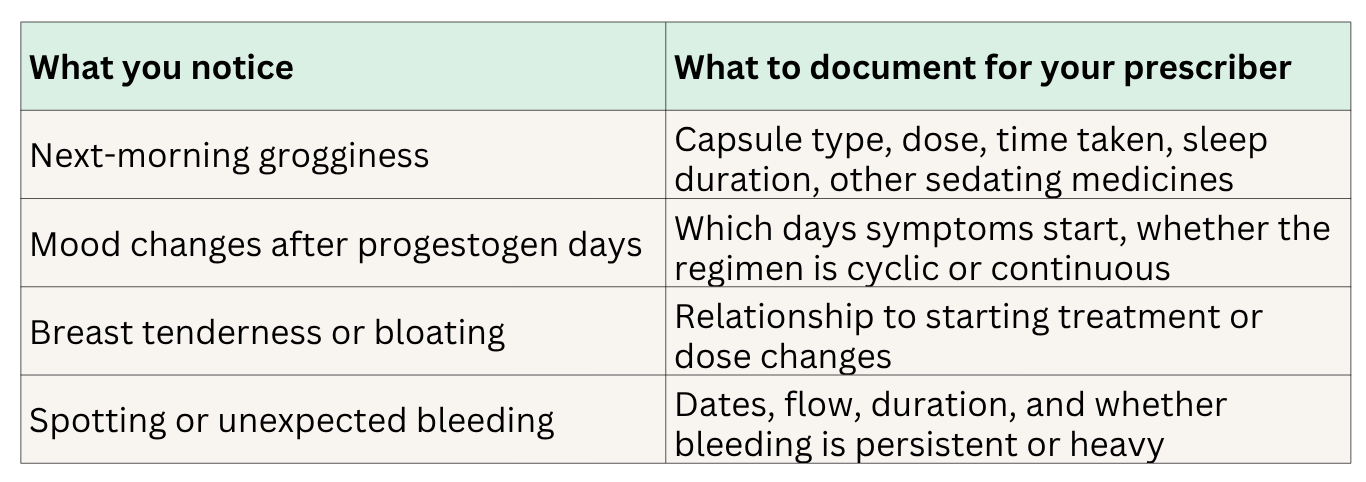
A pattern can raise a useful question, but it cannot establish the cause on its own.
Is it too much progesterone, or is something else happening?
Searching for “symptoms of too much progesterone HRT” usually reflects a real problem: you feel worse and want to know which part of treatment is responsible. Unfortunately, symptoms are not a reliable way to tell whether a prescribed dose is excessive.
Oral micronized progesterone can cause sleepiness and dizziness because of how the drug and its metabolites affect the nervous system. Feeling sedated does not, by itself, mean your uterus is receiving more protection than necessary. Conversely, feeling well does not prove the regimen provides sufficient protection. [1, 3]
Progestogens are also not interchangeable. Progesterone is chemically identical to the hormone made by the body; progestins are synthetic compounds with different properties. The name on your prescription matters when discussing alternatives.
If you initially felt better on HRT but symptoms later returned, the issue may be broader than the progesterone component. Our article on why HRT can stop working explores that separate question.
Why can't I just take estrogen without progesterone?
For most people with a uterus, systemic estrogen stimulates the endometrium, the uterine lining. Without adequate opposition from progesterone or another progestogen, long-term exposure raises the risk of endometrial hyperplasia and cancer. [2, 3]
The rule is different for most people who have had a total hysterectomy. They often can use estrogen without a progestogen, though individual circumstances can change that recommendation. Low-dose local vaginal estrogen used for genitourinary symptoms is another distinct treatment and generally does not require the same progestogen regimen. [2]
If you are unsure why your prescription includes a progestogen, our guide to progesterone with estrogen on HRT explains the purpose of uterine protection.
What are your options if you cannot tolerate progesterone?
There is no universal substitute, but clinicians have several approaches. The right one depends on whether you have a uterus, your bleeding pattern, symptom severity, medical history and what treatment is available where you live.
Review the formulation and dosing schedule
Start by confirming exactly what you take: oral micronized progesterone, a different oral progestin, a combination product, or an intrauterine system. Also check whether it is taken every day or only during part of the month.
A clinician may consider changing the schedule or choosing a different product. Do not shorten the prescribed number of progestogen days, halve the dose, or switch routes on your own. Uterine protection depends on the regimen as a whole. [3]
Discuss a different progestogen
If side effects continue, your prescriber may recommend another type of progestogen. Different agents can have different side-effect profiles. A switch is not guaranteed to solve symptoms, but it can be reasonable to discuss when treatment is otherwise helping.
Ask whether a 52-mg levonorgestrel IUD is appropriate
For some people, a 52-mg levonorgestrel-releasing intrauterine system can provide the progestogen component of menopausal hormone therapy while systemic estrogen is supplied separately. It may also help manage bleeding and provide contraception, depending on the product and clinical circumstances. [3, 4]
Not every hormonal IUD is equivalent for endometrial protection with systemic estrogen. The choice and replacement interval should be checked with the prescriber.
Ask about alternatives when estrogen-progestogen therapy is unsuitable
Some patients need a different overall treatment approach. Depending on the indication, options may include a tissue-selective estrogen complex or treatments aimed specifically at hot flashes, night sweats, or vaginal symptoms. Availability, contraindications and the need for contraception affect the choice. [2]
When hormone treatment isn't appropriate or is poorly tolerated, our guide to nonhormonal options for perimenopause outlines other treatment conversations to have with your clinician.
What about using progesterone vaginally?
Vaginal administration of preparations intended for oral use is sometimes discussed when oral progesterone causes troublesome side effects. This is an off-label approach, and evidence supporting reliable endometrial protection in this setting is limited. It must be managed by a clinician, not treated as a simple home workaround. [4]
Progesterone skin creams are not considered reliable protection for the uterine lining when systemic estrogen is used. [3]
When should side effects prompt medical attention?
Contact your clinician if you have persistent severe dizziness, marked mood changes, a rash, or side effects that interfere with functioning. New or persistent unscheduled vaginal bleeding also deserves assessment, especially if it is heavy or accompanied by pain. [1, 2]
For a fuller explanation of bleeding after starting or adjusting treatment, read our guide to bleeding on HRT.
Seek urgent medical care for chest pain, severe shortness of breath, stroke-like symptoms, fainting, or very heavy bleeding with weakness or dizziness. Do not assume those symptoms are routine HRT side effects.
What should you track before your next HRT appointment?
You don't need an elaborate spreadsheet. Record your prescription name, dose, route and timing, then note symptoms each day for one or two weeks. Include the dates of bleeding, any missed doses, and changes to other medications. Rate sleepiness or mood disruption in simple terms that will be meaningful to your doctor.
A clear note such as “I feel unusually groggy on mornings after my progesterone capsule, but not on the days I don't take it” is far more useful than saying “my hormones are off.”
For women taking oral micronized progesterone, urinary PdG results can reflect metabolites of the medication, not just progesterone made after natural ovulation. This makes an Oova PdG pattern difficult to interpret as an endogenous cycle pattern during treatment. Oova cannot determine whether a prescribed progestogen adequately protects the uterus or whether its dose should change. Keep a medication and symptom diary and review it with your prescriber.
If your main question is whether symptom relief suggests your treatment needs reassessment, see how to know if your HRT dose is right. Clinical dose decisions should be guided by your prescriber, symptoms and medical history, not a consumer hormone reading alone.
Questions to ask your doctor
- Which progestogen am I taking, and why was it chosen?
- Does my uterus require progestogen protection with my current estrogen therapy?
- Could the timing or formulation be contributing to these side effects?
- Would a different progestogen or a 52-mg hormonal IUD be suitable?
- Does my bleeding pattern need investigation before any treatment change?
- How should we judge whether a revised regimen is working?
Frequently asked questions
Can progesterone HRT make you feel depressed or anxious?
Some people report mood symptoms while taking the progestogen component of HRT. Mood changes can also arise from perimenopause, sleep disruption or other causes. Note the timing and discuss significant changes with your clinician rather than assuming the dose is too high.
Does micronized progesterone cause next-day grogginess?
It can. Oral micronized progesterone may cause drowsiness or dizziness in some patients. Ask your prescriber about the product and schedule rather than changing when or how you take it yourself. [1]
Can I stop progesterone but continue my estrogen patch?
If you have a uterus and use systemic estrogen, do not stop prescribed progestogen protection without medical advice. Your clinician can review alternatives that continue to protect the uterine lining. [2, 3]
Is a progesterone cream a safer alternative?
Not as a substitute for proven endometrial protection. Available evidence does not support transdermal progesterone cream as a reliable way to oppose systemic estrogen. [3]
Can a hormone test tell me whether my progesterone HRT dose is too high?
A routine hormone result cannot reliably explain all side effects or establish adequate endometrial protection. Your clinician generally interprets treatment response using symptoms, bleeding, medical history, regimen and any indicated investigation. [2, 3]
The bottom line
Feeling worse after starting progesterone on HRT is a reason to revisit your regimen, not a reason to suffer through symptoms or stop protective medication on your own. There may be alternatives, but choosing one requires attention to uterine protection, bleeding and your wider medical needs.
If symptoms began after starting or changing the progesterone component of HRT, bring your medication and symptom diary to your prescriber. Our guide to HRT dose questions can help you prepare for that conversation.
About the author
Sources
- U.S. National Library of Medicine. Progesterone capsules: prescribing information, adverse reactions and precautions.
- ACOG. Hormone Therapy for Menopause. Patient FAQ.
- British Menopause Society. Progestogens and Endometrial Protection. Clinician tool, 2023.
- Piasta J, Zewail A. Hormonal Options for Perimenopause: A Clinician Toolkit. Obstet Gynecol. 2026;148(5):571-583. doi:10.1097/AOG.0000000000006436.
About the Oova Blog:
Our content is developed with a commitment to high editorial standards and reliability. We prioritize referencing reputable sources and sharing where our insights come from. The Oova Blog is intended for informational purposes only and is never a substitute for professional medical advice. Always consult a healthcare provider before making any health decisions.