< Back to the Blog
Science

What Happens to Your Body After You Start HRT? Week by Week

Amy Divaraniya
Amy Divaraniya

Starting HRT and wondering when you'll actually feel better? Different symptoms respond at different times, and knowing the real timeline can stop you from giving up too early or assuming something is wrong. This is your week-by-week guide to what HRT is doing in your body, from day one through month three and beyond.

Clinically reviewed by
Dr Mary Parman
Modified On:
Published:
Mar 31, 2026
Est. Read Time:
0
A woman in her mid-40s sitting comfortably by a window, looking relieved, representing the gradual improvement after starting HRT
Published:
Mar 31, 2026
Est. Read Time:
0

Starting HRT and wondering when you'll actually feel better? Different symptoms respond at different times, and knowing the real timeline can stop you from giving up too early or assuming something is wrong. This is your week-by-week guide to what HRT is doing in your body, from day one through month three and beyond.

Hormones
Science
Share to:

Starting HRT and wondering when you'll actually feel better? Different symptoms respond at different times, and knowing the real timeline can stop you from giving up too early or assuming something is wrong. This is your week-by-week guide to what HRT is doing in your body, from day one through month three and beyond.

One of the most common questions asked the week after starting HRT is some version of this: When is this supposed to kick in?

It's a reasonable question. You've done the research, you've had the appointment, you've filled the prescription. But the first days can feel anticlimactic, or in some cases, temporarily worse. Hot flashes still happening. Sleep still disrupted. Mood still all over the place.

What most people aren't told upfront is that HRT doesn't work like a light switch. Different symptoms respond on different timelines, driven by how your body reuptakes estradiol at the tissue level, how long it takes for certain systems to recalibrate, and whether your starting dose is actually right for you.

This guide lays out what the research and clinical experience tell us about when to expect relief, symptom by symptom, week by week.

A note before we start: This timeline reflects general patterns for systemic HRT. Your specific form, pill, patch, gel, or cream, and your individual hormone baseline will affect your experience. If your timeline looks meaningfully different from what's described here, that's worth discussing with your provider, not waiting out silently.

Before Week 1: What's Happening in Your Body Before You Feel Anything

In the first few days after starting HRT, your body is absorbing estradiol and beginning the process of binding it to estrogen receptors distributed throughout multiple organ systems, your brain, cardiovascular system, gut, bone, and urogenital tract among them.

This receptor re-sensitization doesn't produce immediate symptomatic change. You're essentially restocking a depleted system, and the downstream effects take time to express. Think of it less like flipping a switch and more like slowly refilling a reservoir.

Some women notice a mild initial increase in breast tenderness or bloating in this first window. This is normal, estradiol is beginning to act on breast and uterine tissue, and it typically resolves within the first few weeks as your body adjusts.

Weeks 1–2: The First Signals

What you may notice:

  • Modest reduction in hot flash intensity or frequency in some women
  • Possible initial breast tenderness, bloating, or mild nausea (particularly with oral estradiol)
  • Improved sense of wellbeing reported by some women even before physical symptoms fully change, likely due to estrogen's early effects on serotonin activity in the brain
  • Sleep may begin to shift slightly, though this is rarely dramatic yet

What's still unchanged for most people:

  • Night sweats may persist
  • Vaginal dryness is unlikely to show improvement yet
  • Brain fog, concentration, and memory are typically unchanged
  • Mood stabilization is usually incomplete

The first two weeks are essentially a calibration period. If you feel a subtle shift in mood or energy, that's real, estradiol has measurable effects on neurotransmitter activity relatively quickly. But if you don't notice much yet, that's also normal. You're not in the window where most symptoms resolve.

Weeks 2–4: Vasomotor Symptoms Begin to Improve

Hot flashes and night sweats are typically the first symptoms to respond to HRT, and most women begin noticing meaningful improvement somewhere in this window, though full relief often takes longer.

Clinical trials consistently show that hot flash frequency and severity begin declining within 2–4 weeks of starting estrogen therapy. A landmark review of randomized controlled trials found that estrogen reduced hot flash frequency by approximately 75% compared to placebo, with benefit beginning to accumulate in this early window and continuing to build over the subsequent months.

What this looks like in practice: hot flashes may become less intense before they become less frequent. Or you may notice fewer nighttime episodes before daytime ones settle. The pattern varies, but direction of travel should be toward improvement.

Sleep often starts improving in this window for women whose primary sleep disruptor was night sweats, because fewer overnight hot flashes means fewer arousals. But if your sleep problems have other drivers (cortisol dysregulation, anxiety, sleep apnea), those won't resolve with estradiol alone. For more on the hormone-sleep relationship, how hormones affect your sleep covers the full picture.

Mood may start to stabilize during weeks 2–4, though this is highly individual. Estrogen has direct effects on serotonin, dopamine, and norepinephrine, and declining estrogen during perimenopause is a genuine driver of mood instability. Women who experience significant mood swings, irritability, or low mood as their primary symptom often report this improving earlier than they expected. Women with clinical depression or anxiety as a primary concern may need additional support beyond HRT.

Weeks 4–6: Sleep and Energy Shift More Clearly

By weeks four to six, you should be noticing more consistent improvement in sleep quality, not just on the nights when hot flashes happen to be mild, but as a sustained pattern.

Energy and fatigue often begin to lift in this window. Perimenopause fatigue has multiple drivers, poor sleep, declining estrogen's effect on mitochondrial function, and often subclinical thyroid issues running concurrently, so HRT addresses some but not necessarily all of them. If fatigue is persistent past this window despite improving sleep, it's worth checking thyroid function separately.

Progesterone side effects, if you're taking combined HRT (estrogen plus a progestogen), may be most prominent in this window. Oral micronized progesterone can cause drowsiness, bloating, or low mood in some women, particularly in the first few weeks. Many women find that taking progesterone at night mitigates the drowsiness and can actually improve sleep quality. If you're experiencing pronounced side effects from progesterone, discuss them with your provider, the form and timing of progestogen can be adjusted.

Weeks 6–8: Mood, Brain Fog, and Concentration

This is the window where cognitive and mood-related changes tend to become more apparent, and where women who've been waiting for the "mental" symptoms to resolve often start feeling the shift.

Brain fog and concentration respond more slowly to HRT than vasomotor symptoms. Estrogen supports synaptic function, cerebral blood flow, and neuroinflammatory regulation, and these processes take longer to recalibrate than the thermoregulatory effects. By weeks 6–8, many women begin noticing that word retrieval is easier, that they can hold a thought longer, or that the mental haziness that characterized their worst days is lifting.

The link between perimenopause and brain fog is well-established biologically, and the good news from recent research is that cognitive symptoms related to estrogen decline appear to be substantially reversible with timely estrogen replacement.

Mood stabilization should be more established by this point. If you're still experiencing significant mood swings, anxiety, or low mood at week 6–8, it's worth evaluating whether your dose is adequate. A dose that's too low won't fully stabilize estrogen's neurotransmitter effects, and symptoms will persist. The signs that your HRT dose may need adjusting are worth reviewing at this point in your journey.

Weeks 8–12: Genitourinary Symptoms, Skin, and Joints

Symptoms that depend on tissue-level changes take the longest to respond, and this is the window where they typically begin to show meaningful improvement.

Vaginal dryness and genitourinary symptoms, including discomfort with intercourse, urinary urgency, and recurrent UTIs, are driven by the thinning and loss of elasticity in urogenital tissue that estrogen normally maintains. Restoring estrogen levels begins reversing this, but tissue remodeling takes time. Most women see meaningful improvement in vaginal symptoms between weeks 8–12, with full benefit sometimes taking 3–6 months, particularly if tissue atrophy was significant. Vaginal dryness during perimenopause covers treatment approaches including local estrogen for women who need additional genitourinary support.

Joint pain is one of the more underappreciated symptoms of estrogen decline. Estrogen has anti-inflammatory effects on joint tissue, and perimenopause joint pain is reported by the majority of women in the menopausal transition. Many women notice significant improvement in joint stiffness and aching by the 8–12 week mark, though this varies with baseline inflammation.

Skin changes, dryness, loss of elasticity, increased sensitivity, also respond in this window. Collagen production, which estrogen supports significantly, begins recovering, though visible skin changes take longer than symptomatic ones.

Month 3 and Beyond: The Bigger Picture

By month three, you should have a reasonably clear signal about whether your current regimen is working for you. Hot flashes should be substantially reduced. Sleep should be consistently better. Mood and cognition should have improved meaningfully.

If you've reached month three and symptoms are only partially improved or have returned after early relief, it's not a sign that HRT has "stopped working", it's a sign that something in the regimen needs evaluation. The most common reasons include:

  • Dose is too low for your absorption or your symptom burden
  • Form isn't absorbing adequately, particularly relevant with certain topical preparations
  • Other hormones are contributing, thyroid, cortisol, and testosterone all interact with how you feel on estrogen
  • Life circumstances have shifted, stress, sleep disruption, and illness all affect how HRT performs

Why your HRT stopped working is a detailed guide to troubleshooting each of these scenarios, and it's worth reading before concluding that HRT isn't the right path for you.

A Note on Monitoring: Don't Guess, Measure

The timeline above reflects what typically happens when estradiol levels are actually in a therapeutic range. But one of the most common reasons women don't progress through this timeline on schedule is that their dose isn't delivering adequate blood levels, and without tracking, there's no way to know.

A single lab test weeks after starting HRT captures your level at one moment. But as explored in why your hormones look normal but you still feel terrible, a snapshot can miss the patterns that explain persistent symptoms. Continuous or regular monitoring gives a clearer picture of whether your estradiol is consistently in range, or dipping in ways that explain the gaps in your symptom relief.

If you're tracking your response and want to understand what your numbers should look like at each stage, the first 90 days of HRT: what your hormones should look like is the companion piece to this guide.

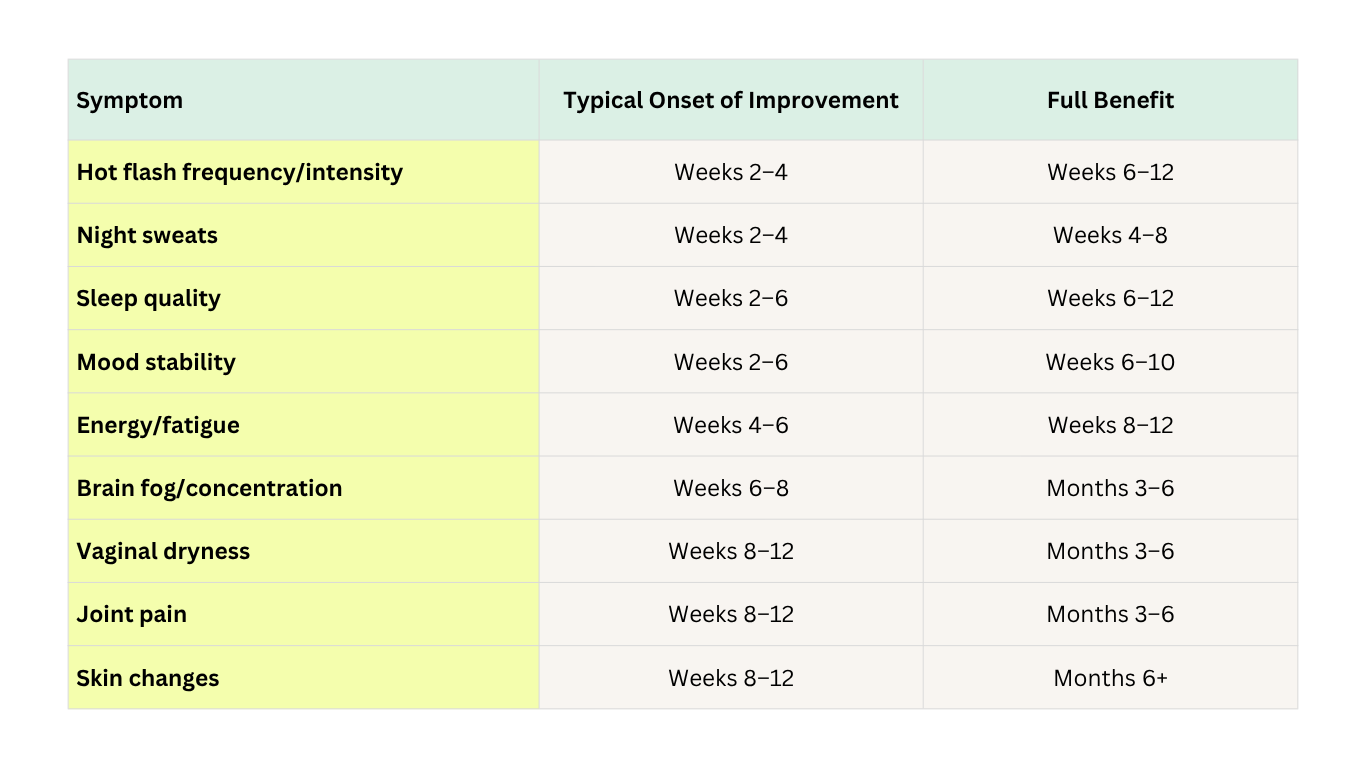
Quick Reference: HRT Symptom Timeline
The Bottom Line

HRT doesn't work on a single timeline, it works on multiple timelines simultaneously, with each symptom driven by a different biological mechanism. Hot flashes respond in weeks. Brain fog responds in months. Tissue-level changes take longer still.

Knowing this matters because the most common reason women stop HRT prematurely is expecting uniform improvement that doesn't come, and interpreting partial improvement as failure. It isn't. It's the expected pattern of a body recalibrating after years of fluctuating, then declining, hormone levels.

Give each symptom its window. Track your levels. Adjust the dose if the timeline is significantly off. And if something feels wrong rather than just slow, that's always worth a conversation with your provider, not a reason to stop.

About the author

Amy Divaraniya
Dr. Aparna (Amy) Divaraniya is the Founder and CEO of Oova. She has over 10 years experience working in data science and a PhD in Biomedical Sciences. In 2017, Amy pivoted to women's healthcare after facing her own fertility struggles. Amy started Oova to give women control over their fertility by making high-quality hormone testing more accessible.

Sources

  1. MacLennan AH, Broadbent JL, Lester S, Moore V. Oral oestrogen and combined oestrogen/progestogen therapy versus placebo for hot flushes. Cochrane Database Syst Rev. 2004;(4):CD002978. doi:10.1002/14651858.CD002978.pub2
  2. Santoro N, Epperson CN, Mathews SB. Menopausal symptoms and their management. Endocrinol Metab Clin North Am. 2015;44(3):497-515. doi:10.1016/j.ecl.2015.05.001
  3. Shifren JL, Gass ML; NAMS Recommendations for Clinical Care of Midlife Women Working Group. The North American Menopause Society recommendations for clinical care of midlife women. Menopause. 2014;21(10):1038-1062.
  4. Maki PM, Henderson VW. Hormone therapy, dementia, and cognition: the Women's Health Initiative 10 years on. Climacteric. 2012;15(3):256-262. doi:10.3109/13697137.2012.660613
  5. Sturdee DW, Panay N; International Menopause Society Writing Group. Recommendations for the management of postmenopausal vaginal atrophy. Climacteric. 2010;13(6):509-522. doi:10.3109/13697137.2010.522875
  6. The NAMS 2022 Hormone Therapy Position Statement Advisory Panel. The 2022 hormone therapy position statement of The Menopause Society. Menopause. 2022;29(7):767-794. doi:10.1097/GME.0000000000002028
  7. Prior JC. Progesterone for treatment of symptomatic menopausal women. Climacteric. 2018;21(4):358-365. doi:10.1080/13697137.2018.1472567
  8. Blumel JE, Castelo-Branco C, Binfa L, et al. Quality of life after the menopause: a population study. Maturitas. 2000;34(1):17-23.
  9. Lobo RA. Hormone-replacement therapy: current thinking. Nat Rev Endocrinol. 2017;13(4):220-231. doi:10.1038/nrendo.2016.164
  10. Genazzani AR, Monteleone P, Giannini A, Simoncini T. Hormone therapy in the postmenopausal years: considering benefits and risks in clinical practice. Hum Reprod Update. 2021;27(6):1115-1150. doi:10.1093/humupd/dmab026
https://www.oova.life/blog/irregular-menstrual-cycle-hormonal-variability
How is Oova different from a standard ovulation predictor kit?
tandard OPKs detect the presence of an LH surge but cannot confirm whether ovulation was completed or whether progesterone rose adequately afterward. Oova measures LH, estrogen (E3G), and progesterone (PdG) quantitatively across your cycle, providing biochemical confirmation of ovulation and luteal phase adequacy over time.
https://www.oova.life/blog/irregular-menstrual-cycle-hormonal-variability
How do I know if my irregular cycles are related to perimenopause?
Perimenopause can begin years before your last period, often in the late 30s or 40s, and standard hormone tests frequently appear normal during this transition. Cycle-to-cycle changes in ovulation patterns and luteal progesterone are often among the earliest signs. If your cycles have changed and your labs are "normal," longitudinal monitoring may reveal what a single test cannot.
https://www.oova.life/blog/irregular-menstrual-cycle-hormonal-variability
What is a luteal phase defect?
A luteal phase defect refers to insufficient progesterone production in the second half of your cycle, after ovulation. It can cause symptoms like premenstrual spotting, a shortened cycle, low mood, and poor sleep, and is frequently missed by single-timepoint blood testing.
https://www.oova.life/blog/irregular-menstrual-cycle-hormonal-variability
Can you have a period without ovulating?
Yes. Anovulatory cycles, cycles in which ovulation does not fully occur, can still produce a bleed that looks like a normal period. In our research, nearly 1 in 5 cycles with an LH surge showed no biochemical confirmation of ovulation. This is especially common in women with PCOS.
https://www.oova.life/blog/irregular-menstrual-cycle-hormonal-variability
Why does my cycle feel different every month?
Cycle-to-cycle hormonal variability is common and often goes undetected. Research shows that nearly two-thirds of women show inconsistency in ovulation or luteal progesterone from one cycle to the next, meaning what happens in one cycle is not necessarily predictive of the next.
https://www.oova.life/blog/how-to-fix-hormonal-imbalance
Can stress alone cause a hormonal imbalance?
Yes and this is underappreciated. Chronic psychological stress directly suppresses progesterone production, delays or prevents ovulation, and disrupts the entire downstream hormone cascade. Many women with "unexplained" hormonal symptoms have cortisol dysregulation as the root cause, with sex hormone imbalances as the consequence. Addressing stress isn't a soft add-on to the real treatment. In many cases, it is the treatment.
https://www.oova.life/blog/how-to-fix-hormonal-imbalance
Can you fix a hormonal imbalance without medication?
For many women, yes particularly when the imbalance is driven by lifestyle factors like chronic stress, poor sleep, undereating, or insulin resistance. However, hormonal imbalances caused by perimenopause, PCOS, or thyroid conditions often benefit significantly from medical support alongside lifestyle changes. The answer depends on which hormone is off and why which is why testing first matters so much.
https://www.oova.life/blog/how-to-fix-hormonal-imbalance
What foods fix hormonal imbalance?
No single food fixes hormonal imbalance, but dietary patterns matter significantly. A Mediterranean-style diet rich in fiber, healthy fats, and adequate protein supports estrogen clearance, insulin sensitivity, and hormone production. Reducing refined carbohydrates, alcohol, and ultra-processed foods is equally important.
https://www.oova.life/blog/how-to-fix-hormonal-imbalance
Is hormonal imbalance permanent?
Not typically. While hormonal changes from aging like perimenopause are natural and progressive, most hormonal imbalances driven by lifestyle, stress, or correctable medical conditions can be meaningfully improved with the right interventions. The key is identifying the right interventions for your specific pattern, not a generic approach.
https://www.oova.life/blog/how-to-fix-hormonal-imbalance
How long does it take to fix a hormonal imbalance?
It depends on the cause and severity, but lifestyle interventions typically take 2–3 full menstrual cycles to produce measurable hormonal changes. Medical treatments like HRT or thyroid medication may work faster but still require 4–12 weeks of monitoring to optimize. The most important thing is having a tracking system in place so you can actually see what's changing otherwise you're guessing.
https://www.oova.life/blog/how-to-fix-hormonal-imbalance
How do I know if my hormones are actually out of balance?
Symptoms are a starting point, but they overlap significantly between different hormone patterns. The most reliable approach is testing specifically tracking hormone levels across multiple days of your cycle rather than relying on a single blood draw.
https://www.oova.life/blog/how-to-fix-hormonal-imbalance
What is the fastest way to fix a hormonal imbalance?
Addressing sleep is often the highest-leverage starting point because cortisol, progesterone, estrogen, and insulin are all directly affected by sleep quality. Simultaneously reducing refined sugar and ultra-processed food intake can improve insulin and androgen balance relatively quickly. That said, "fast" is relatively meaningful; hormonal shifts take weeks, not days, and there are no shortcuts that the evidence supports.
https://www.oova.life/blog/fertility-vitamins
How long does it take for fertility vitamins to work?
Because egg development takes about 90 days, you may see benefits after 3 months of consistent supplementation. However, some benefits (like improved energy from iron) may appear sooner.
https://www.oova.life/blog/fertility-vitamins
Are prenatal vitamins the same as fertility vitamins?
They're similar but not identical. Prenatal vitamins are designed for pregnancy needs, while fertility vitamins may contain different ratios or additional nutrients like CoQ10 or inositol specifically for supporting conception.
https://www.oova.life/blog/fertility-vitamins
Do men need fertility vitamins too?
Absolutely. Male fertility accounts for about 40-50% of infertility cases. Men benefit from vitamins C and E, zinc, selenium, folate, and CoQ10 to improve sperm quality, count, and motility.
https://www.oova.life/blog/fertility-vitamins
Yes, excessive amounts of certain vitamins and minerals can be harmful. Fat-soluble vitamins (A, D, E, K) and minerals like iron can accumulate to toxic levels. Always follow recommended dosages and consult your healthcare provider.
Can I take too many fertility vitamins?
https://www.oova.life/blog/fertility-vitamins
When should I start taking fertility vitamins?
Begin taking fertility vitamins at least 3 months before trying to conceive, ideally 6-12 months. This gives your body time to build adequate nutrient stores for conception and early pregnancy.
https://www.oova.life/blog/fertility-vitamins
Which vitamin is most important for fertility?
Folate (folic acid) is considered most critical because it prevents neural tube defects and supports healthy egg development. However, fertility depends on multiple nutrients working together, so a comprehensive approach is best.
https://www.oova.life/blog/signs-of-ovulation-while-breastfeeding
Should I take a pregnancy test if I think I'm ovulating while breastfeeding?
If you've had unprotected intercourse and notice signs of ovulation, taking a pregnancy test is reasonable, especially if your period doesn't arrive when expected. Home pregnancy tests are accurate from the first day of a missed period.
https://www.oova.life/blog/signs-of-ovulation-while-breastfeeding
Will ovulation affect my milk supply?
Some women notice temporary milk supply dips around ovulation or during their period due to hormonal fluctuations. This is usually brief and doesn't require weaning. Continued nursing typically restores supply.
https://www.oova.life/blog/signs-of-ovulation-while-breastfeeding
Does pumping breast milk suppress ovulation like nursing does?
Pumping is less effective at suppressing ovulation than direct breastfeeding. The physical stimulation of nursing more effectively triggers prolactin release. If you're pumping exclusively or frequently, ovulation may return sooner.
https://www.oova.life/blog/signs-of-ovulation-while-breastfeeding
How effective is breastfeeding as birth control?
When all LAM criteria are met (exclusive breastfeeding, no period, less than 6 months postpartum), it's about 98% effective comparable to hormonal birth control. However, effectiveness drops significantly when any criterion is not met.
https://www.oova.life/blog/signs-of-ovulation-while-breastfeeding
Can you get pregnant while breastfeeding before your first period?
Yes, you can ovulate and therefore get pregnant before your first postpartum period returns. Ovulation occurs before menstruation in the cycle sequence, so your first fertile window happens before you realize your period is coming back.
https://www.oova.life/blog/signs-ovulation-is-over
Do you always have symptoms when ovulation ends?
Not everyone experiences noticeable symptoms. Some people have very subtle signs while others have pronounced changes. This is why hormone tracking provides more objective confirmation than symptoms alone.
https://www.oova.life/blog/signs-ovulation-is-over
What's the difference between ovulation and the fertile window?
Ovulation is the specific moment when the egg is released and lasts 12-48 hours. The fertile window is approximately 6 days, the 5 days before ovulation plus ovulation day, because sperm can survive several days while waiting for the egg.
https://www.oova.life/blog/signs-ovulation-is-over
How accurate is basal body temperature for confirming ovulation?
BBT is fairly reliable when tracked consistently, but it confirms ovulation retrospectively (1-2 days after it occurs) rather than predicting it. It's most useful when combined with other tracking methods.
https://www.oova.life/blog/signs-ovulation-is-over
Can you ovulate twice in one cycle?
While rare, it's possible to release two eggs during one ovulation event (within 24 hours), which can result in fraternal twins. However, you don't ovulate twice at different times in a single cycle.
https://www.oova.life/blog/signs-ovulation-is-over
How many days after ovulation can you get pregnant?
The egg is only viable for 12-24 hours after ovulation. However, since sperm can survive up to 5 days, your fertile window includes the 5 days before ovulation and the day of ovulation itself.
https://www.oova.life/blog/why-is-my-period-late-but-my-pregnancy-test-is-negative
Can stress really delay your period?
Absolutely. Stress affects the hypothalamus, which regulates hormones controlling your menstrual cycle. Significant stress can delay ovulation and therefore your period.
https://www.oova.life/blog/why-is-my-period-late-but-my-pregnancy-test-is-negative
What should I do if my period is 2 weeks late but the test is negative?
Take another test. If it's still negative and your period doesn't arrive, schedule an appointment with your healthcare provider to investigate potential causes.
https://www.oova.life/blog/why-is-my-period-late-but-my-pregnancy-test-is-negative
Can you be pregnant with a negative test?
Yes, especially if you test too early. Wait until at least a few days after your missed period and retest. HCG levels need time to rise to detectable levels.
https://www.oova.life/blog/why-is-my-period-late-but-my-pregnancy-test-is-negative
How long can your period be late without being pregnant?
Periods can be late for various reasons unrelated to pregnancy. If you're not pregnant, a period can be delayed by several days to weeks due to stress, illness, or hormonal changes. However, if your period is more than a week late and tests remain negative, consult your doctor.
https://www.oova.life/blog/hormonal-imbalance-symptoms
Will hormonal imbalance symptoms go away on their own?
Some temporary imbalances resolve naturally, especially those related to life transitions, but persistent symptoms typically require intervention to improve.
https://www.oova.life/blog/hormonal-imbalance-symptoms
Are hormonal imbalances more common in women?
While women experience certain hormonal imbalances more frequently (like PCOS and thyroid disorders), men also experience hormonal issues, particularly with testosterone and thyroid hormones.
https://www.oova.life/blog/hormonal-imbalance-symptoms
Can stress alone cause hormonal imbalances?
Yes, chronic stress significantly impacts cortisol, which can then disrupt other hormones including thyroid hormones and sex hormones.
https://www.oova.life/blog/hormonal-imbalance-symptoms
How quickly can hormonal imbalance symptoms appear?
Some symptoms develop gradually over months, while others can appear within weeks depending on the hormone affected and severity of the imbalance.
perimenopause-periods
Should I still see my gynecologist if my periods are just "weird" but not painful?
Yes. Annual visits remain important during perimenopause. Your provider can help determine if your "weird" periods are typical perimenopause changes or something requiring attention. They can also discuss management options to improve your quality of life.
perimenopause-periods
How long do irregular periods last before menopause?
Irregular perimenopause periods typically last 4 to 8 years before your final period, though this varies greatly. Some women experience irregularity for just a few months, while others have irregular periods for over a decade before reaching menopause.
perimenopause-periods
Is it normal to have two periods in one month during perimenopause?
Yes, this can happen, especially in early perimenopause when cycles shorten. You might have a 21 day cycle, meaning you could have a period at the beginning and end of the same calendar month. Track these patterns to distinguish between short cycles and abnormal bleeding.
perimenopause-periods
Why are my periods suddenly so heavy in my 40s?
Heavy perimenopause periods often result from estrogen dominance. When progesterone drops but estrogen remains high, your uterine lining builds up more than usual, causing heavier bleeding when it sheds. This is common in perimenopause but should be evaluated if it affects your daily life.
perimenopause-periods
Can I still get pregnant if my periods are irregular during perimenopause?
Yes. As long as you're having periods, even irregular ones, you may still be ovulating. Pregnancy is possible until you've gone 12 full months without any period. If you don't want to become pregnant, continue using contraception throughout perimenopause.
perimenopause-and-weight-gain
Can you prevent perimenopause weight gain completely?
While you may not prevent all weight changes during perimenopause, you can minimize gain through proactive strategies. Starting strength training before perimenopause, maintaining consistent sleep habits, and managing stress can help your body adapt to hormonal changes more smoothly. Remember, some body changes during this transition are normal and healthy.
perimenopause-and-weight-gain
At what age does perimenopause weight gain typically start?
Perimenopause weight gain can begin in your late 30s or early 40s, often coinciding with the first hormonal changes. Many women notice gradual changes starting 5 to 10 years before their final period. The timing varies greatly based on genetics, lifestyle, and overall health.
perimenopause-and-weight-gain
Does everyone gain the same amount during perimenopause?
No. Perimenopause weight gain varies significantly. Some women gain 5 pounds, others 20 or more, and some maintain their weight. Factors include genetics, starting weight, activity level, stress, sleep quality, and how dramatically hormones fluctuate. Your experience is unique to your body.
Is perimenopause weight gain different from regular aging weight gain?
Yes. While metabolism naturally slows with age, perimenopause weight gain has distinct characteristics. The hormonal shifts cause fat redistribution to the midsection, even if overall weight doesn't change dramatically. This abdominal weight gain pattern is specifically linked to declining estrogen and progesterone, not just aging.
perimenopause-and-weight-gain
Will the weight come off after menopause?
Perimenopause weight gain often stabilizes after menopause when hormones level out, but the weight doesn't automatically disappear. The metabolic and body composition changes that occur during perimenopause tend to persist. However, with consistent healthy habits, weight management becomes more predictable post menopause than during the fluctuating perimenopause years.
https://www.oova.life/blog/progesterone-supplementation-guide
Can I take progesterone if I'm breastfeeding?
Yes, progesterone is generally safe while breastfeeding and doesn't significantly affect milk supply. However, always discuss with your healthcare provider before starting any hormone supplementation while nursing.
https://www.oova.life/blog/progesterone-supplementation-guide
Is it safe to take progesterone throughout pregnancy?
Yes, when prescribed by your healthcare provider. Progesterone supplementation in early pregnancy is safe and can reduce miscarriage risk in women with low progesterone or a history of pregnancy loss. Most providers continue supplementation through the first trimester (weeks 10-12) when the placenta takes over.
https://www.oova.life/blog/progesterone-supplementation-guide
Can progesterone supplementation cause weight gain?
Progesterone can cause temporary water retention and bloating, which may show up as a few pounds on the scale, but it doesn't cause true fat weight gain. Most women don't experience significant weight changes from progesterone supplementation.
https://www.oova.life/blog/progesterone-supplementation-guide
Can I switch from pills to suppositories or vice versa?
Yes, but only under your doctor's guidance. The dosing and timing may need adjustment when switching between forms since they're absorbed differently. Never switch on your own, especially if you're pregnant or undergoing fertility treatment.
https://www.oova.life/blog/progesterone-supplementation-guide
Will progesterone supplementation delay my period?
Yes, progesterone keeps the uterine lining intact, so if you're not pregnant and continue taking progesterone, your period will be delayed. Once you stop taking it, your period should start within 2-10 days. If you are pregnant, progesterone helps maintain the pregnancy and you won't get a period.
https://www.oova.life/blog/progesterone-supplementation-guide
Should I take progesterone pills orally or vaginally?
For fertility and pregnancy support, vaginal progesterone is usually preferred because it delivers higher concentrations directly to the uterus. For perimenopause or general hormone balance, oral progesterone often works well and is more convenient. Your doctor will recommend the best route based on your specific needs.
https://www.oova.life/blog/progesterone-supplementation-guide
When should I start taking progesterone after ovulation?
Typically, progesterone supplementation for luteal phase support starts 2-3 days after ovulation (confirmed by LH surge or temperature rise). Your doctor will give you specific timing based on your protocol. Some women start immediately after a positive ovulation test.
https://www.oova.life/blog/progesterone-supplementation-guide
What's better: progesterone cream or pills?
Pills (oral micronized progesterone) are generally more effective and reliable than creams because absorption from creams is inconsistent. For medical conditions like fertility issues, low progesterone, or HRT, prescription pills or suppositories are strongly recommended over over-the-counter creams.
https://www.oova.life/blog/low-vs-high-progesterone-symptoms
How can I tell if I have low or high progesterone?
The only definitive way to know is through hormone testing via blood tests or at-home urine tests that measure progesterone metabolites. However, symptom patterns can provide clues: anxiety and irregular periods suggest low progesterone, while bloating and extreme fatigue suggest high progesterone.
https://www.oova.life/blog/low-vs-high-progesterone-symptoms
When during my cycle should I test progesterone levels?
Test progesterone levels during the luteal phase, typically 7 days after ovulation or around day 21 of a 28-day cycle. This is when progesterone should be at its peak, making it easier to identify if levels are too low or too high.
https://www.oova.life/blog/low-vs-high-progesterone-symptoms
What are the main differences between low and high progesterone symptoms?
Low progesterone typically causes irregular or heavy periods, anxiety, hot flashes, and sleep issues. High progesterone causes bloating, fatigue, intense breast tenderness, and depression-like mood changes. Low progesterone symptoms persist throughout your cycle, while high progesterone symptoms are most intense during the luteal phase.
https://www.oova.life/blog/low-vs-high-progesterone-symptoms
Can you have symptoms of both low and high progesterone?
Some symptoms like breast tenderness and mood changes can occur with both low and high progesterone, making it confusing. However, the timing, intensity, and accompanying symptoms differ. Hormone testing is the best way to determine which imbalance you're experiencing.
https://www.oova.life/blog/10-dpo
Can stress affect 10 DPO symptoms?
Yes, stress can worsen or mimic 10 DPO symptoms. Stress increases cortisol, which can cause cramping, fatigue, and mood changes similar to both PMS and early pregnancy. During the two-week wait, try stress-reduction techniques like gentle exercise, meditation, or spending time with loved ones.
https://www.oova.life/blog/10-dpo
Is it better to test at 10 DPO or wait?
It's better to wait until 12–14 DPO for more accurate results. Testing at 10 DPO often leads to false negatives because hCG levels may still be too low. If you absolutely can't wait, use a sensitive early detection test with first morning urine, and be prepared to retest in 2–3 days if negative.
https://www.oova.life/blog/10-dpo
What does implantation bleeding look like at 10 DPO?
Implantation bleeding at 10 DPO is typically light pink or brown, much lighter than a period, and lasts 1–2 days. It's often just spotting when you wipe or a few drops on a panty liner. However, only 15–20% of pregnant women experience implantation bleeding—most don't have any bleeding at all.
https://www.oova.life/blog/10-dpo
Why am I cramping at 10 DPO?
Cramping at 10 DPO can be caused by elevated progesterone (whether you're pregnant or not), implantation (if you're pregnant), or premenstrual cramping. Unfortunately, cramping alone can't tell you if you're pregnant since progesterone causes similar symptoms in both scenarios.
https://www.oova.life/blog/10-dpo
What are the chances of a BFP at 10 DPO?
If you're pregnant, you have about a 50–60% chance of getting a positive test at 10 DPO. This means there's a 40–50% chance of a false negative even if you conceived. Chances improve significantly by 12–14 DPO.
https://www.oova.life/blog/10-dpo
What DPO is most accurate for pregnancy testing?
14 DPO (the day of your missed period) is the most accurate time to test, with 99% accuracy. 12 DPO offers 80–90% accuracy. 10 DPO has only 50–60% accuracy. For best results, wait as long as you can—ideally until 12–14 DPO.
https://www.oova.life/blog/10-dpo
Is 10 DPO too early to test?
10 DPO is considered early for pregnancy testing. While some women get positives at 10 DPO, accuracy is only 50–60% if you're pregnant. For best results, wait until 12 DPO (80–90% accuracy) or 14 DPO/missed period (99% accuracy).
https://www.oova.life/blog/10-dpo
Can you have implantation at 10 DPO?
Yes, implantation can still occur at 10 DPO, though 84% of women have already implanted by this point. Late implantation at 10–12 DPO is normal. If implantation happens at 10 DPO, you won't get a positive pregnancy test for another 2–3 days.
https://www.oova.life/blog/10-dpo
What does a negative test at 10 DPO mean?
A negative test at 10 DPO does not mean you're not pregnant. It's very common to get negatives at 10 DPO even if you conceived. Your hCG levels may still be too low, or implantation may have occurred later. Wait until 12–14 DPO to retest for more accurate results.
https://www.oova.life/blog/10-dpo
Can you get a positive pregnancy test at 10 DPO?
Yes, but only about 50–60% of pregnant women will get a positive at 10 DPO. The other 40–50% have hCG levels that are still too low to detect. If you test negative at 10 DPO, wait 2–3 days and test again.
https://www.oova.life/blog/high-progesterone-symptoms
Can high progesterone cause weight gain?
Yes, elevated progesterone can cause temporary weight gain through water retention and bloating. This is a normal part of the luteal phase and early pregnancy.
https://www.oova.life/blog/how-to-increase-estrogen
Does stress affect estrogen levels?
Yes, chronic stress elevates cortisol, which can suppress estrogen production and disrupt hormonal balance. Stress reduction through meditation, yoga, adequate sleep, and self-care practices helps maintain optimal estrogen levels.
https://www.oova.life/blog/how-to-increase-estrogen
When should I consider medical treatment for low estrogen?
Consider medical intervention if natural methods don't improve symptoms after 3 months, if symptoms severely impact quality of life, if you're experiencing early menopause (before 40), or if you have fertility concerns. Hormone replacement therapy may be appropriate in these cases.
https://www.oova.life/blog/how-to-increase-estrogen
What are the signs that my estrogen is increasing?
Signs of rising estrogen include more regular menstrual cycles, reduced hot flashes, improved vaginal lubrication, better mood stability, increased energy, and improved skin elasticity. You may also notice reduced symptoms that originally indicated low estrogen.
https://www.oova.life/blog/how-to-increase-estrogen
Can exercise increase estrogen levels?
Yes, moderate exercise stimulates estrogen release and helps maintain hormonal balance. Aim for 150 minutes of moderate cardio weekly plus strength training twice per week. However, excessive exercise can actually lower estrogen, so balance is key.
https://www.oova.life/blog/how-to-increase-estrogen
How long does it take to increase estrogen naturally?
With consistent dietary and lifestyle changes, you may notice improvements in symptoms within 4-8 weeks. However, significant hormonal changes typically take 2-3 months. Tracking your cycle and symptoms can help you monitor progress.
https://www.oova.life/blog/how-to-increase-estrogen
What foods increase estrogen levels naturally?
Foods high in phytoestrogens can help increase estrogen naturally. The best options include flax seeds (high in lignans), soy products (tofu, tempeh, edamame), lentils, chickpeas, whole grains (oats, quinoa, brown rice), and garlic. These plant compounds mimic estrogen's effects in the body.
https://www.oova.life/blog/perimenopause
What helps relieve hot flashes quickly?
Cool environments, layered clothing, herbal teas, and medical treatments like gabapentin or HRT may help—depending on severity. Lifestyle changes like reducing caffeine and alcohol can also provide relief.
https://www.oova.life/blog/perimenopause
Are there tests to confirm perimenopause?
Yes. Tests measuring estradiol, LH, and FSH levels can indicate hormonal shifts—but diagnosis is often symptom-based since hormone levels fluctuate widely during perimenopause.
https://www.oova.life/blog/perimenopause
How do I know it's perimenopause and not something else?
A doctor may recommend hormone testing (like LH, E3G, and PdG) and track symptom timing. Diagnosis is often based on symptoms combined with age and menstrual pattern changes.
https://www.oova.life/blog/perimenopause
What's the earliest age perimenopause can start?
Some women begin experiencing symptoms as early as their mid-30s, though perimenopause typically starts between ages 38-45.
https://www.oova.life/blog/perimenopause
Does perimenopause affect mental clarity?
Yes. Brain fog and difficulty concentrating are common during hormone fluctuations in perimenopause.
https://www.oova.life/blog/TBD-10-symptoms-and-how-to-get-relief
What happens after the last sign of perimenopause?
After your final period, you enter postmenopause. You'll need 12 consecutive months without a period to confirm menopause. Many symptoms gradually improve, though some like vaginal dryness may persist without treatment.
https://www.oova.life/blog/TBD-10-symptoms-and-how-to-get-relief
When do perimenopause symptoms finally stop?
Some symptoms like brain fog improve after menopause, while others like hot flashes may continue for up to 10 years post-menopause. Vaginal symptoms often persist or worsen without treatment. Each person's timeline is different.
https://www.oova.life/blog/high-progesterone-symptoms
Is high progesterone a sign of pregnancy?
Yes, high progesterone is one of the earliest indicators of pregnancy. Progesterone levels rise significantly after conception to support the developing embryo and reach their peak during the third trimester.
https://www.oova.life/blog/TBD-10-symptoms-and-how-to-get-relief
Can you still get pregnant in late perimenopause?
Yes, you can still get pregnant during perimenopause as long as you're having periods, even if they're infrequent. Continue using birth control until you've gone 12 consecutive months without a period and have officially reached menopause.
https://www.oova.life/blog/TBD-10-symptoms-and-how-to-get-relief
Do symptoms get worse before perimenopause ends?
Yes, most perimenopause symptoms intensify in the final 1-2 years before menopause. Hot flashes peak around your final period, vaginal symptoms worsen, and mood changes increase. However, brain fog typically improves in late perimenopause.
https://www.oova.life/blog/TBD-10-symptoms-and-how-to-get-relief
How long does late perimenopause last?
Late perimenopause typically lasts 1-3 years before your final period. However, the exact duration varies significantly from person to person. You've reached menopause after 12 consecutive months without a period.
https://www.oova.life/blog/high-progesterone-symptoms
What are the symptoms of high progesterone?
High progesterone symptoms include fatigue, bloating, breast tenderness, weight gain, anxiety, depression, headaches, and food cravings. During pregnancy, you may also experience increased nipple sensitivity and muscle aches.
https://www.oova.life/blog/TBD-10-symptoms-and-how-to-get-relief
What are the first signs that perimenopause is ending?
The earliest signs include longer gaps between periods (60+ days), intensifying hot flashes that peak around your final period, and worsening vaginal dryness. These symptoms typically increase in late perimenopause before you reach official menopause.
https://www.oova.life/blog/high-progesterone-symptoms
When should I be concerned about high progesterone?
Consult a healthcare provider if you experience high progesterone symptoms outside your luteal phase when not pregnant, or if symptoms include severe pelvic pain, abnormal vaginal bleeding, or rapid weight gain while on hormone therapy.
https://www.oova.life/blog/high-progesterone-symptoms
How do you test progesterone levels?
Progesterone can be measured through blood tests at your doctor's office or at-home urine tests that measure PdG (a progesterone metabolite). Testing is typically done during the luteal phase, about 7 days after ovulation.

About the Oova Blog:
Our content is developed with a commitment to high editorial standards and reliability. We prioritize referencing reputable sources and sharing where our insights come from. The Oova Blog is intended for informational purposes only and is never a substitute for professional medical advice. Always consult a healthcare provider before making any health decisions.