If anxiety, depression, irritability, or feeling unlike yourself shows up at the same point every month, your cycle may be part of the picture. Learn how hormone-related mood changes differ from PMDD and premenstrual exacerbation (PME), why normal hormone levels can still affect mood, and what to track before talking with a provider.

If anxiety, depression, irritability, or feeling unlike yourself shows up at the same point every month, your cycle may be part of the picture. Learn how hormone-related mood changes differ from PMDD and premenstrual exacerbation (PME), why normal hormone levels can still affect mood, and what to track before talking with a provider.
Quick answer: If anxiety, depression, or irritability reliably gets worse before your period and improves after it starts, your menstrual cycle may be part of the picture. That doesn't necessarily mean your hormone levels are abnormal. PMDD is thought to involve heightened sensitivity to normal hormone changes. If anxiety or depression is present all month but gets worse before your period, that pattern may be premenstrual exacerbation (PME) of an existing condition.
Key takeaways
- Anxiety and depression can change with the menstrual cycle.
- Cycle-related mood symptoms don't necessarily mean your estrogen or progesterone levels are abnormal.
- PMDD and premenstrual exacerbation are different patterns with different implications.
- When symptoms start and stop is one of the most useful clues.
- Tracking mood daily for at least two cycles can show whether a repeatable pattern exists.[1,2,3]
- Hormone data can add context, but it cannot diagnose PMDD, anxiety, or depression.
Maybe there are several days every month when you suddenly don't feel like yourself.
You're more anxious. Small things feel overwhelming. You snap at people you'd normally have patience for. Or your mood drops low enough that you start wondering whether you're depressed.
Then your period comes, and a few days later you feel noticeably better.
If that sounds familiar, it's reasonable to wonder whether hormones are involved. They may be. But "hormonal" doesn't necessarily mean your hormones are too high, too low, or out of balance.
Sometimes the more important clue is how your brain responds to the normal hormonal changes of your cycle.
Why does my anxiety get worse before my period?
For some women, anxiety rises during the luteal phase, the stretch between ovulation and your next period.
During this phase, progesterone rises after ovulation. Then, if pregnancy doesn't occur, both estrogen and progesterone fall as your period approaches. These changes interact with brain systems involved in mood and stress.
Progesterone is also converted into a neuroactive steroid called allopregnanolone. It acts on GABA-A receptors, part of the brain's main inhibitory signaling system, which helps regulate anxiety and the stress response.[5]
For most people, these shifts don't cause serious mood symptoms. Some people appear to be much more sensitive to them.
Can your hormones be “normal” and still affect your mood?
Yes. PMDD doesn't appear to be caused by abnormally high or low estrogen or progesterone.
In a landmark study, researchers suppressed ovarian hormones and then added them back at normal physiological levels. Women with a history of premenstrual mood symptoms experienced a return of symptoms, while women without that history did not.[4]
The difference wasn't simply the hormone level. It was how the individual responded to the hormonal change.
So a hormone result can fall within a reference range while your symptoms are real and clearly cyclical.
A "normal" result tells you whether one measurement fell within an expected range. It doesn't tell you whether changes across your cycle line up with changes in how you feel.
That's why how to interpret hormone results matters alongside the individual number.
PMS, PMDD, depression, or anxiety: how can you tell?
The symptoms overlap considerably. Anxiety, low mood, irritability, difficulty concentrating, sleep changes, fatigue, feeling overwhelmed, and appetite changes can all occur with PMS or PMDD. They can also occur with anxiety and depressive disorders.
The timing of your symptoms can help distinguish these patterns.
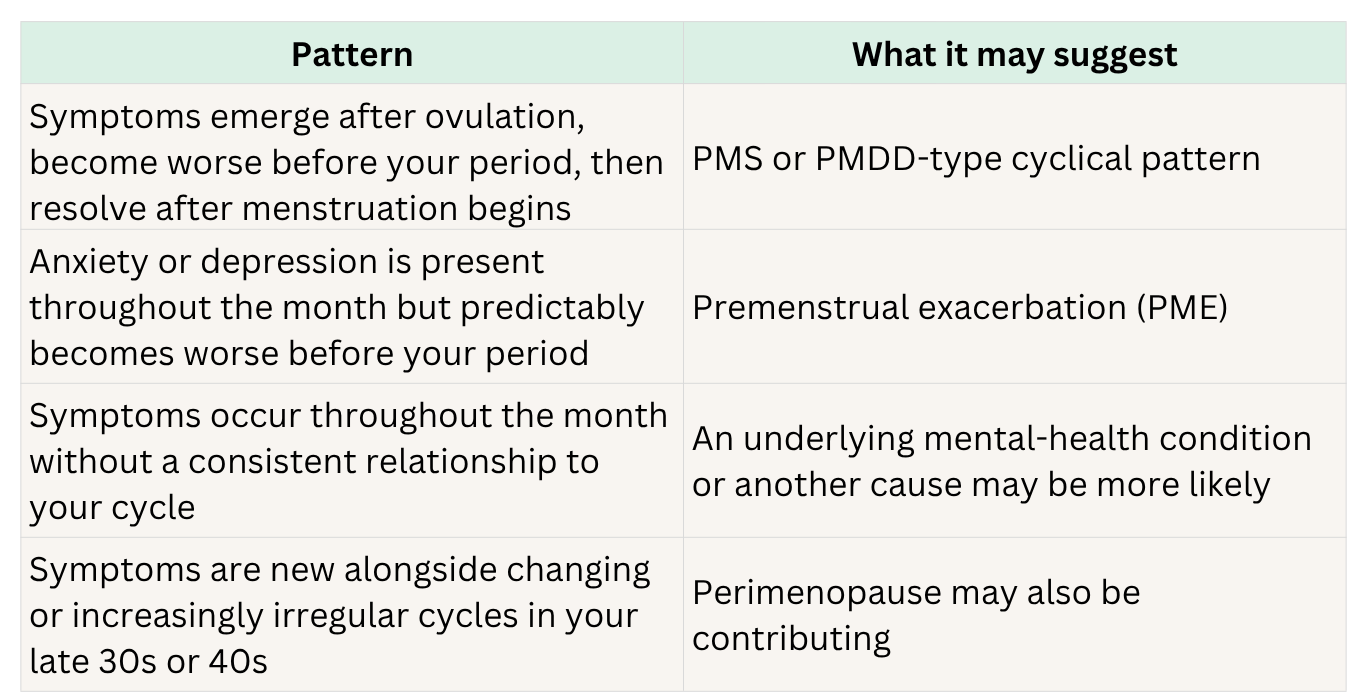
This table isn't a diagnostic tool. But these patterns give you more useful information than the symptom alone.
What is PMDD?
Premenstrual dysphoric disorder (PMDD) is a severe, cyclical mood disorder. Symptoms occur premenstrually during the luteal phase and improve within a few days after your period begins.[1]
They can include:
- marked irritability or anger
- depressed mood or hopelessness
- significant anxiety or tension
- mood swings
- trouble concentrating
- fatigue
- changes in sleep or appetite
- feeling overwhelmed
- physical premenstrual symptoms
To meet the definition of PMDD, symptoms must be severe enough to interfere with work, relationships, school, or daily life.[1]
PMDD isn't diagnosed with a hormone blood test. Diagnosis relies on daily symptom ratings recorded prospectively across at least two symptomatic cycles.[1,2,3]
If PMDD already sounds familiar, our guide to PMDD symptoms goes deeper into symptoms and relief strategies.
What is premenstrual exacerbation (PME)?
PME is a different pattern. With premenstrual exacerbation, symptoms of an existing condition such as depression or an anxiety disorder are present during the rest of the month but reliably get worse before your period.[2]
For example:
PMDD-type pattern: You feel emotionally well for much of the month. Symptoms appear premenstrually, become most severe before your period, and largely clear once bleeding starts.
PME pattern: You experience anxiety throughout the month. It becomes noticeably worse before your period, then eases back toward your usual baseline without disappearing.
That distinction can affect diagnosis and treatment.
It's also difficult to establish from memory alone. Looking back on a hard month can make it difficult to remember exactly when symptoms started, peaked, and eased.[3]
How do I know if my anxiety or depression is hormonal?
You usually can't tell from one symptom, one bad week, or one hormone result.
Look for repetition instead:
- Does anxiety consistently appear or worsen after ovulation?
- Does your mood reliably drop during the same part of your cycle?
- Do symptoms ease within a few days of your period starting?
- Is there another part of the month when you feel like yourself?
- Or are anxiety and depression present all month but noticeably worse before your period?
The answers can help separate a cyclical pattern from symptoms that happen to coincide with your period.
Why tracking ovulation matters
Your period start date gives you one marker in your cycle. Ovulation gives you another.
PMDD symptoms occur premenstrually during the luteal phase, which follows ovulation. Knowing approximately when you ovulated can add useful context to your symptom timeline.
Instead of: “I felt terrible last week.”
You may be able to say: “My anxiety started four days after my LH surge, was worst in the days before my period, and eased on Day 2 of my next cycle.”
That's information a clinician can work with. It also lets you see whether the same sequence happens the following month.
What should you track?
If you think your mood changes with your cycle, track every day, not only on your hardest days.
For at least two cycles, record:
- Mood and severity: anxiety, low mood, irritability, and mood swings, using the same simple scale each day.
- Cycle days: including the first day of each period.
- Ovulation timing: if you're tracking it.
- Sleep: poor sleep can affect mood and occur alongside hormone changes.
- Major stressors: work, relationships, illness, travel, or anything else that could explain a difficult stretch.
- Medications: including antidepressants, supplements, and hormonal contraception. If your contraception suppresses ovulation, you won't see a natural ovulatory hormone pattern.
- Hormone patterns: if you're tracking E3G, LH, and PdG.
The goal isn't to prove every hard day is hormonal. It's to see whether a repeatable relationship exists.
For a step-by-step approach, see how to track mood alongside your hormones.
What if my symptoms don't follow my cycle?
That's useful information too.
Anxiety and depression have many possible causes, and having a menstrual cycle doesn't mean hormones explain every mood symptom.
Sleep disorders, thyroid conditions, medications, chronic stress, other medical conditions, and primary mental-health conditions can all contribute.
If your symptoms never reliably ease during another part of your cycle, don't assume reproductive hormones are the main cause.
Why Do I Feel Off? Hormones, Stress, Thyroid, or Something Else? looks at the overlap more broadly.
Bring the pattern to your appointment
If you've been told your hormones are "normal" but your mood changes predictably every month, a symptom timeline can make the conversation more concrete.
Instead of saying: “I get really anxious before my period.”
You can show: “For the last three cycles, my anxiety started after ovulation, peaked two to three days before my period, and eased within the first few days of bleeding.”
Or: “I'm anxious all month, but it becomes much more severe about a week before every period.”
Those are different patterns, and the distinction can help your provider decide what to evaluate next.
Effective treatments exist for premenstrual mood disorders, including SSRIs and, in some cases, hormonal treatment options.[2] Identifying the pattern can help your provider determine what approach makes sense for you.
What if this starts in your late 30s or 40s?
Perimenopause adds another layer. During the menopausal transition, estrogen and ovulation become less predictable, and some women experience new or worsening anxiety, low mood, and sleep disruption.[6,7]
The pattern may also stop fitting neatly into "the week before my period" as cycles become more variable.
If you've had premenstrual mood symptoms for years and they're changing, read PMDD vs. perimenopause.
If anxiety is new in midlife, Is It Perimenopause or an Anxiety Disorder? walks through how to tell the difference.
When should you talk to a healthcare professional?
If anxiety, depression, irritability, or other mood symptoms are affecting your daily life, relationships, sleep, or ability to function, talk with a healthcare or mental-health professional.
You don't need to finish two months of tracking before getting help. Tracking can support an evaluation; it isn't a prerequisite for care.
PMDD can include thoughts of suicide, and those thoughts deserve to be taken seriously even if they fade once your period starts.
If you're having thoughts of suicide or self-harm, feel unable to keep yourself safe, or are in crisis, get help now. In the U.S., call or text 988 to reach the Suicide & Crisis Lifeline.
Hormones can influence mental health. That doesn't make your symptoms any less real or any less worth treating.
The bottom line
If anxiety or depression gets worse before your period, hormones may be part of the picture, but that doesn't mean your levels are abnormal.
For some women, the issue is heightened sensitivity to normal changes that happen across the menstrual cycle. For others, an existing anxiety or depressive disorder gets worse premenstrually.
You can't always tell which from how the symptoms feel.
When symptoms start, when they ease, and whether that timing repeats across cycles can help you and your provider understand what's happening.
FAQ
Why does my anxiety get worse before my period?
Changes in estrogen, progesterone, and progesterone-derived neurosteroids occur after ovulation and before menstruation. Some people appear to be particularly sensitive to these normal hormonal changes, which can contribute to premenstrual anxiety and other mood symptoms.
Why do I feel depressed before my period?
Depressed mood can be a symptom of PMS or PMDD, particularly when it predictably appears during the luteal phase and improves shortly after menstruation begins. Depression that persists throughout the month but becomes worse premenstrually may instead represent premenstrual exacerbation.
Can hormones cause anxiety and depression?
Hormonal changes can influence brain systems involved in mood, anxiety, and stress response, but anxiety and depression have many possible causes. A repeatable relationship between symptoms and the menstrual cycle can be an important clue, but it isn't a diagnosis by itself.
How do I know if my anxiety is hormonal?
Look at timing across multiple cycles. Anxiety that repeatedly emerges or worsens after ovulation and improves after your period begins may have a cyclical component. Daily symptom tracking for at least two cycles can help establish whether that pattern is present.
What's the difference between PMDD and depression?
PMDD symptoms follow a cyclical pattern, emerging during the luteal phase and improving around or shortly after menstruation begins. Major depression isn't defined by the menstrual cycle. However, someone with depression can experience premenstrual exacerbation, meaning their existing symptoms become worse before their period.
What is premenstrual exacerbation?
Premenstrual exacerbation, or PME, occurs when symptoms of an existing condition, such as depression or an anxiety disorder, become worse during the premenstrual phase. Unlike a classic PMDD pattern, symptoms remain present at other times of the month.
Can my hormone levels be normal and still affect my mood?
Yes. PMDD isn't thought to result simply from abnormal estrogen or progesterone levels. Evidence suggests that some people have greater sensitivity to normal changes in ovarian hormones and their effects on the brain.
About the author
Sources
- American Psychiatric Association. Diagnostic and Statistical Manual of Mental Disorders, Fifth Edition, Text Revision (DSM-5-TR). American Psychiatric Association Publishing; 2022.
- Eisenlohr-Moul TA, et al. Premenstrual disorders: a primer and research agenda for psychologists. Clin Psychol. 2020;73(1):5–17.
- Hantsoo L, Epperson CN. Premenstrual dysphoric disorder: epidemiology and treatment. Curr Psychiatry Rep. 2015;17(11):87.
- Schmidt PJ, Nieman LK, Danaceau MA, Adams LF, Rubinow DR. Differential behavioral effects of gonadal steroids in women with and in those without premenstrual syndrome. N Engl J Med. 1998;338(4):209–216.
- Maki PM, Kornstein SG, Joffe H, et al. Guidelines for the evaluation and treatment of perimenopausal depression: summary and recommendations. Menopause. 2018;25(10):1069–1085.
- Bromberger JT, Epperson CN. Depression during and after the perimenopause: impact of hormones, genetics, and environmental determinants of disease. Obstet Gynecol Clin North Am. 2018;45(4):663–678.
- International Association for Premenstrual Disorders. Premenstrual Disorders: Core Consensus and Clinical Resources.
- American College of Obstetricians and Gynecologists. Management of Premenstrual Disorders: Clinical Practice Guideline No. 7. Obstet Gynecol. 2023;142(6):1516–1533.
About the Oova Blog:
Our content is developed with a commitment to high editorial standards and reliability. We prioritize referencing reputable sources and sharing where our insights come from. The Oova Blog is intended for informational purposes only and is never a substitute for professional medical advice. Always consult a healthcare provider before making any health decisions.