
Noticed changes in your period after starting Ozempic, Wegovy, or Mounjaro? Learn how GLP-1 medications may affect ovulation, why some women notice more regular cycles, and what you need to know about contraception and pregnancy.

Noticed changes in your period after starting Ozempic, Wegovy, or Mounjaro? Learn how GLP-1 medications may affect ovulation, why some women notice more regular cycles, and what you need to know about contraception and pregnancy.
Can Ozempic change your period or make you ovulate? Possibly. Some women notice more regular menstrual cycles after starting GLP-1 medications, particularly when insulin resistance or polycystic ovary syndrome (PCOS) has contributed to irregular ovulation.
The relationship between GLP-1s and the menstrual cycle is still being studied. These medications may improve metabolic factors that influence reproductive health, but they are not approved fertility treatments. They also come with important pregnancy and birth control precautions that differ by medication.
If your period has changed since starting Ozempic, Wegovy, Mounjaro, or Zepbound, here's what might be happening and what you should know.
Key takeaways
- GLP-1 medications may be associated with changes in menstrual regularity, especially in women with PCOS, but research is still limited.
- A more regular period doesn't necessarily mean you're ovulating.
- Mounjaro and Zepbound can reduce the effectiveness of oral hormonal birth control, particularly after starting treatment or increasing the dose.
- Pregnancy planning requires medication-specific guidance. Do not assume all GLP-1-related medications have the same recommendations.
Can GLP-1 medications affect your menstrual cycle?
Yes, menstrual changes are possible, although not everyone experiences them and there is no single predictable pattern.
GLP-1 medications were developed to manage blood sugar and, for certain products, support weight management. They affect appetite, digestion, and metabolic regulation. Those changes can also influence factors involved in reproductive health.
For women whose irregular cycles are associated with insulin resistance, PCOS, or higher body weight, improvements in metabolic health may be accompanied by more regular menstrual cycles.
That doesn't mean the medication directly stimulates the ovaries or guarantees ovulation.
A 2023 systematic review of randomized trials in women with PCOS reported improvements in menstrual regularity and spontaneous pregnancy outcomes with GLP-1 receptor agonists. However, a 2026 systematic review of 11 randomized trials concluded that evidence remained insufficient to determine whether these medications reliably improve menstrual regularity. [1, 2]
The distinction matters: a more regular period may be encouraging, but it doesn't automatically confirm that ovulation has returned.
Why might your period change after starting Ozempic or Wegovy?
If you've noticed Ozempic period changes, or you're wondering about Wegovy and your menstrual cycle, several things may be happening at once.
Improvements in insulin resistance
Insulin plays an important role in metabolic health, but elevated insulin levels can also affect ovarian hormone production.
In women with PCOS, insulin resistance may contribute to higher androgen activity and disrupted follicle development. This can make ovulation less predictable.
When insulin sensitivity improves, the hormonal environment affecting the ovaries may also change. For some women, this could be associated with more regular ovulation and menstrual cycles.
It is not a guaranteed response, and insulin resistance is not the only factor involved.
Changes in body weight and energy balance
Weight changes can affect reproductive function, but the relationship is not as simple as losing weight and becoming more fertile.
In women with metabolic dysfunction, weight management may be associated with improved menstrual regularity. On the other hand, inadequate nutrition, substantial energy deficits, or rapid changes in weight can disrupt normal reproductive signaling.
If you're eating considerably less because of nausea, appetite suppression, or other medication effects, that is worth discussing with your provider, particularly if your periods become irregular or stop.
Changes in ovulation
For someone who previously had infrequent or absent ovulation, a change in metabolic health may coincide with ovulation becoming more frequent.
This is particularly relevant to women with PCOS.
But menstruation and ovulation are not the same thing. You can experience bleeding without ovulating, and a more predictable cycle does not prove that an egg was released.
Understanding whether ovulation actually occurred requires looking beyond the date your period arrives.
Can Ozempic or other GLP-1s help women with PCOS ovulate?
They may improve some factors associated with ovulatory dysfunction, but the evidence is not strong enough to consider GLP-1 medications established ovulation treatments.
PCOS often involves a combination of irregular ovulation, androgen-related symptoms, and metabolic changes, although these features vary from person to person.
The 2023 international PCOS guideline says GLP-1 receptor agonists may be considered for weight management in adults with PCOS, alongside lifestyle interventions, when appropriate. It does not recommend them as first-line fertility treatment. The guideline also emphasizes effective contraception during treatment because pregnancy safety data are insufficient. [3]
Some studies have reported improvements in menstrual frequency and spontaneous conception in women with PCOS. However, studies have not consistently measured ovulation directly, and results cannot automatically be applied to every medication or every patient.
If you have PCOS and are not currently trying to conceive, tracking menstrual and ovulatory patterns can still provide useful information about reproductive health. Our guide to tracking PCOS hormones when pregnancy isn't the goal explains what to monitor and why.
Does a regular period mean your PCOS is improving?
It may be one encouraging sign, but it isn't enough to determine whether your PCOS is improving overall.
Your clinician may also want to consider metabolic health, blood pressure, glucose regulation, androgen-related symptoms, and whether ovulation is occurring.
A more predictable cycle is useful information. It is not a replacement for a broader assessment.
Can you get pregnant unexpectedly while taking a GLP-1?
Yes. Pregnancy can occur if you ovulate and are not using effective contraception, even if your periods have been irregular for a long time.
What are "Ozempic babies"?
The phrase "Ozempic babies" refers to reports of pregnancies among people using GLP-1-related medications, sometimes after years of irregular cycles or difficulty conceiving.
There are plausible explanations. For example, some women may begin ovulating more regularly as their metabolic health changes. With certain medications, oral contraceptive effectiveness is also an important consideration.
But these reports do not establish that Ozempic itself increases fertility, and there is not enough evidence to predict who might experience improved ovulation.
If you do not want to become pregnant, do not assume irregular periods mean you cannot conceive. Discuss contraception with the clinician prescribing your medication.
Do GLP-1 medications make birth control less effective?
This depends on the medication.
GLP-1-related medications can delay gastric emptying, which affects how quickly food and some oral medications move through the digestive system. But not every medication in this category has the same clinically significant effect on birth control.
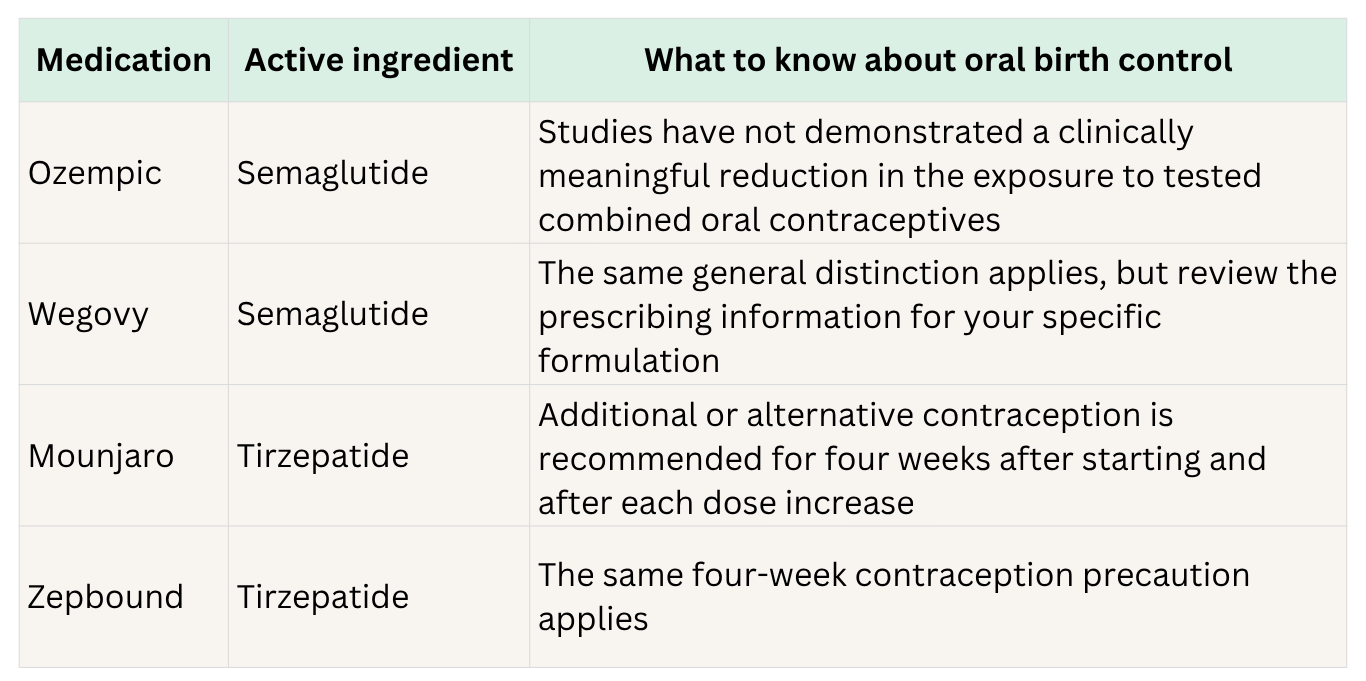
Mounjaro and Zepbound: An important contraception warning
Tirzepatide can reduce the effectiveness of oral hormonal contraceptives because of its effects on gastric emptying.
Its prescribing information advises patients using oral hormonal birth control to switch to a non-oral contraceptive method or add a barrier method for four weeks after starting tirzepatide and four weeks after every dose increase. [4]
This applies to oral hormonal contraception. The prescribing information states that non-oral hormonal contraceptives should not be affected by this mechanism.
If you use the pill, review your contraception plan with your prescriber before starting or increasing tirzepatide.
Does Ozempic affect the birth control pill?
Semaglutide is different.
A 2015 study of once-weekly semaglutide at 1.0 mg in postmenopausal women found no reduction in exposure to a tested combined oral contraceptive containing ethinylestradiol and levonorgestrel. [5]
This is reassuring for the formulation studied, but it should not be treated as direct evidence for every semaglutide formulation or dose, including all Wegovy regimens.
Severe vomiting or diarrhea can also interfere with taking or absorbing an oral contraceptive, regardless of the medication causing those symptoms.
Follow the missed-pill and gastrointestinal-illness instructions for your specific contraceptive, and ask your pharmacist or healthcare provider if you're unsure.
What hormone and cycle changes should you track while taking a GLP-1?
If your menstrual cycle changes after starting medication, documenting what happens can make your next healthcare appointment more productive.
Start with a few concrete observations:
- Cycle length: Are your periods coming more regularly, getting further apart, or arriving sooner?
- Ovulation: Are you detecting an LH surge, and is there evidence of a progesterone rise afterward?
- Bleeding: Have you noticed changes in timing, flow, or bleeding between periods?
- Symptoms: Are cramps, breast tenderness, mood changes, or other cycle-related symptoms changing?
- Medication changes: When did you start treatment or increase the dose?
- Weight and nutrition: Have changes in eating patterns or weight occurred around the same time?
The goal isn't to attribute every symptom to your medication. It's to understand the sequence of changes and give your provider useful context.
How can you tell whether you're actually ovulating?
An LH surge can suggest that ovulation is approaching, but it doesn't confirm that ovulation occurred.
That's why a positive OPK alone can't confirm you actually ovulated.
Progesterone normally rises after ovulation. Tracking that rise, along with LH and estrogen patterns, provides a more complete view of the ovulatory cycle than period dates or LH testing alone.
This can be especially useful when your cycles have historically been irregular, including with PCOS.
Can hormone tracking tell you whether your GLP-1 is working?
Not by itself.
The effectiveness of GLP-1 treatment depends on why it was prescribed. A clinician may assess measures such as blood sugar, HbA1c, weight, metabolic risk factors, treatment tolerability, or other clinical outcomes.
Reproductive hormone tracking answers a different question: What is happening to your menstrual and ovulatory patterns over time?
If your periods were previously irregular and you're now seeing evidence of more consistent ovulation, that's a meaningful change to discuss with your clinician. It doesn't prove that the medication caused it, or that your overall treatment is effective.
Ideally, establish a baseline before making a treatment change and continue tracking comparable information afterward. This makes it easier to distinguish an emerging pattern from a single unusual cycle.
Our guide to how to know whether a hormone treatment or lifestyle change is working explains how to approach that comparison.
Oova does not measure GLP-1 medication levels or insulin and cannot determine whether a medication caused a change in your cycle.
Can you take Ozempic or Mounjaro while trying to get pregnant?
This is a discussion to have with your prescribing clinician before you begin trying to conceive.
GLP-1-related medications require pregnancy planning, and recommendations differ depending on the medication and why it was prescribed.
How long before pregnancy should you stop Ozempic or Wegovy?
For Ozempic, the U.S. prescribing information recommends discontinuation at least two months before a planned pregnancy, because semaglutide takes time to clear from the body. [6]
Wegovy's current labeling also specifies a two-month discontinuation interval for weight reduction and cardiovascular risk reduction. Its labeling includes separate risk-benefit considerations for patients receiving treatment for metabolic dysfunction-associated steatohepatitis (MASH), so the exact indication matters. [7]
If you're using semaglutide to manage diabetes, your healthcare team should also establish a plan to maintain appropriate blood sugar control before and during pregnancy.
How long before pregnancy should you stop Mounjaro or Zepbound?
Tirzepatide also requires preconception planning, but its U.S. prescribing information does not specify the same fixed two-month interval used for semaglutide.
Your clinician can advise on an appropriate discontinuation timeline based on the medication, your medical history, and your pregnancy plans. [4]
Do not assume that a washout recommendation for one GLP-1-related medication applies to all others.
What if you become pregnant while taking a GLP-1?
Contact your prescribing clinician promptly if you have a positive pregnancy test.
For medications prescribed for weight management, current labeling generally recommends stopping treatment when pregnancy is recognized. Your care team should also address the underlying condition being treated, particularly if you have diabetes. Wegovy's MASH indication has additional risk-benefit language that requires individualized clinical assessment. [4, 6, 7]
An unexpected exposure does not, by itself, establish that harm has occurred. Individual assessment and appropriate pregnancy care are important.
When should you talk to your doctor about menstrual changes?
Contact your healthcare provider if your periods become persistently absent or unusually irregular, if you experience bleeding between periods, or if menstrual changes are accompanied by other concerning symptoms.
If pregnancy is possible and your period is late, take a pregnancy test rather than assuming the delay is related to medication.
Seek urgent assessment for severe pelvic pain, heavy bleeding accompanied by dizziness or weakness, or other severe symptoms.
It may also be useful to schedule a routine conversation when you notice a sustained change in cycle length or ovulation after starting or adjusting treatment, even when you feel otherwise well.
Questions to ask your healthcare provider
If you're taking a GLP-1 and noticing changes in your cycle, consider asking:
- Could changes in insulin resistance, weight, or nutrition be affecting my menstrual cycle?
- If my periods are becoming more regular, should we check whether I'm ovulating?
- How should I manage contraception with this specific medication?
- What is the safest approach if I want to become pregnant in the future?
- Which outcomes should we monitor to know whether treatment is working?
- Would tracking my hormone and cycle patterns provide useful information alongside my other clinical measurements?
Frequently asked questions
Can Ozempic make your period regular?
Some women, particularly those with PCOS or insulin resistance, may notice more regular periods as their metabolic health changes. Research suggests potential benefits in some groups, but evidence is inconsistent, and regular periods are not guaranteed.
Can Ozempic cause a missed period?
A missed period can occur for many reasons, including pregnancy, changes in energy intake, weight changes, stress, PCOS, and other medical conditions. Do not assume semaglutide is the cause. If pregnancy is possible, take a pregnancy test.
Can GLP-1 medications improve fertility?
Studies in women with PCOS have reported some promising reproductive outcomes, but evidence remains limited. GLP-1 medications aren't approved fertility treatments, and their use during pregnancy requires medication-specific clinical guidance.
Can you ovulate without getting a regular period?
Yes. Ovulation happens before a subsequent period, so you can ovulate and conceive before you've had a period that signals your cycle has returned. This is particularly important if your periods have previously been absent or irregular.
Does Mounjaro interfere with birth control?
Mounjaro contains tirzepatide, which can reduce the effectiveness of oral hormonal contraception. The prescribing information recommends an additional barrier method or a switch to non-oral contraception for four weeks after starting and four weeks after every dose increase.
Does Wegovy affect birth control the same way as Mounjaro?
Not necessarily. Semaglutide and tirzepatide have different evidence and prescribing guidance concerning oral contraceptive exposure. The specific tirzepatide contraception warning should not automatically be applied to semaglutide.
Can Oova tell whether Ozempic is making me ovulate?
Oova can help track estrogen, LH, and progesterone patterns that provide information about ovulation. It cannot determine whether Ozempic caused ovulation to occur or evaluate the medication's effectiveness.
The bottom line
GLP-1 medications can affect metabolic factors connected to reproductive health. For some women, particularly those with PCOS, these changes may coincide with more regular menstrual cycles or ovulation.
But a period becoming more predictable doesn't prove ovulation is occurring, and a change in ovulation doesn't automatically mean that the medication caused it.
If pregnancy is possible, contraception deserves particular attention. Tirzepatide has specific precautions for oral hormonal contraceptives, and pregnancy planning recommendations differ among medications.
If you're noticing changes in your cycle, recording your symptoms and hormone patterns can give you useful information to discuss with your healthcare provider.
About the author
Sources
- Zhou L, et al. Effects of GLP1RAs on pregnancy rate and menstrual cyclicity in women with polycystic ovary syndrome: a meta-analysis and systematic review. BMC Endocrine Disorders. 2023;23. DOI: 10.1186/s12902-023-01500-5.
- Forslund M, Wändell P, Forsberg L, et al. GLP-1 receptor agonist treatment in women with polycystic ovary syndrome: a systematic review and meta-analysis. European Journal of Endocrinology. 2026;194(3):25–39. DOI: 10.1093/ejendo/lvag033.
- Teede HJ, et al. Recommendations From the 2023 International Evidence-based Guideline for the Assessment and Management of Polycystic Ovary Syndrome. Human Reproduction. 2023;38(9):1655–1679. DOI: 10.1093/humrep/dead156.
- Eli Lilly and Company. Mounjaro (tirzepatide) Injection, Full Prescribing Information. DailyMed. See also Eli Lilly and Company. Zepbound (tirzepatide) Injection, Full Prescribing Information. Revised August 2026. DailyMed.
- Kapitza C, Nosek L, Jensen L, et al. Semaglutide, a once-weekly human GLP-1 analog, does not reduce the bioavailability of the combined oral contraceptive, ethinylestradiol/levonorgestrel. Journal of Clinical Pharmacology. 2015;55(5):497–504. DOI: 10.1002/jcph.443.
- Novo Nordisk. Ozempic (semaglutide) Injection, Full Prescribing Information. Revised May 2026. DailyMed. Supports semaglutide pregnancy planning and contraceptive pharmacology.
- Novo Nordisk. Wegovy (semaglutide) Injection and Tablets, Full Prescribing Information. June 2026 DailyMed labeling. DailyMed.
About the Oova Blog:
Our content is developed with a commitment to high editorial standards and reliability. We prioritize referencing reputable sources and sharing where our insights come from. The Oova Blog is intended for informational purposes only and is never a substitute for professional medical advice. Always consult a healthcare provider before making any health decisions.
