PCOS hormone tracking is often discussed only in the context of pregnancy, but ovulation is also an important signal of overall hormone and cycle health. This guide explains how to track LH, E3G, PdG, cycle variability, symptoms, and treatment response when conception is not the goal. Readers will learn what patterns may be useful to monitor, why single tests often miss PCOS variability, and how longitudinal data can support more productive conversations with a healthcare provider.

PCOS hormone tracking is often discussed only in the context of pregnancy, but ovulation is also an important signal of overall hormone and cycle health. This guide explains how to track LH, E3G, PdG, cycle variability, symptoms, and treatment response when conception is not the goal. Readers will learn what patterns may be useful to monitor, why single tests often miss PCOS variability, and how longitudinal data can support more productive conversations with a healthcare provider.
Most PCOS hormone advice ends in the same place: getting pregnant.
But even when conception is not your goal, your cycle is still telling you something.
Outside fertility, PCOS hormone tracking is about understanding cycle function, symptoms, and whether your pattern changes after an intervention, not simply predicting a fertile window.
Are your ovaries attempting to ovulate? Does progesterone rise afterward, suggesting that ovulation occurred? Are your cycles becoming more consistent? Do symptoms appear alongside particular hormone changes? If you start metformin, inositol, a different exercise routine, or another intervention, does anything measurably shift?
Those questions matter whether you are trying to conceive now, may want to later, or have no plans to become pregnant.
One caveat before going further: PCOS can overlap with thyroid dysfunction, metabolic conditions, medication effects, sleep disruption, and chronic stress. Hormone monitoring can help make your reproductive pattern more visible, but it cannot determine by itself which condition is driving a particular symptom. That requires clinical evaluation.
For help thinking through overlapping symptoms, read Why Do I Feel Off? Hormones, Stress, Thyroid, or Something Else.
Why Track PCOS Hormones If You Are Not Trying to Conceive?
PCOS is often treated as a fertility condition. In reality, it is a broader endocrine and metabolic disorder that can affect ovulation, bleeding patterns, androgen-related symptoms, metabolic health, sleep, and emotional well-being. Current international guidance specifically addresses both reproductive and non-fertility aspects of PCOS care.
Hormone tracking may help you answer practical questions such as:
- Am I ovulating consistently?
- Is bleeding occurring after ovulation, or could it be anovulatory bleeding?
- Is my cycle becoming more or less variable?
- Do certain symptoms appear near identifiable hormone shifts?
- Does my pattern change after starting a treatment or lifestyle intervention?
- What information would be useful to bring to my clinician?
The goal is not to achieve one universal “perfect” hormone number. PCOS is heterogeneous, which means its presentation differs substantially between individuals. The more useful question is often: What is typical for me, and is that pattern changing?
What Is Worth Tracking With PCOS?
A useful PCOS record combines biological measurements with cycle context, symptoms, and interventions.

Each category answers a different question. Period dates alone cannot confirm ovulation. An LH result alone cannot show whether an egg was released. Symptoms alone cannot establish whether a change is hormonal. The value comes from seeing them together.
Why LH Alone Is Not the Full Story With PCOS
Luteinizing hormone, or LH, participates in the hormonal signal that precedes ovulation. Standard ovulation predictor kits are designed to detect an LH rise.
But detecting LH is not the same as confirming ovulation.
Some people with PCOS have elevated or irregular LH patterns, while others do not. Because PCOS presentations vary, a single threshold or test line may be difficult to interpret. An LH rise can indicate that the body is moving toward ovulation, but it does not prove that ovulation followed. Research and clinical literature also caution that elevated LH is not present in every person with PCOS, so it should not be treated as a defining feature of the condition.
This is why a positive ovulation test may leave important questions unanswered:
- Was this the true pre-ovulatory surge?
- Was it one of several LH rises?
- Did progesterone increase afterward?
- Did the cycle progress into a luteal phase?
For a deeper explanation of why PCOS can make LH-only testing hard to interpret, see PCOS Ovulation Patterns: Why You Need Daily Tracking, Not Just LH Tests.
What E3G Adds to the Picture
Estrone-3-glucuronide, or E3G, is a urinary metabolite of estrogen.
Estrogen generally rises as a follicle develops. Looking at E3G across time can provide context around the lead-up to a possible ovulation event. Instead of asking whether estrogen was “normal” on one day, you can look at whether it rose, stayed relatively flat, fluctuated, or followed a different pattern from one cycle to the next.
That does not mean every irregular E3G curve has one specific interpretation. PCOS can involve varied reproductive patterns, and urinary E3G does not replace clinical estradiol testing or ovarian imaging.
Its value is longitudinal context: what happened before the LH rise, and how did that sequence compare with your other cycles?
Why PdG Matters Even When Pregnancy Does Not
Pregnanediol glucuronide, or PdG, is a urinary metabolite of progesterone.
Progesterone normally rises after ovulation. A sustained post-LH increase in urinary PdG can therefore provide evidence that ovulation occurred, rather than only that an LH signal was detected. Studies comparing urinary PdG patterns with established methods support its use as an adjunct for retrospective ovulation confirmation.
That distinction matters outside fertility because ovulation is also part of cycle function.
Tracking PdG may help differentiate between:
- An LH rise followed by a progesterone response
- An LH rise without a clear subsequent PdG increase
- Bleeding after an apparent ovulatory cycle
- Irregular bleeding without evidence of a preceding ovulation
It should not be used to self-diagnose a progesterone disorder or determine treatment without a clinician. But it can help close the information gap left by LH-only tracking.
For more context, read Anovulatory vs. Ovulatory PCOS: The Difference That Changes Everything. Although that article is framed around conception, the distinction between ovulatory and anovulatory cycles matters beyond TTC.
Can You Bleed Without Ovulating?
Yes.
Anovulatory bleeding occurs when bleeding happens without ovulation. Without the normal post-ovulation progesterone pattern, the uterine lining can become unstable and shed irregularly. That bleeding may be prolonged, heavy, unpredictable, light, or period-like.
This means a bleed on your calendar does not automatically prove that a complete ovulatory cycle occurred.
For someone with PCOS, that distinction can change how you interpret:
- “Regular” versus irregular cycles
- Whether an intervention is affecting cycle function
- Long gaps between bleeds
- Repeated spotting
- Heavy or prolonged bleeding
- Whether progesterone is rising after LH
Persistent, heavy, painful, or otherwise concerning bleeding should be evaluated by a healthcare professional. At-home tracking is not a substitute for assessing abnormal uterine bleeding.
What a PCOS Diagnosis Actually Requires
Hormone tracking does not diagnose PCOS.
In adults, current international guidance uses updated Rotterdam-based criteria. After other possible causes are excluded, diagnosis generally requires at least two of the following:
- Clinical or biochemical hyperandrogenism
- Ovulatory dysfunction
- Polycystic ovarian morphology on ultrasound or, in adults, elevated anti-Müllerian hormone as an alternative to ultrasound in the appropriate diagnostic pathway
AMH is not recommended as a stand-alone PCOS test, and the adult diagnostic pathway differs from the approach used for adolescents.
A clinician may also evaluate for other causes of irregular cycles or androgen-related symptoms, including thyroid disease, hyperprolactinemia, non-classic congenital adrenal hyperplasia, Cushing syndrome, or androgen-producing tumors, depending on the presentation.
Oova measures LH, E3G, and PdG. It does not measure:
- Testosterone or other androgens
- Insulin
- Blood glucose or HbA1c
- Thyroid markers
- Prolactin
- Lipids
- AMH
Oova’s role is to provide longitudinal reproductive-hormone and symptom context that can complement, not replace, a clinical workup.
PCOS Is Also a Metabolic Condition
PCOS can include metabolic risk even when pregnancy is not a concern.
Insulin resistance is common in PCOS and may occur across body sizes. NIH women’s health materials estimate that roughly 70% of women with PCOS have insulin resistance leading to hyperinsulinemia, although estimates vary according to population and measurement method. PCOS is also associated with increased long-term risk for type 2 diabetes and other metabolic conditions.
That is why weight, cravings, fatigue, and energy changes should not automatically be treated as a matter of willpower, or assumed to come entirely from reproductive hormone changes.
For more on the metabolic side of the condition, see Why PCOS Makes Weight Loss So Hard, and What Actually Helps.
How to Build a Useful PCOS Baseline
Before you can tell whether your pattern changed, you need an initial reference point.
One cycle can provide a first view. Two complete cycles can offer a more useful baseline because PCOS patterns may differ substantially from one cycle to the next.
Across those cycles, track:
- LH, E3G, and PdG according to your testing plan
- The first day and duration of bleeding
- Cycle length
- Spotting or unexpected bleeding
- Symptoms and their severity
- Medication and supplement use
- The date of any dose or routine change
- Relevant contextual factors such as illness or major sleep disruption
Do not judge the cycle by one isolated high or low result. Look at the sequence:
- Did E3G rise?
- Was there an identifiable LH increase?
- Did PdG rise afterward?
- Did bleeding follow?
- Did the sequence recur in the next cycle?
- How did your symptoms align with those changes?
For a broader guide to interpreting these trends, read How to Read Your Hormone Results and What They Mean.
You can also use How to Build Your Hormone Baseline Before Everything Changes to organize your first baseline period.
See Your Full PCOS Hormone Pattern
How to Track Whether a Change Is Working
Suppose you start metformin, inositol, a new nutrition strategy, a different exercise routine, or another clinician-recommended treatment.
Hormone tracking cannot prove by itself that the intervention caused a particular result. But comparing your baseline with later cycles may help show whether measurable aspects of your pattern are shifting.
Establish the baseline first
Ideally, collect your starting hormone, cycle, and symptom pattern before making a change. If treatment needs to begin immediately, start tracking as early as practical and document the exact start date.
Avoid changing everything at once
When several medications, supplements, or routines change simultaneously, it becomes difficult to understand which factor may have contributed to any improvement or worsening.
Look for predefined markers
Choose markers connected to your goal, such as:
- Shorter or more consistent cycle length
- Fewer prolonged gaps between bleeds
- A clearer LH pattern
- A PdG rise following LH more consistently
- Reduced symptom severity
- Improved sleep or energy
- Less unpredictable bleeding
Compare several signals
A treatment should not be judged solely by whether one hormone value moved. A medication might improve androgen-related symptoms or metabolic markers without creating an immediate change in the three hormones tracked by Oova.
Clinical labs, symptoms, cycle patterns, and your provider’s assessment may all matter.
Give the pattern appropriate time
The correct observation period depends on the intervention, the symptom, and your clinician’s plan. Do not delay needed follow-up while waiting for a certain number of cycles.
Common PCOS Patterns You May See
The following patterns are not diagnoses. They are observations that can help organize a provider conversation.
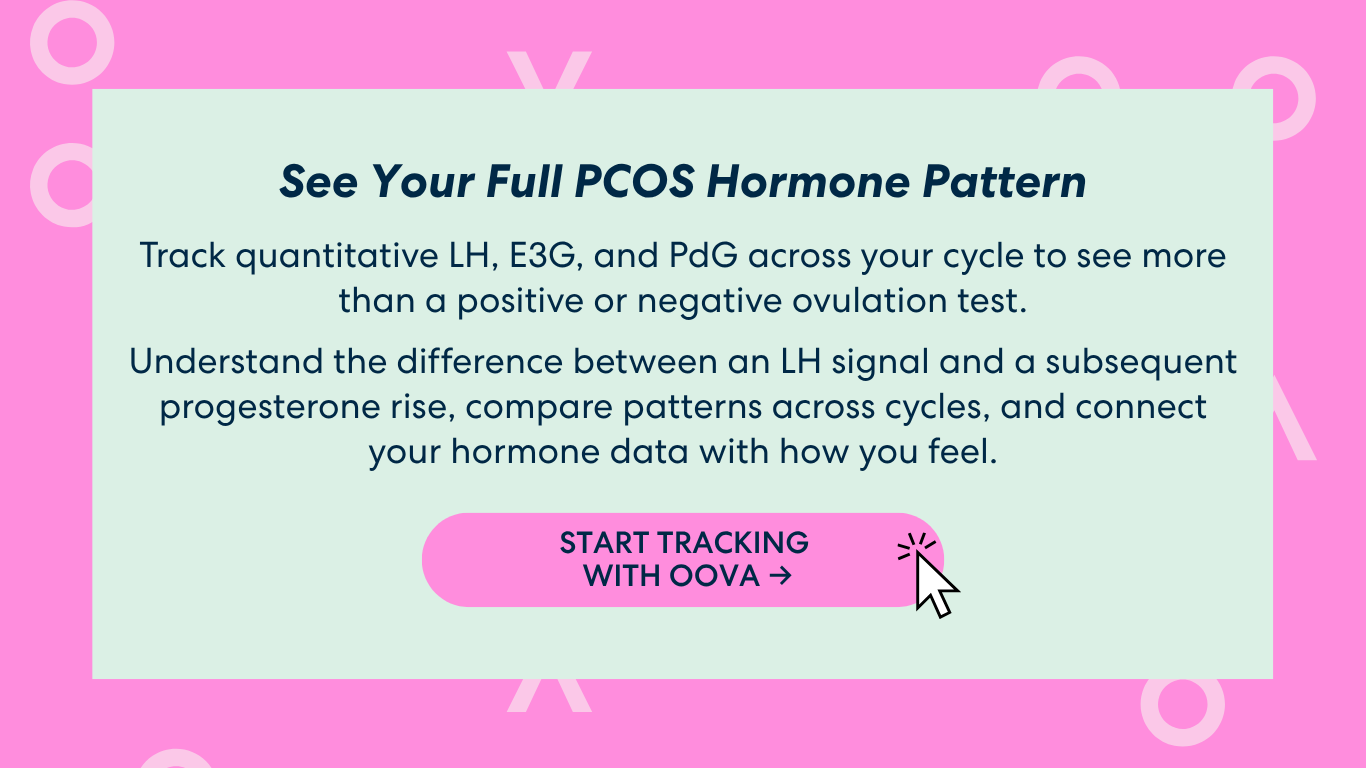
Avoid turning these patterns into conclusions such as “I have low progesterone,” “my estrogen is too high,” or “my treatment failed” without clinical interpretation.
The point is to bring a clearer timeline into the conversation: Here is what happened before the LH rise, what happened afterward, when I bled, how I felt, and whether the same sequence occurred again. That is more useful than arriving with a folder of disconnected screenshots.
When to Bring Your Data to a Provider
Consider discussing your cycle and hormone pattern with a clinician when you notice:
- Persistently absent or very infrequent periods
- Repeated cycles without an identifiable PdG rise
- Increasingly irregular cycles
- Heavy, prolonged, or unexpected bleeding
- Significant pelvic pain
- New or rapidly worsening acne, facial hair, or scalp hair loss
- Symptoms suggestive of thyroid or metabolic disease
- A treatment is not producing the expected clinical benefit
- A sudden change from your established baseline
Seek prompt medical attention for severe bleeding, severe pain, fainting, chest pain, shortness of breath, or other acute symptoms rather than relying on app-based tracking.
PCOS Across Life Stages
PCOS patterns can change as reproductive aging progresses.
In the late 30s and 40s, changes in cycle length, bleeding, mood, sleep, or metabolism may reflect PCOS, perimenopause, another condition, or some combination. A previous PCOS diagnosis should not lead you to assume that every new symptom has the same cause.
For a closer look at that overlap, read PCOS in Your 40s: Is It Perimenopause, PCOS, or Both?.
A personal baseline can be particularly useful during this transition. Instead of comparing yourself only with population-wide ranges, you can see how your current pattern differs from your own earlier cycles.
What PCOS Hormone Tracking Can, and Cannot, Do
It may help you:
- See whether an LH rise is followed by a PdG increase
- Identify broad cycle patterns and variability
- Distinguish a calendar bleed from evidence of an ovulatory sequence
- Connect symptoms with cycle timing
- Establish a baseline before an intervention
- Compare patterns before and after a change
- Prepare for a more informed provider conversation
It cannot:
- Diagnose PCOS
- Measure androgens, insulin, thyroid hormones, or prolactin
- Determine the cause of every symptom
- Prove that a treatment caused a change
- Replace evaluation of abnormal bleeding
- Tell you to start, stop, or adjust medication
- Replace clinical judgment
Your PCOS Is More Than a Fertility Diagnosis
Your hormone data can be useful even when pregnancy is nowhere on your agenda.
Oova helps you see how LH, E3G, and PdG move across your cycle, compare patterns over time, and understand whether an LH signal is followed by a progesterone response.
Use that information to understand your body more clearly, and bring better evidence into your next appointment.
The Bottom Line
PCOS hormone tracking outside fertility is not about chasing a fertile window or one perfect hormone number.
It is about building a personal baseline, distinguishing an attempted ovulatory signal from evidence that ovulation occurred, observing how symptoms align with your cycle, and seeing whether your pattern changes over time.
That pattern does not replace a diagnosis or treatment plan.
But it can help you stop guessing, ask more precise questions, and make your next care conversation more productive.
Frequently Asked Questions
Can you track PCOS hormones if you are not trying to conceive?
Yes. PCOS hormone tracking may help you understand cycle function, ovulation patterns, cycle variability, symptoms, and whether your pattern changes after an intervention. It does not diagnose PCOS.
Which hormones are useful to track with PCOS?
LH provides information about the hormonal signal that precedes ovulation, E3G reflects changes in estrogen activity, and a sustained PdG rise after LH can provide evidence that ovulation occurred.
Do people with PCOS always have high LH?
No. Some people with PCOS have elevated or irregular LH, while others do not. LH levels alone are not used to diagnose PCOS.
Can you have a period without ovulating?
Yes. Anovulatory bleeding can occur without ovulation and may resemble a period. Tracking the hormone sequence before bleeding can provide additional context.
How many cycles should you track with PCOS?
One full cycle provides an initial view. Two complete cycles may provide a stronger baseline because PCOS patterns can vary between cycles. Individual needs may differ.
Can Oova diagnose PCOS?
No. Oova tracks LH, E3G, and PdG over time. PCOS diagnosis requires clinical evaluation and consideration of ovulatory dysfunction, hyperandrogenism, ovarian morphology or AMH in appropriate adults, and exclusion of other causes.
About the author
Sources
- 2023 International Evidence-Based Guideline for the Assessment and Management of PCOS.
- American College of Obstetricians and Gynecologists overview of PCOS.
- NICHD overview of PCOS diagnosis and long-term health considerations.
- Research on urinary PdG as an adjunct for confirming ovulation.
- NCBI clinical overview of anovulatory bleeding.
- NIH overview of metabolic and insulin-resistance considerations in PCOS.
About the Oova Blog:
Our content is developed with a commitment to high editorial standards and reliability. We prioritize referencing reputable sources and sharing where our insights come from. The Oova Blog is intended for informational purposes only and is never a substitute for professional medical advice. Always consult a healthcare provider before making any health decisions.