
Starting a hormone treatment, supplement, or lifestyle change can feel like an experiment without a clear endpoint. This guide explains how to establish a personal baseline, choose meaningful measures of progress, document the timing of an intervention, and compare hormone and symptom patterns over time. Readers will learn how to distinguish normal variability from a possible treatment response, when clinical testing is still needed, and what information to bring to a healthcare provider.

Starting a hormone treatment, supplement, or lifestyle change can feel like an experiment without a clear endpoint. This guide explains how to establish a personal baseline, choose meaningful measures of progress, document the timing of an intervention, and compare hormone and symptom patterns over time. Readers will learn how to distinguish normal variability from a possible treatment response, when clinical testing is still needed, and what information to bring to a healthcare provider.
You started something because you wanted to feel better. HRT. Metformin. Progesterone. Inositol. A new supplement. Strength training. Less alcohol.
A few weeks in, the question changes. It's no longer what should I try, it's is this actually working?
That's harder to answer than it sounds. Hormones shift day to day and cycle to cycle. Symptoms improve unevenly. Several things usually change at once. A more useful approach treats the change as a structured personal experiment: document what was happening before, define what improvement would look like, record exactly what changed, and compare the same measures afterward. This borrows from the logic of an N-of-1 trial: evaluating yourself against your own baseline rather than assuming everyone responds the same way.
Start With the Question You Actually Want Answered
"Are my hormones better?" is too vague to measure. Better questions: Are my cycles more consistent? Is progesterone rising after ovulation? Are hot flashes less frequent? Is my sleep improving? Do clinical markers such as thyroid, glucose, androgens, look better? Do the benefits outweigh the side effects?
The right measure depends on the treatment's purpose. A sleep intervention shouldn't be judged by a reproductive hormone. A medication for insulin resistance needs different markers than HRT prescribed for hot flashes. Before tracking anything: what problem am I solving, and what would count as progress?
What to Track, and Why

No single category tells the whole story, symptoms can improve before hormone numbers shift noticeably, or vice versa, and a treatment can help its target while causing side effects that make it a poor fit anyway.
Step 1: Establish Your Baseline
You can't measure change without knowing your starting point. A baseline captures what's typical for you, not just one unusually good or bad day. Depending on the intervention, that might include LH/E3G/PdG across one or more cycles, cycle length and variability, whether an LH rise is followed by a PdG rise, symptom frequency and severity, sleep, current medications, and relevant stressors or illness.
Two complete cycles often provide a more useful baseline than one, because meaningful cycle-to-cycle variation can occur. That said, the right baseline period depends on the intervention being tracked. Learning how to read your hormone results and what they mean is worth doing before drawing conclusions from either. You may also want to start with how to build a personal hormone baseline so you know which patterns, symptoms, and cycle changes to capture before evaluating an intervention.
Already started treatment? Don't stop a prescribed treatment just to create a cleaner baseline. Record the start date, document what you remember beforehand, gather prior labs or cycle records if you have them, and start tracking consistently now. A less-than-perfect baseline still beats no timeline.
Build Your Baseline Before You Change the Plan
Track quantitative LH, E3G, PdG, cycle patterns, and symptoms so you have a clearer before-and-after record to share with your provider.
Step 2: Record What Actually Changed
"Started supplements" isn't enough detail six weeks later. Document the treatment, dose, route, start date, any dose changes, missed doses, side effects, and anything else you changed around the same time.
Before deciding that an intervention failed, confirm that it was used consistently and as directed. A missed dose, a patch that didn't adhere, inconsistent supplement timing, or a changed formulation can look like non-response when the real issue is exposure. This distinction matters especially for HRT: delivery method, adherence, absorption, and your own fluctuating hormone baseline can all affect how a dose performs. For more context, see why some women thrive on HRT while others feel worse and how pills, patches, creams, and gels can absorb differently.
This principle is especially useful with supplements, where taking something consistently is not the same as knowing whether it changed your biology. Our guide to whether hormone supplements are actually working explains how to evaluate common interventions such as magnesium, inositol, Vitex, and DIM without relying only on how you feel that day.
Tell your provider and pharmacist about everything you're taking, prescription or not, supplements can interact with medications or change how they're absorbed.
Step 3: Change One Major Variable at a Time When You Can
If you start progesterone, cut alcohol, add magnesium, and change your diet in the same week and then sleep better, you won't know which change helped. Necessary treatment should never be delayed to make tracking cleaner, but when changes are elective, introducing one at a time makes the resulting pattern easier to read. Follow your prescriber's plan for anything involving medication starts, stops, or dose changes.
Step 4: Pick a Small Set of Measures You'll Actually Repeat
The best metric isn't the most impressive one, it's the one you'll record consistently. For symptoms, use a simple scale rather than "felt bad": hot flashes per day, sleep awakenings per night, migraine days per month, mood on a 1–5 scale. For hormones, focus on sequence and pattern rather than a single number relative to a threshold, whether E3G rises before ovulation, the shape of the LH rise, whether PdG follows it, cycle length, cycle-to-cycle variability. A useful model is tracking mood alongside your hormone levels, which helps show whether anxiety, irritability, or mood changes repeatedly appear near the same biological shifts.
Wearables can add context, sleep duration, resting heart rate, HRV, temperature trends, but a wearable score isn't a reproductive hormone measurement. It's most useful read alongside biochemical patterns and symptoms, not as a standalone explanation.
For a closer look at how reproductive hormones can influence readiness, HRV, and recovery metrics, read Can Hormones Affect Recovery? What Wearables Don’t Tell You and why your Oura score may change before your period.
How Long Should You Track?
There's no single timeline that fits every intervention. Symptom-focused changes may become visible within days or weeks, while reproductive hormone and cycle patterns may require one or more complete cycles to show a reliable pattern. Clinical treatments may also require scheduled bloodwork or other monitoring on their own timeline, regardless of what appears in at-home data, don't use a general timeline in place of your provider's monitoring plan.
For HRT specifically, review what happens after starting HRT, week by week, what to track during the first 90 days of HRT, and why HRT can appear to stop working after it initially helped. Use these guides to prepare more precise questions for your clinician—not to self-adjust a prescription.
Step 5: Compare Patterns, Not Individual Days
A good day is encouraging. It isn't proof, and a bad day doesn't mean the intervention failed. Compare frequency, severity, duration, timing relative to your cycle, and consistency across repeated cycles instead.
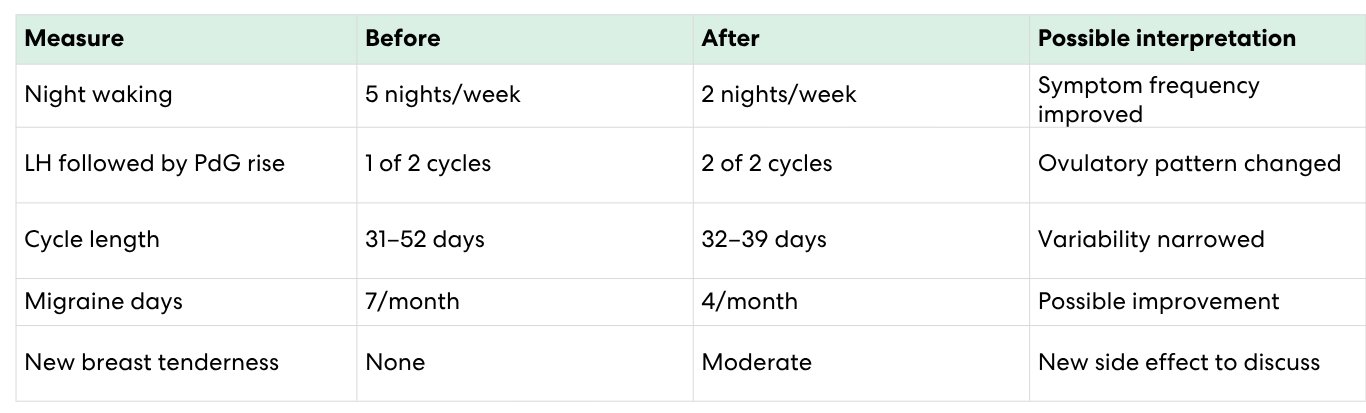
The same principle applies when tracking ovulation and cycle function. One positive LH result does not show the full sequence; what matters is whether estrogen rose beforehand, whether LH increased, and whether PdG rose afterward. Our guide to confirming whether ovulation actually occurred explains why the pattern matters more than one result.
The word possible matters, an observed change doesn't establish causation on its own. Natural variation, regression to the mean, adherence changes, illness, and other concurrent changes can all contribute.
Telling Signal From Normal Variability
A difference is more persuasive when it repeats across multiple cycles, is sustained rather than a single-day blip, lines up in time with the intervention, shows up in more than one relevant measure, and is consistent with what the treatment is supposed to do. It's less persuasive when it appears once, several things changed at the same time, adherence was inconsistent, or the observation window was too short.
If your cycles themselves are changing, it may help to first understand why fertility and hormone patterns can become more variable before they consistently decline. Normal variation does not make tracking useless; it is the reason repeated measurements are more informative than a single snapshot.
When Hormone Data and How You Feel Disagree
Sometimes your numbers change and you don't feel better. Sometimes you feel much better and the hormone pattern doesn't look dramatically different. Neither should be ignored. Possible reasons: the treatment affects something Oova doesn't measure, symptoms have more than one cause, timing or dose isn't optimized yet, or the reproductive hormones weren't the primary driver to begin with.
Before assuming one explanation covers everything, review whether your symptoms may be hormonal, stress-related, thyroid-related, or something else. If your clinical labs were labeled normal but you still feel unwell, why hormones can look normal while you still feel terrible also explains why timing and patterns can matter.
When to Bring This to Your Provider
Bring your tracking record in when symptoms are worsening, new side effects appear, bleeding becomes heavy or unexpected, a prescribed treatment isn't producing the expected benefit, or your symptom and hormone data seem to contradict each other. A useful summary includes: the problem you were addressing, your baseline, the treatment and start date, adherence, symptom and hormone changes, side effects, and the specific decision you need help making. That's a far more actionable conversation starter than "I think it's helping, but I'm not sure."
For help interpreting the point at which self-tracking should become a clinical conversation, see how to know when your hormone data means you should talk to a doctor.
What Oova Can, and Can't, Show
Can help you: establish a quantitative hormone baseline, track LH/E3G/PdG over time, compare cycle patterns before and after a change, see whether LH is followed by a PdG rise, connect symptoms with hormone movement, and prepare a clearer provider conversation.
Can't: prove an intervention caused a change, determine whether a medication is safe for you, tell you to start, stop, or adjust a prescription, measure thyroid hormones, insulin, testosterone, or cortisol, or replace required clinical labs.
Stop Relying on "I Think It's Helping"
Oova helps you compare quantitative hormone, cycle, and symptom patterns before and after a change, so you can see whether a shift repeated and bring a clearer record into care.
SEE WHETHER MY PATTERN IS CHANGING →
The Bottom Line
Define the outcome you want. Establish your baseline. Document exactly what changed. Track a small, consistent set of measures. Compare patterns at reasonable intervals, not day to day. Tracking can't turn an everyday experiment into proof of cause and effect, but it can replace a vague impression with a real record, and help you and your provider make the next decision with more information.
About the author
Sources
- AHRQ/NCBI: Understanding How to Use Single-Patient Studies to Answer Patient-Specific Questions/
- ACOG: Menopause Symptom Tracker.
- ACOG: Hormone Therapy for Menopause.
- FDA: Drug Interactions: What You Should Know.
- NIH/PMC: N-of-1 Trials as a Decision Support Tool in Clinical Practice.
About the Oova Blog:
Our content is developed with a commitment to high editorial standards and reliability. We prioritize referencing reputable sources and sharing where our insights come from. The Oova Blog is intended for informational purposes only and is never a substitute for professional medical advice. Always consult a healthcare provider before making any health decisions.