
Inositol is popular for PCOS, but does it actually help ovulation? Here is what clinical guidance says, how to judge change over time, and when to seek fertility care.

Inositol is popular for PCOS, but does it actually help ovulation? Here is what clinical guidance says, how to judge change over time, and when to seek fertility care.
Inositol may help some women with PCOS, but evidence that it reliably restores ovulation is limited and uncertain. Research suggests possible improvements in certain metabolic measures. That is different from proving that the supplement makes your cycle regular, improves your chances of pregnancy, or corrects the underlying causes of PCOS. [1, 2]
If you've started taking myo-inositol or a myo-inositol and D-chiro-inositol combination, the practical question is probably not whether a study reported a promising average. It's whether anything meaningful has changed for you. Here's what to watch for and where clinical testing still matters.
Key takeaways
- The 2023 international PCOS guideline allows consideration of inositol based on preferences, while emphasizing limited clinical benefits and uncertain ovulation outcomes.
- Menstrual regularity is useful to track, but a more predictable period does not prove ovulation occurred.
- There is no sufficiently established formulation or dose that guidelines recommend as best for all women with PCOS.
- Hormone tracking can document changes in your cycle; it cannot show that inositol caused them.
What is inositol, and why do women take it for PCOS?
Inositols are compounds involved in cell signaling, including pathways related to insulin. Myo-inositol and D-chiro-inositol are two commonly discussed forms. Supplements may contain one or both, sometimes alongside folic acid or other ingredients.
PCOS is not one single hormone profile. Some people have insulin resistance, others primarily experience ovulatory dysfunction or androgen-related symptoms, and many have a mix of features. This helps explain the appeal of a supplement marketed around insulin signaling.
But a plausible mechanism is not the same as a proven clinical benefit. Researchers have studied inositol for glucose-related measurements, androgen levels, cycle regularity, ovulation, and pregnancy outcomes. The findings differ by study design, formulation, and outcome. [1, 2]
Does inositol help women with PCOS ovulate?
There isn't a dependable yes-or-no answer for an individual person. The 2023 international evidence-based PCOS guideline concludes that inositol can be considered for some women with PCOS, but notes limited clinical benefits in ovulation, hirsutism, and weight. For infertility specifically, it considers inositol experimental because benefits and risks are too uncertain to recommend it as fertility therapy. [1]
A systematic review informing that guideline found limited and inconclusive evidence overall. Some comparisons suggested possible benefits in certain outcomes, but the evidence was not sufficiently consistent or strong to support sweeping treatment claims. [2]
That doesn't prove inositol never helps. It means you should be wary of statements such as 'everyone with PCOS ovulates within three months' or 'this ratio is guaranteed to restore your period.' The studies do not justify those promises.
Does getting a period mean the supplement worked?
Not necessarily. Some people with PCOS have bleeding episodes without ovulation. Others ovulate but have variable cycle lengths. A shorter or more predictable cycle can be useful information, but it isn't proof that an egg was released. Anovulatory vs. Ovulatory PCOS: What It Means for TTC
You may also have changed your exercise routine, nutrition, weight, sleep, or prescription treatment around the same time. Without a controlled comparison, it is rarely possible to isolate the effect of a single supplement.
The more useful question is whether your ovulatory pattern has changed, and whether that change matters for the goals you discussed with your clinician.
Myo-inositol vs. D-chiro-inositol: does the type matter?
Supplement marketing often focuses on a specific myo-inositol to D-chiro-inositol ratio. You may see confident claims that one formula copies a natural balance or works better for everyone.
The international PCOS guideline does not recommend any particular inositol type, dose, or combination because high-quality evidence is lacking. It also warns that supplement composition and quality can vary. [1]
If you are considering a product, look beyond the ratio. Ask how much of each ingredient it contains, whether there is independent quality testing, and whether other compounds have been added. Bring the label to your clinician, especially if you're also taking metformin or fertility medications.
What does inositol research say about insulin and testosterone?
Because insulin resistance can contribute to increased androgen activity and disrupted ovulation in PCOS, researchers have also studied inositol-related changes in metabolic and androgen markers.
Some small trials report improvements in individual laboratory measures, but results differ. A change in insulin or testosterone does not by itself prove that ovulation has returned or that symptoms will improve. [1, 2]
How long does inositol take to work for PCOS?
There is no validated timeline for when inositol should improve ovulation or menstrual regularity. Many studies assessed outcomes after approximately three to six months, but study duration is not a promise that a supplement will work by then. The formulation, dose, outcome measured, and participant population all vary. [2]
If you and your clinician decide to try inositol, agree in advance on what you're trying to change. Are you monitoring cycle length, signs of ovulation, a laboratory measurement, or a symptom such as acne? What would count as a meaningful difference, and when should it be reassessed?
How can you tell if your PCOS cycle is changing?
Begin by recording several pieces of information consistently. A simple calendar can show whether a cycle becomes more predictable, while hormone data can add context about what happens before and after a possible ovulation event.
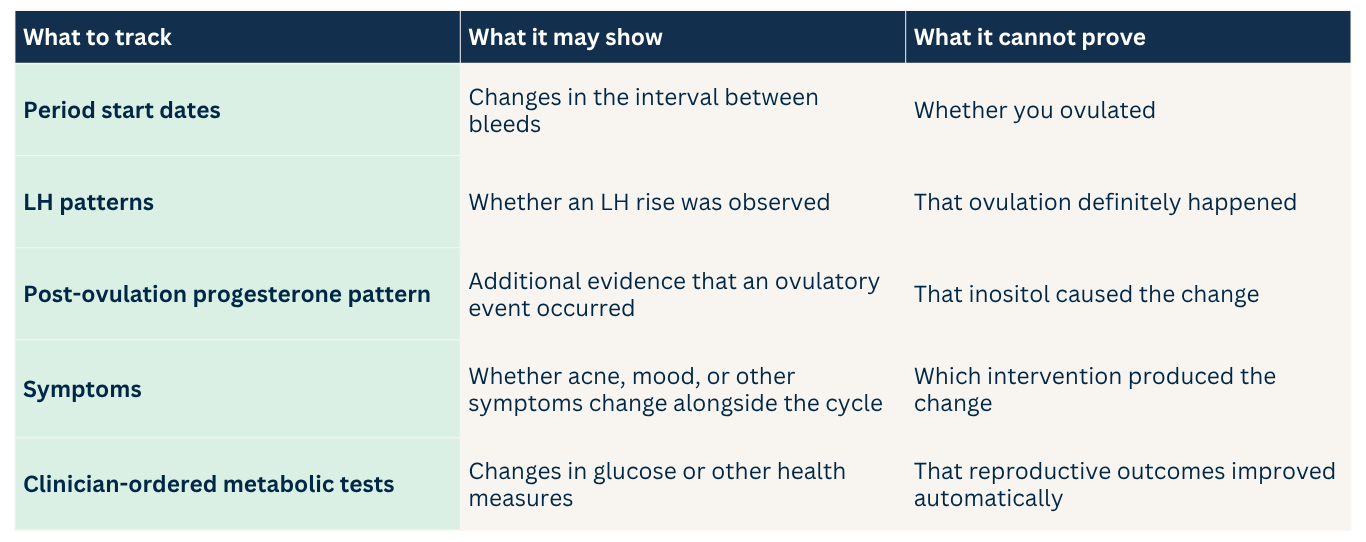
LH tests alone may be difficult to interpret in some PCOS cycles because elevated or fluctuating LH can complicate identification of a true surge. Looking for a subsequent progesterone rise is useful context, although results should still be interpreted with your clinician. [3] PCOS Ovulation Patterns: Why LH Tests Alone Can Miss It
For PCOS-specific interpretation, see our guide to confirming ovulation with PCOS. How to Confirm Ovulation With PCOS
What if you're not trying to get pregnant?
Ovulation still matters to many people with PCOS who are not trying to conceive. Long gaps without periods may require attention to endometrial health, while androgen symptoms and metabolic risks deserve their own assessment.
Our guide to tracking PCOS hormones when pregnancy isn't the goal explains how to think about this without assuming every reader is TTC.
What if you're trying to conceive with PCOS?
If pregnancy is your goal, a supplement should not replace evidence-based fertility evaluation or ovulation induction when those are indicated. The international guideline identifies letrozole as a first-line pharmacologic ovulation induction treatment for anovulatory infertility in PCOS when other infertility factors are absent. [1] For a comparison of ovulation induction options, consult our Letrozole and Clomid guide once its published URL has been checked in the CMS.
How quickly to seek evaluation depends on age and medical history. ASRM recommends evaluation after 12 months of regular unprotected intercourse if under 35, after six months at 35 or older, and earlier when there is a known condition associated with infertility. [3]
A clinician can also review whether your cycles appear ovulatory, whether other factors need assessment, and whether current supplements or medicines are appropriate when planning pregnancy.
Are there risks to taking inositol?
Inositol is often described as gentle, but supplements are not regulated in the same way as prescription medicines. Quality, ingredient amounts, and combinations can vary. Trial evidence on adverse effects and longer-term outcomes is incomplete. [1, 2]
Tell your healthcare team what you take, including dose, brand, and other ingredients. That is especially important if you are pregnant, trying to conceive, or taking medications to manage metabolic health.
Do not stop a prescribed medication because a supplement advertisement promises equivalent results. Clinical care for PCOS can involve lifestyle support, metabolic management, treatments for androgen symptoms, or fertility treatment depending on your priorities.
Questions to ask your clinician
1. Which PCOS features are we trying to improve, and how should we measure them?
2. Is inositol reasonable for my situation, given the limited evidence?
3. Does the supplement interact with my prescribed treatment or pregnancy plans?
4. Should we assess whether I am ovulating, not only whether I am bleeding?
5. How long should we monitor before reassessing the plan?
6. What evidence-based alternatives should we consider if my goals aren't being met?
The bottom line
Inositol is worth discussing with a clinician if you're interested in its potential role in PCOS management, but the research is less certain than many supplement advertisements suggest. A cycle that looks more regular may be encouraging; it is not definitive evidence of improved ovulation or fertility.
The most useful way to evaluate any change is to choose outcomes that match your goals, record them consistently, and review them with a clinician. If cycle insight is part of that plan, explore Oova's Hormone Optimization Kit for longitudinal estrogen, LH, and progesterone tracking.
Frequently asked questions
Can myo-inositol make you ovulate?
It might help some people, but evidence is not strong enough to promise restored ovulation. The 2023 PCOS guideline describes limited clinical benefits and does not recommend inositol as an established infertility treatment.
How long before my period becomes regular on inositol?
There is no reliable universal timeline. Many trials measured results over roughly three to six months, but that is a study follow-up period, not a validated time to benefit. A more regular bleed also does not necessarily prove ovulation. [2]
Is a 40:1 inositol ratio best for PCOS?
No particular ratio or combination has been established as the best option for everyone. The international guideline says evidence is insufficient to recommend a specific type, dose, or combination. [1]
Can I take inositol with metformin?
Some people use both, but the decision should be made with a clinician who knows your prescriptions, other supplements, medical history, and goals. Do not alter prescribed treatment on your own.
Can Oova tell me whether inositol is working?
No. Oova can help you observe estrogen, LH, and progesterone patterns over time. It does not measure inositol, insulin, or prove that a supplement caused a reproductive change.
About the author
Sources
- Teede HJ, et al. Recommendations from the 2023 International Evidence-based Guideline for the Assessment and Management of Polycystic Ovary Syndrome. Human Reproduction. 2023;38(9):1655–1679. https://pmc.ncbi.nlm.nih.gov/articles/PMC10505534/.
- Fitz V, Graca S, et al. Inositol for Polycystic Ovary Syndrome: A Systematic Review and Meta-analysis to Inform the 2023 Update of the International Evidence-based PCOS Guidelines. J Clin Endocrinol Metab. 2024;109(6):1630–1655. DOI: 10.1210/clinem/dgad762. https://pubmed.ncbi.nlm.nih.gov/38163998/.
- American Society for Reproductive Medicine. Fertility evaluation of infertile women: a committee opinion, 2026. https://www.asrm.org/practice-guidance/practice-committee-documents/fertility-evaluation-of-infertile-women-a-committee-opinion-2026.
About the Oova Blog:
Our content is developed with a commitment to high editorial standards and reliability. We prioritize referencing reputable sources and sharing where our insights come from. The Oova Blog is intended for informational purposes only and is never a substitute for professional medical advice. Always consult a healthcare provider before making any health decisions.
