
A practical comparison of what each tracker tells you, what happens after a positive LH test, and how testing, wearables, and costs fit your routine.
A practical comparison of what each tracker tells you, what happens after a positive LH test, and how testing, wearables, and costs fit your routine.
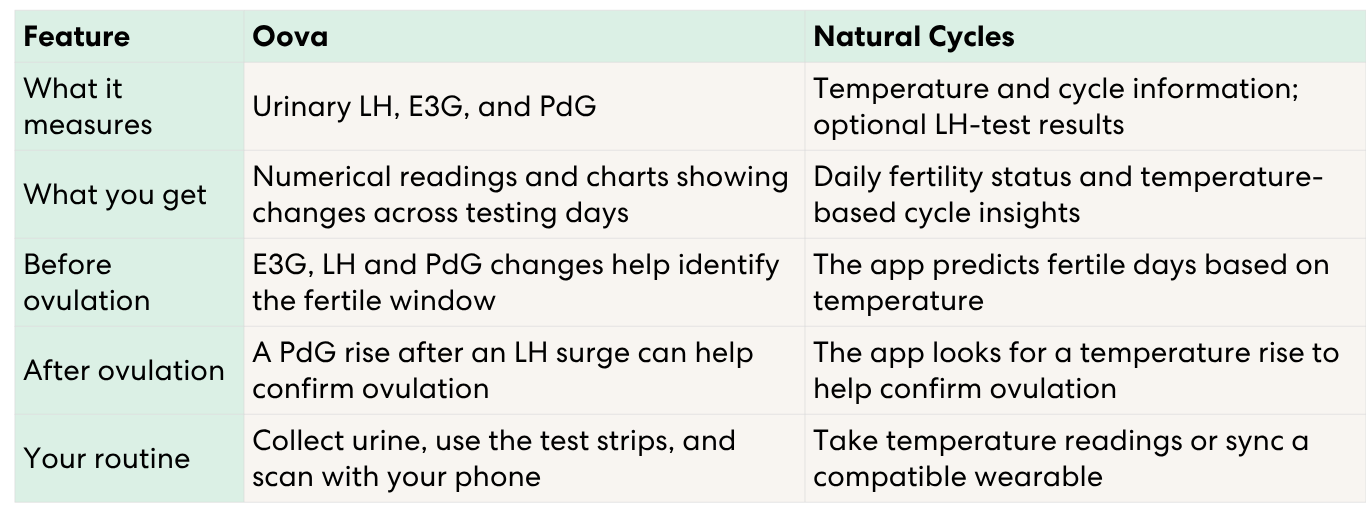
Oova and Natural Cycles help you follow your cycle in different ways. Oova uses urine tests to measure LH and two hormone metabolites, E3G and PdG. Natural Cycles uses temperature and cycle information to calculate fertile days and identify ovulation.[1,2]
If you're trying to conceive, Oova lets you understand your hormonal changes leading up to and following ovulation. Natural Cycles gives you fertility guidance built around temperature readings, with the option to add LH-test results.[1–3]
The choice depends on what you want to know and how you'd prefer to collect that information. Here's how the two approaches compare.
Oova vs. Natural Cycles at a glance
One difference matters immediately if you're choosing contraception: Oova is not intended to prevent pregnancy. NC° Birth Control has a separate FDA-authorized contraceptive intended use.[4] The comparison below focuses on tracking while trying to conceive.
What can you learn from hormone tracking?
An ovulation test can leave you with a follow-up question. You saw an LH rise, but what happened afterward?
LH rises as ovulation approaches. Oova also measures E3G, an estrogen metabolite, and PdG, a progesterone metabolite. A metabolite is a substance your body produces as it processes a hormone.[1]
These readings describe different parts of your cycle. E3G and LH changes provide information leading up to expected ovulation. PdG provides information afterward. A PdG rise following an LH surge can help confirm ovulation when the app's criteria are met.[1]
That makes Oova useful when you want to follow the sequence, including what happens after a positive LH result. The app shows numerical readings across your testing days, so you can review the changes together.
For example, you might notice E3G rising, followed by an LH surge, then a later PdG rise. Following that order helps you connect a positive ovulation test with the readings that come next.
Oova measures urinary markers. A blood test measures circulating hormones, and the results are not interchangeable. You can share your Oova chart with your provider as a record of cycle and ovulation trends.
What can you learn from temperature tracking?
Natural Cycles follows another change that happens after ovulation: progesterone usually causes a small increase in body temperature.[2]
You collect temperature readings with a supported device, either by measuring manually or syncing a compatible wearable. The app combines those readings with cycle information to calculate daily fertility status.[2,8]
It looks for the temperature shift to help identify ovulation. As you continue collecting data, the app updates its calculations. You see the fertility guidance and temperature chart rather than numerical E3G or PdG measurements.[1,2]
Natural Cycles also accepts LH-test results. These are optional and help narrow down ovulation timing. The algorithm still looks for a temperature rise afterward to confirm ovulation.[3]
If you prefer checking an app's daily fertility guidance to reading several urinary marker values, that may suit you. Your temperature device and the app work together, so compatibility matters when choosing a setup.
What happens after a positive LH test?
Say your LH test turns positive on Tuesday. If you're trying to conceive, that result suggests ovulation may be approaching. The days before ovulation matter for timing intercourse.[3,5]
Over the following days, each system looks for different information. With Oova, you continue the testing schedule and follow the PdG readings. With Natural Cycles, you continue collecting temperatures while the app looks for a sustained shift.[1–3]
This explains why an LH result and a temperature change may appear on different days. They reflect different parts of the process. Our guide to a positive ovulation test without a BBT rise covers that situation in more detail.
For conception, use the information available before ovulation to time attempts. The later PdG or temperature pattern helps you look back at the cycle.[5] Read about signs ovulation is over for more on those changes.
How much work does each routine involve?
With Oova, testing takes place on the days in your personalized scanning schedule. You collect urine, use the indicated test strips, and scan them with your smartphone after the instructed wait.[6]
The practical commitment is having supplies ready and making time to test. Follow the sampling and scanning instructions consistently so you're comparing readings collected under similar conditions.
With Natural Cycles, the routine depends on your temperature device. Manual measurement means taking the reading yourself. With a compatible wearable, you wear it during sleep and sync the data to the app.[2,8]
A wearable may fit easily into a routine you already have. It still requires enough recorded data, charging, and syncing. Natural Cycles also provides instructions for excluding temperatures affected by illness or other circumstances.[11]
If you already wear an Oura Ring and don't want routine urine testing, a compatible temperature-based setup may feel convenient.
If seeing numerical urinary LH, E3G, and PdG readings matters to you, Oova's testing routine provides that information. Consider whether collecting and scanning tests fits comfortably into your mornings.
Where does Oura fit?
Oura is a separate wearable platform that works with both Oova and Natural Cycles through different integrations.[7]
For Natural Cycles, Oura supplies overnight temperature data used in the app's fertility calculations. You check your fertility status in Natural Cycles.[8]
For Oova, eligible Oura sleep and recovery data can appear alongside your urinary marker readings.[7,9] You still use Oova's urine tests to measure LH, E3G, and PdG. Connecting a ring doesn't collect those measurements for you.
Oova and Oura scientists have also collaborated on menstrual-cycle research presented at ASRM in October 2026.[10]
If you already have Oura, choose the additional information you want. Natural Cycles uses the temperature record for fertility calculations. Oova adds urine measurements and lets you view eligible wearable data beside that cycle record.
What if your cycles are irregular?
Unpredictable cycles can make it harder to plan testing around a date on the calendar. Before choosing Oova, check how the scanning schedule works when your cycle runs longer than expected. Include any additional testing supplies in your budget.[6]
For Natural Cycles, review the instructions for variable cycles and missing temperature readings. The guidance you receive depends on the information available to its algorithm.[2]
Hormonal medications can affect cycle patterns or temperature. If you use them, check suitability with your healthcare team before starting either routine.[11] Keep prescribed treatment monitoring and medication decisions with that team.
What should you compare on price?
Compare the total cost over the same number of months. For Oova, that includes the kit and the testing supplies you'll use. Check what's included in the purchase and how refill orders work.
For Natural Cycles, include the app subscription and the device required for your chosen setup. Check whether that setup also requires a separate wearable membership.[8,12]
Already owning a compatible device changes the upfront calculation. You should still include recurring subscriptions, memberships, and supplies. Check renewal terms and the price after any introductory offer ends.
Which should you choose?
Choose Oova if you want numerical urinary marker readings before and after expected ovulation. It suits the question, “What happened after my LH surge?” by adding PdG tracking to the record.[1]
Choose Natural Cycles if you prefer temperature-based fertility guidance and a daily measurement or wearable routine.[2]
If you're comparing Oova with other urine-testing systems, our Oova vs. Mira and Oova vs. Inito guides cover those choices.
Follow your LH surge and the PdG pattern afterward
Oova measures urinary LH, E3G, and PdG to help you track your fertile window and follow ovulation. See your readings together in the app after testing at home. Explore Oova Fertility
Frequently asked questions
Does Natural Cycles measure progesterone?
It follows temperature changes associated with progesterone after ovulation. Oova measures urinary PdG, a progesterone metabolite, and displays a numerical reading.[1,2]
Can I use LH strips with Natural Cycles?
Yes. You can add LH results to help narrow down ovulation timing. Its algorithm still looks for a temperature rise afterward.[3]
Does Oova work without an Oura Ring?
Yes. Oova measures urinary markers using test strips and a smartphone scan. Oura is an optional integration for viewing eligible wearable data alongside those readings.[1,9]
Can I use either tracker as a pregnancy test?
Use an hCG pregnancy test to check for pregnancy. Follow that test's instructions or your clinic's testing schedule.[13]
If you'd like to see urinary LH, E3G, and PdG changes through your next cycle, explore Oova's fertility kit.
About the author
Sources
1. Oova. Fertility Hormone Tracking Kit. Live product details, accessed November 23, 2026. Product page. Urinary markers, smartphone scanning, and cycle-tracking scope.
2. Natural Cycles. How the Natural Cycles app works. Live documentation, accessed November 23, 2026. How it works. Temperature-based fertility guidance and ovulation detection.
3. Natural Cycles. Why should I take ovulation tests? Live documentation, accessed November 23, 2026. LH guidance. Optional LH results and subsequent temperature confirmation.
4. US Food and Drug Administration. Natural Cycles De Novo classification order DEN170052. 2018. FDA order. Natural Cycles' contraceptive intended use.
5. ASRM and Society for Reproductive Endocrinology and Infertility Practice Committees. Optimizing natural fertility: a committee opinion. 2022. Guidance. Fertile-window timing.
6. Oova. When should I scan? Updated February 4, 2026. Instructions. Personalized testing schedules and scanning routine.
7. Oura. Partner Integrations. Updated November 16, 2026. Partner documentation. Oova and Natural Cycles are separate Oura integrations.
8. Natural Cycles. How does the Oura Ring work with Natural Cycles? Live documentation, accessed November 23, 2026. Integration guidance. Temperature syncing and app routine. See also the membership FAQ for costs associated with that setup.
9. Oova. How do I connect my Oura Ring to Oova? Updated July 10, 2026. Connection instructions. Also see Oova's July 6, 2026 integration announcement. Connection and sleep/recovery data alongside hormone tracking.
10. Oova. New Oova Research with ŌURA Scientists Describes How Menstrual Cycle Hormones Align with Sleep and Readiness. October 28, 2026. Research announcement. ASRM pilot research; exploratory findings requiring further study.
11. Natural Cycles. When and how should I exclude my temperature? Live documentation, accessed November 23, 2026. Guidance. Illness and medication considerations.
12. Natural Cycles. Terms of Service. Updated October 27, 2025. Terms. Subscription and renewal structure.
13. US Food and Drug Administration. Pregnancy. Live consumer guidance, accessed November 23, 2026. Home pregnancy testing. hCG pregnancy testing.
About the Oova Blog:
Our content is developed with a commitment to high editorial standards and reliability. We prioritize referencing reputable sources and sharing where our insights come from. The Oova Blog is intended for informational purposes only and is never a substitute for professional medical advice. Always consult a healthcare provider before making any health decisions.
