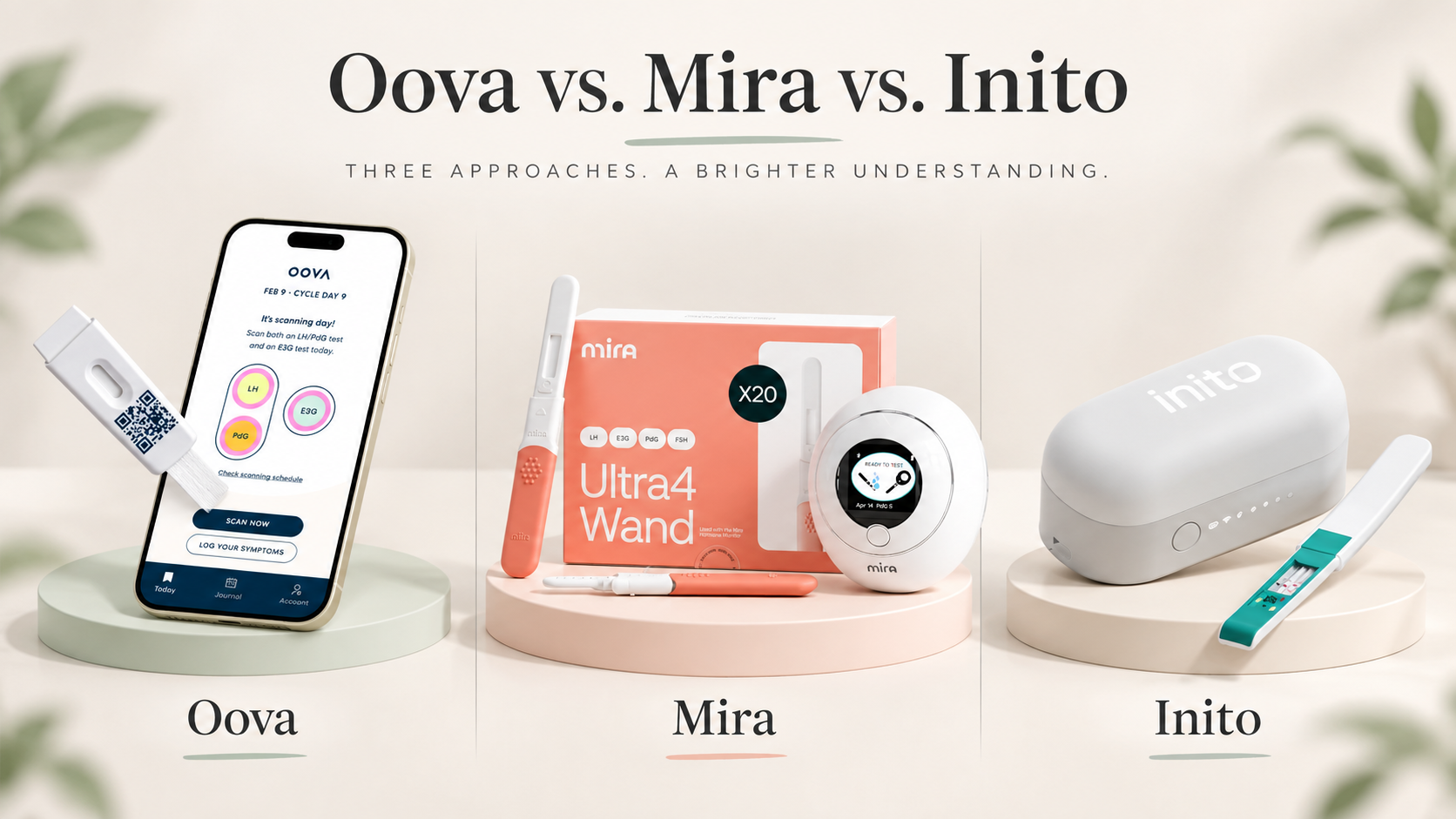
Oova and Inito both provide quantitative at-home hormone tracking, but they are designed around different needs. Compare hormones measured, ovulation tracking, irregular-cycle support, longitudinal insights, provider sharing, testing experience, and cost to determine which hormone tracker is the better fit for your goals.
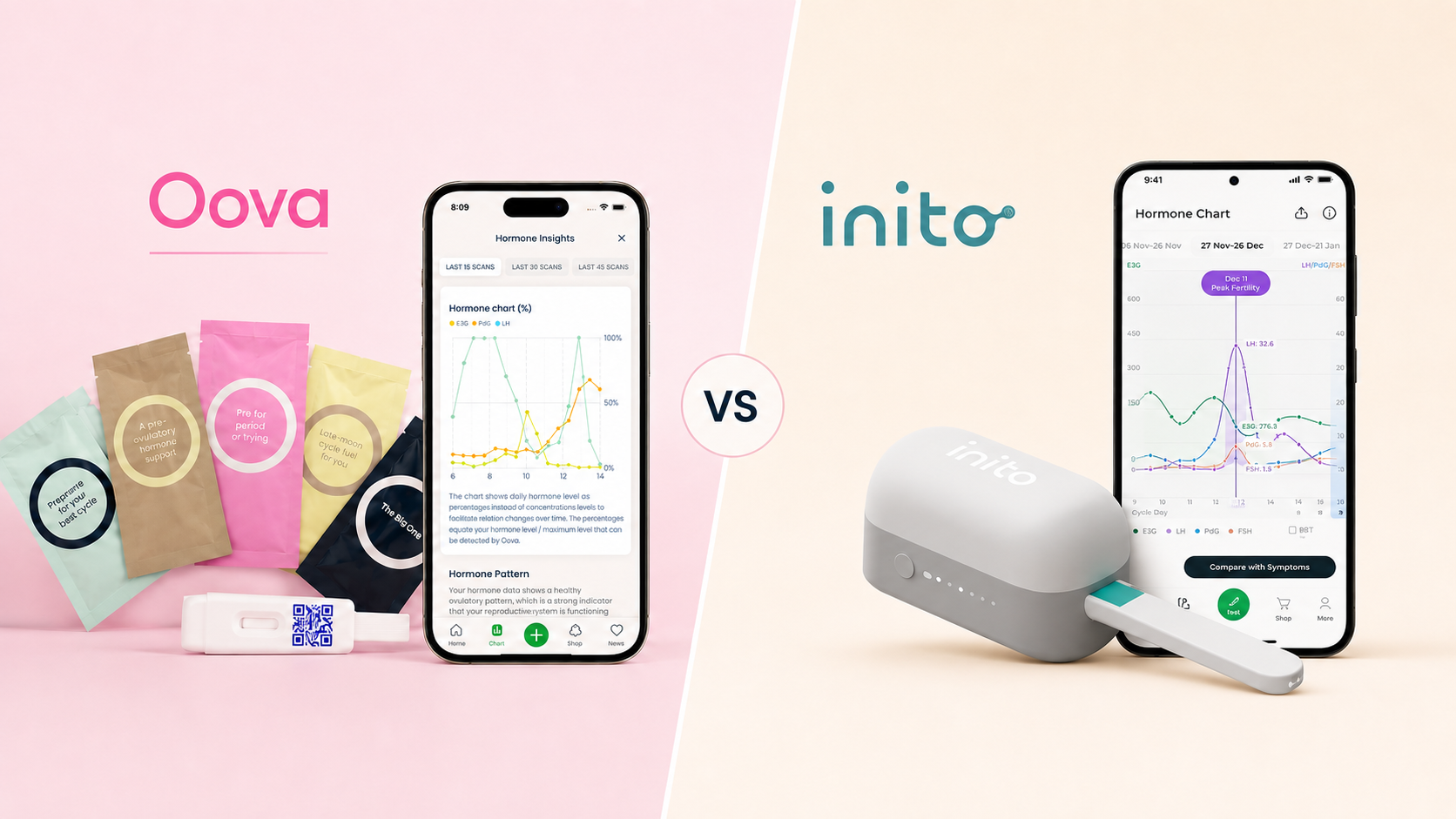
Oova and Inito both provide quantitative at-home hormone tracking, but they are designed around different needs. Compare hormones measured, ovulation tracking, irregular-cycle support, longitudinal insights, provider sharing, testing experience, and cost to determine which hormone tracker is the better fit for your goals.
If you're weighing Oova against Inito, both give you quantitative hormone data instead of a simple positive-or-negative line. Where they differ is in what they're built to answer. Inito is a fertility-focused, four-hormone-per-strip tracker built around a one-time device purchase. Oova is a broader hormone-health platform spanning fertility, symptom investigation, and perimenopause, built around a subscription or one-time kit model. Here's how they compare.
Oova vs. Inito at a Glance
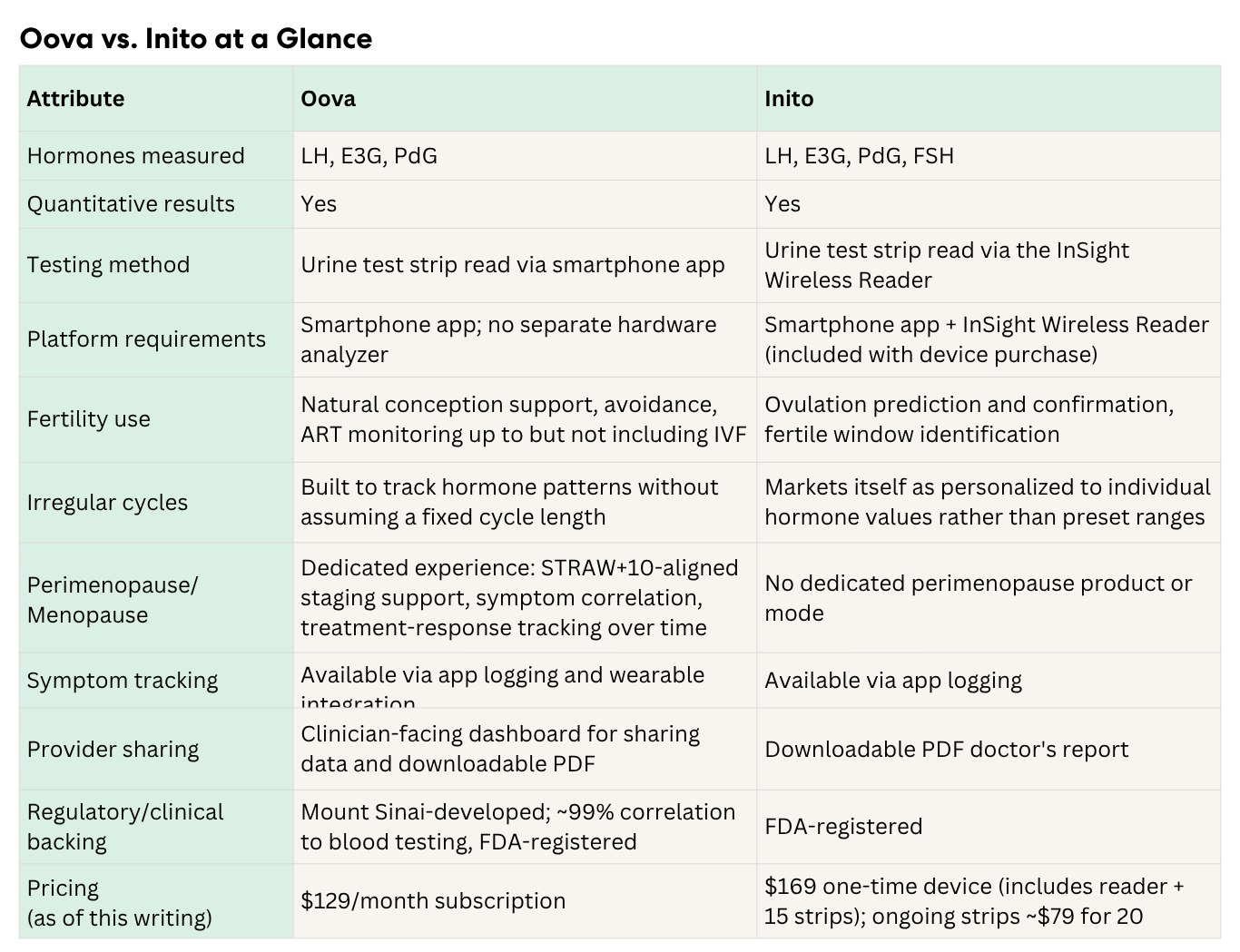
Pricing, promotions, and feature availability change on both sides , confirm current numbers directly with each company before making a purchase decision.
What Is Oova?
Oova is an AI-powered hormone diagnostics platform built around a daily urine test and a companion app. It measures LH, E3G, and PdG, three hormones tied to ovulation and reproductive hormone patterns, and reports quantitative values rather than a simple positive or negative line. The product was developed in collaboration with Mount Sinai and is designed to work without assuming a standard 28-day cycle, which matters for anyone whose cycles are irregular, whether from PCOS, perimenopause, or another cause. Oova is structured around three main experiences: fertility, hormone optimization for people with symptoms and no clear diagnosis, and perimenopause, including support aligned with the STRAW+10 staging framework.
What Is Inito?
Inito is an at-home fertility monitor that measures estrogen, LH, PdG, and FSH on a single test strip, read by its InSight Wireless Reader. Inito's positioning centers on precision and cycle personalization: it uses what it calls Spectral Mapping technology to read each hormone in an independent measurement area on the strip, and it builds a personalized hormone baseline from the user's own data rather than a fixed population range. Inito runs on a one-time device cost plus ongoing strip purchases, with no subscription fee for the app itself. Its core use cases are ovulation prediction and confirmation, fertile window identification, and cycle tracking for people with regular, irregular, PCOS-related, or anovulatory cycles.
Oova vs. Inito: Hormones Measured and What the Difference Means
Oova measures three hormones: LH, E3G, and PdG. Inito measures four on every test: the same three, plus FSH. Because Inito puts all four hormones on one strip, someone testing daily gets an FSH reading alongside their LH and PdG values without needing a separate test. Inito describes FSH as helping track follicle growth. FSH adds another reproductive hormone signal that can provide context around follicle development and reproductive hormone patterns, though a single at-home FSH reading, quantitative or not, is generally understood as one data point rather than a standalone answer.
Oova vs. Inito for Fertility
Both platforms are built to support natural conception through quantitative hormone tracking. Inito's fertility positioning is direct and specific: it identifies a six-day fertile window, tracks the PdG rise that follows ovulation, and markets itself for PCOS, irregular, and anovulatory cycles specifically. Oova uses the same longitudinal hormone-pattern approach across fertility and its broader hormone-health experiences, so someone actively trying to conceive gets the same underlying data model used for other use cases, without switching tools if their goals shift toward avoidance, postpartum recovery, or symptom investigation later on. For more on why hormone patterns over multiple days matter more than a single reading, see how long you need to track hormones to see a real pattern.
Oova vs. Inito for Confirming Ovulation
An LH surge signals that ovulation is likely approaching; it doesn't establish that ovulation occurred. Both Oova and Inito address this the same way: by pairing the LH surge with a subsequent rise in PdG, since a sustained progesterone metabolite increase is generally considered stronger evidence that ovulation took place than an LH surge alone. Inito markets this specifically as confirming ovulation, where other tests only track LH. Either platform requires consistent testing across the cycle to catch the full pattern, not just the surge day, see what a healthy hormone pattern looks like across a cycle and what a progesterone pattern can reveal about fertility for more on how this works.
Oova vs. Inito for PCOS or Irregular Cycles
Standard ovulation predictor kits assume a roughly consistent cycle length, which breaks down for anyone with PCOS or irregular cycles. Oova is designed specifically not to rely on a fixed 28-day assumption. Inito takes a similar approach from a different angle, building a personalized hormone baseline from the user's own data rather than comparing against a fixed population range. Inito also markets a continuous hormone record specifically so users and their doctor can see whether treatments or supplements are helping them ovulate, treatment-response tracking within the fertility use case is a real part of Inito's current positioning, not something unique to Oova. For more on what distinguishes ovulatory from anovulatory patterns in PCOS specifically, see anovulatory vs. ovulatory PCOS: what it means for TTC.
Oova vs. Inito for Understanding Symptoms
Neither device diagnoses the cause of a symptom. Inito's symptom logging sits alongside its hormone charts and lets users track symptoms, sex, medications, and pregnancy tests in one place, and its PCOS-focused materials extend to tracking whether treatments and supplements are working within a TTC context. Oova's hormone optimization experience takes this further, beyond a fertility goal: it's built for people who have symptoms without a clear cause, who may not be actively trying to conceive, who suspect something like PCOS or a thyroid issue, or who've been told they're "too young" for perimenopause despite what they're feeling, with symptom-hormone correlation and provider-ready reports built into a use case that doesn't require TTC as the starting point. If that's the situation you're in, this piece on whether your symptoms are hormonal or something else is a useful starting point regardless of which tracker you choose.
This is also where the perimenopause difference shows up. Inito doesn't have a dedicated perimenopause product or mode. Its perimenopause content is educational, explaining that no single test diagnoses the transition, but the device itself is built and marketed around fertility use cases. Oova's perimenopause experience is a distinct part of the product, built to support STRAW+10-aligned staging conversations and track how hormone patterns and symptoms move together over time.
Oova vs. Inito for Sharing Data With Your Doctor
Inito generates a structured, exportable report with charts and exact hormone values, built specifically for doctor use. Oova also supports clinician-facing access to longitudinal hormone and symptom data. Both are designed to get data in front of a provider; the difference is largely in format and workflow, which may matter more or less depending on how your provider prefers to receive information. If you're preparing for a fertility specialist visit specifically, here's what to track before your appointment.
Oova vs. Inito: Cost and Ongoing Testing
Inito's cost structure is a one-time device purchase, currently $169 list, which includes the InSight Wireless Reader and 15 test strips, followed by ongoing strip purchases (roughly $49 for a 15-pack or $79 for a 20-pack, with a 10% discount available through Subscribe & Save), and no subscription or monthly platform fee.
Oova runs on a monthly model at $129/month, or $159 one-time for a kit of 15 LH/PdG tests and 15 E3G tests, and is HSA/FSA eligible, as is Inito. If you'd rather pay once for hardware and restock strips only as needed, Inito's model may feel more predictable. If you'd rather not manage strip inventory and prefer an ongoing kit relationship, Oova's model may fit better. For a broader look at how at-home daily tracking compares to other testing approaches, see DUTCH test vs. daily hormone tracking.
Which Is Better for You?
Neither product is a strictly better version of the other. Both are quantitative, multi-hormone trackers aimed at giving you more than a yes-or-no answer, and the right choice depends on what you're actually trying to understand.
Inito may be the better fit if you want fertility focused four hormone tracking, including FSH on every test, with a one time reader purchase and refill strips.
Oova may be the better fit if you want hormone tracking to extend beyond TTC into symptom investigation, PCOS outside a fertility goal, post birth control changes, perimenopause, or treatment response over time.
Oova's current hormone optimization offering is explicitly positioned around symptoms, irregular cycles, PCOS, "normal" labs, symptom-hormone correlations, and provider-ready reports.
About the author
Sources
- Oova. Hormone Optimization Kit. https://shop.oova.life/en-US/shop/hormone-optimization
- Oova. Perimenopause Hormone Testing. https://www.oova.life/perimenopause
- Oova. Hormone Monitoring Kits. https://www.oova.life/
- Inito. Inito Fertility Tracker. https://www.inito.com/
- Inito. How Much Does the Inito Fertility Monitor Cost? https://blog.inito.com/how-much-does-the-inito-fertility-monitor-cost/
- Inito. Is the Inito Fertility Monitor Worth It? https://blog.inito.com/is-the-inito-fertility-monitor-worth-it/
- Inito. Can You Actually Confirm Ovulation at Home? https://blog.inito.com/can-you-actually-confirm-ovulation-at-home-heres-what-matters/
About the Oova Blog:
Our content is developed with a commitment to high editorial standards and reliability. We prioritize referencing reputable sources and sharing where our insights come from. The Oova Blog is intended for informational purposes only and is never a substitute for professional medical advice. Always consult a healthcare provider before making any health decisions.