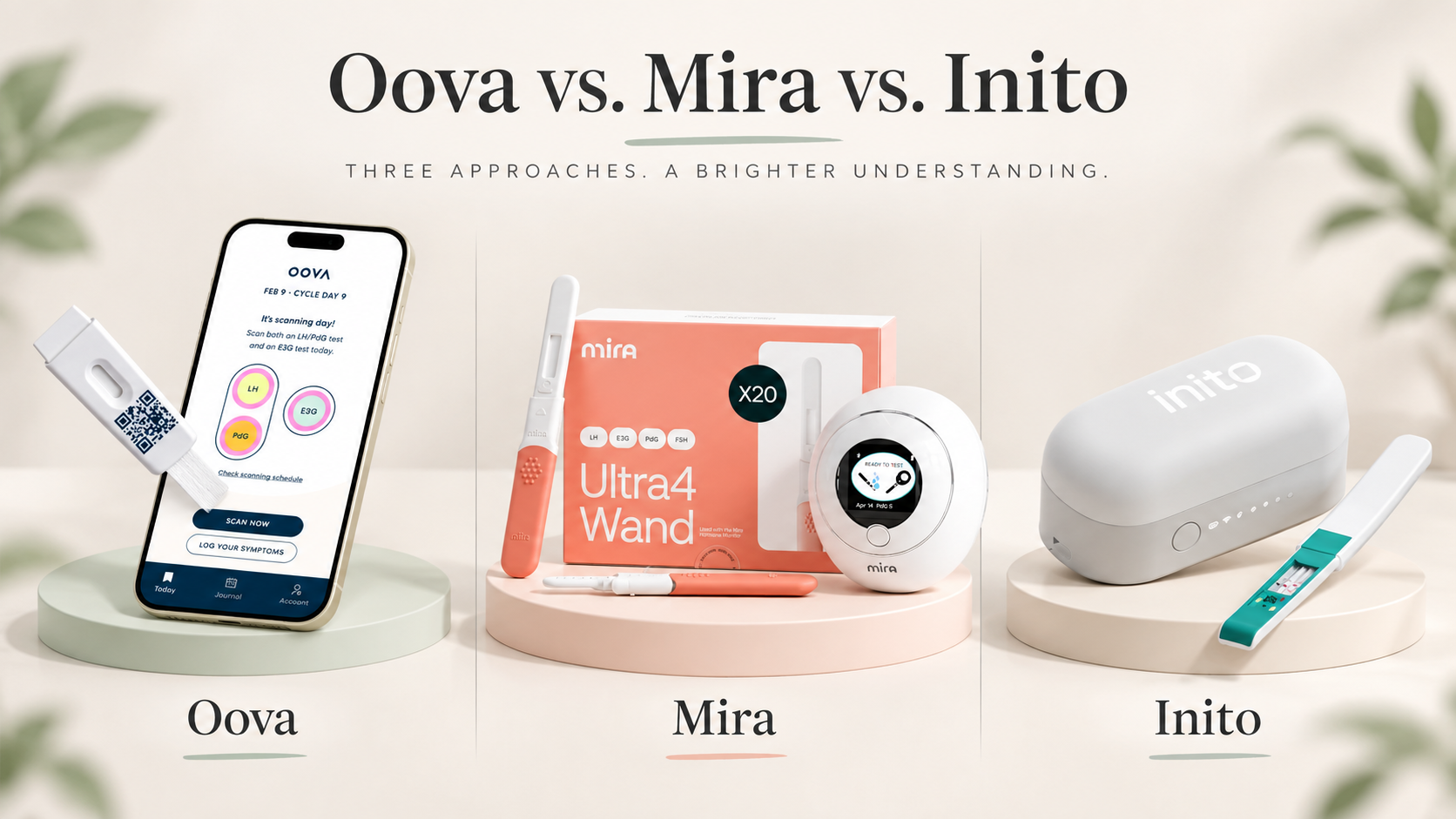
Comparing Oova vs. Mira? See how the two hormone monitors differ in hormones measured, fertility tracking, perimenopause support, symptom insights, provider sharing, and cost so you can choose the right fit for your goals.
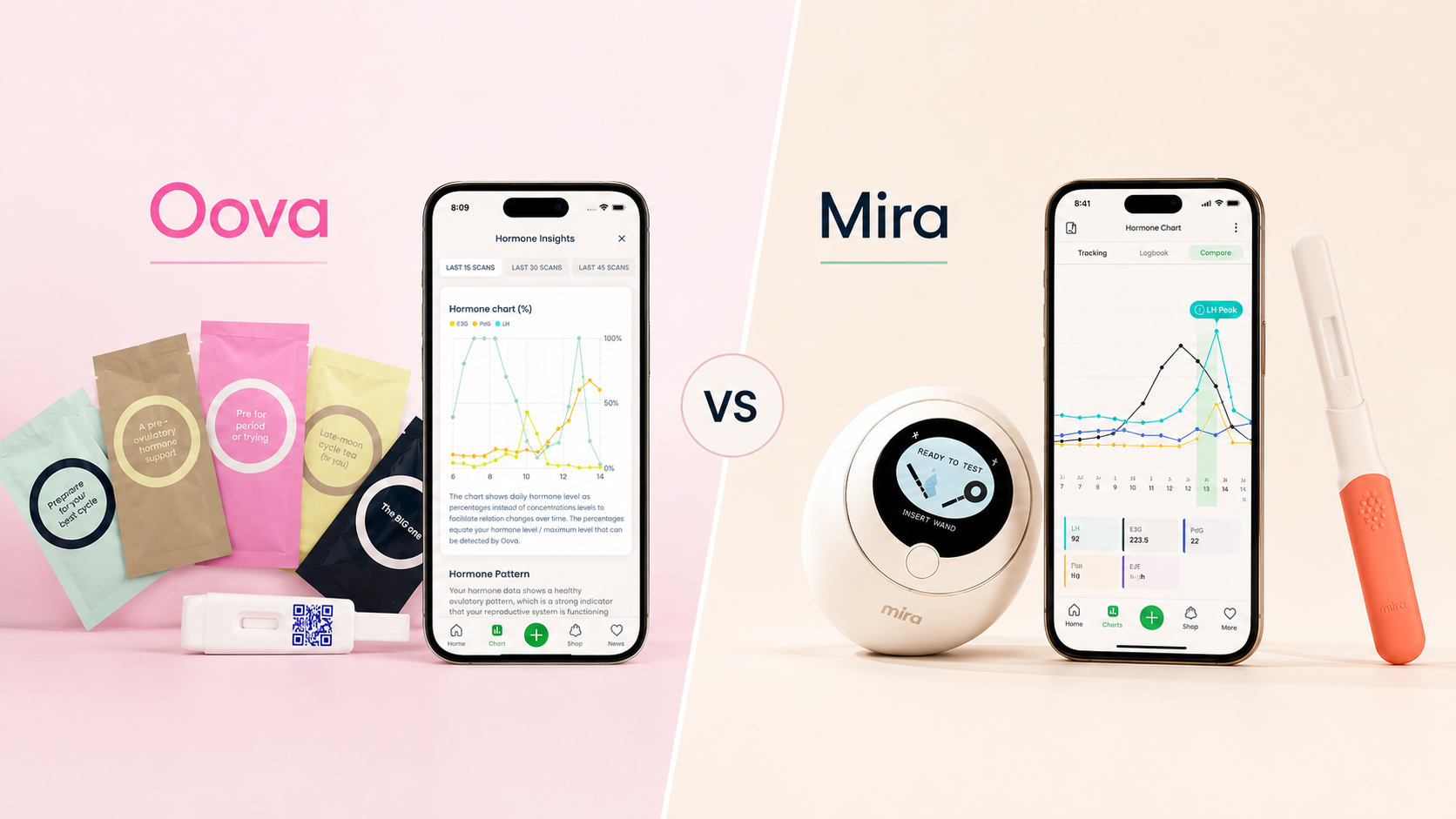
Comparing Oova vs. Mira? See how the two hormone monitors differ in hormones measured, fertility tracking, perimenopause support, symptom insights, provider sharing, and cost so you can choose the right fit for your goals.
If you're choosing between Oova and Mira, the honest answer is: it depends on what you're actually trying to understand. Both are quantitative, at-home hormone monitors that go beyond a yes/no ovulation predictor kit. But they're built around different testing models, different core use cases, and different depths of support once you move past fertility into perimenopause or symptom investigation. Here's how they compare.
Oova vs. Mira at a Glance
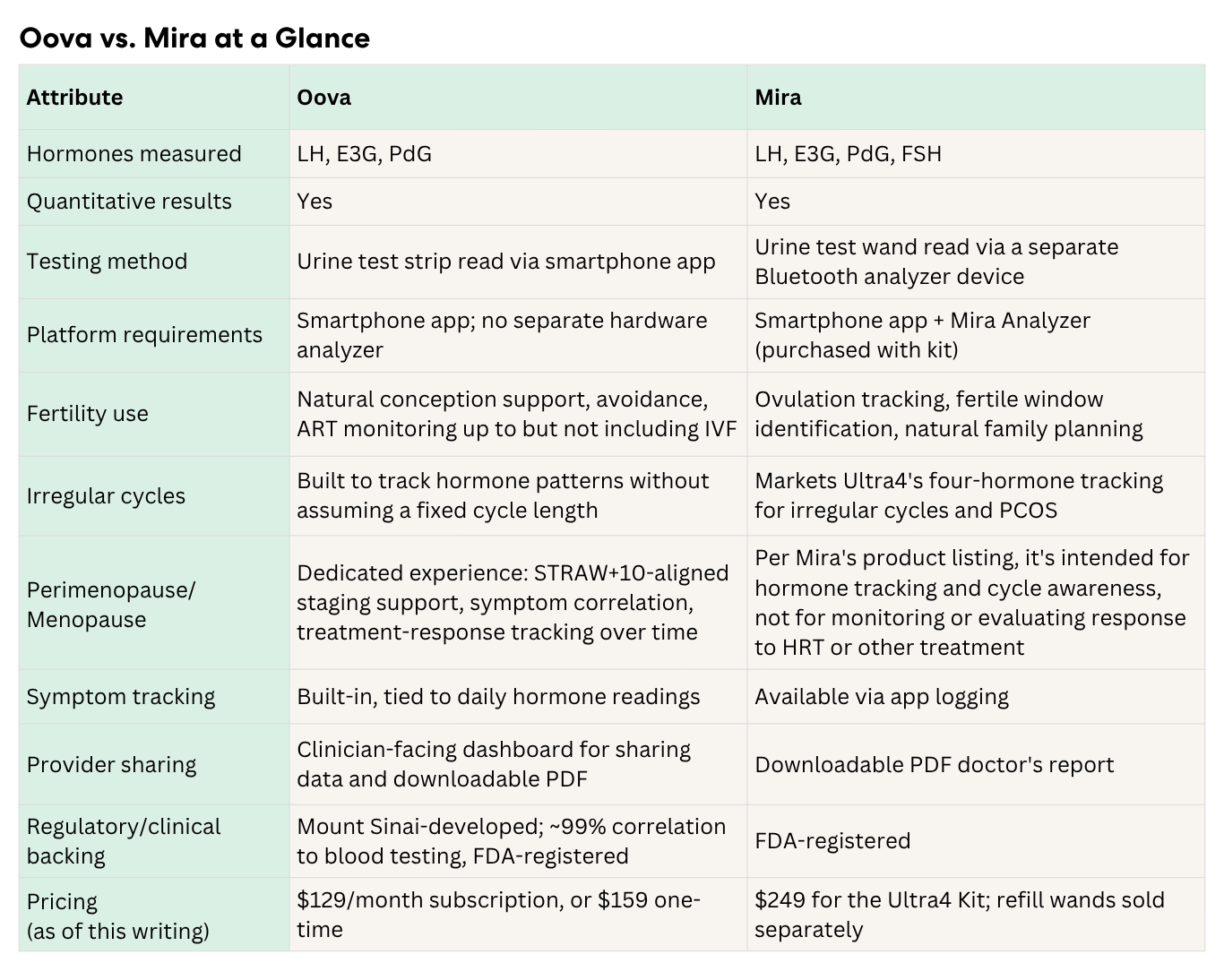
Pricing, promotions, and feature availability change on both sides. Confirm current numbers directly with each company before making a purchase decision.
What Is Oova?
Oova is an AI-powered hormone diagnostics platform built around a daily urine test and a companion app. It measures LH, E3G, and PdG, three hormones tied to ovulation and reproductive hormone patterns, and reports quantitative values rather than a simple positive or negative line. The product was developed in collaboration with Mount Sinai doctors and researchers, and is designed to work without assuming a standard 28-day cycle, which matters for anyone whose cycles are irregular, whether from PMOS, perimenopause, or another cause. Oova is structured around three main experiences: fertility, hormone optimization for people with symptoms and no clear diagnosis, and perimenopause/menopause, including support aligned with the STRAW+10 staging framework.
What Is Mira?
Mira is an at-home fertility and hormone monitor that pairs disposable urine test wands with a separate Bluetooth-connected analyzer device. Depending on the wand type, Mira can track LH, E3G, PdG, and FSH, with its Ultra4 wand measuring all four hormones in a single test. Mira uses fluorescent technology and reports quantitative concentrations through its app, which also offers trend charts, hormone surge analysis, a personalized testing schedule, and a downloadable PDF report for providers. Mira is FDA-registered. Alongside its core fertility tracking, Mira offers a Menopause Mode and a dedicated Ultra4 Perimenopause kit for users navigating that transition.
Oova vs. Mira: Hormones Measured and What the Difference Means
Oova measures three hormones: LH, E3G, and PdG. Mira's hormone range depends on which wand is used, with its Ultra4 wand adding FSH to the same three. FSH can be a useful additional data point when someone is trying to understand a longer reproductive transition, since elevated FSH is often discussed alongside declining estrogen in that context. That said, at-home FSH measurements are not intended to indicate ovarian reserve or menopausal status on their own, Mira's own product materials note this explicitly, and any single hormone reading, quantitative or not, is best treated as one data point rather than a standalone answer.
Oova vs. Mira for Fertility
Both platforms are built to help identify a fertile window and support natural conception. Mira's fertility positioning is broad, covering ovulation prediction, fertile window identification, and general cycle tracking, with kit and wand options aimed at different budgets and hormone combinations. Oova uses the same longitudinal hormone-pattern approach across fertility and its broader hormone-health experiences, so someone actively trying to conceive gets the same underlying data model used for other use cases, without switching testing protocols as their goals change.
Oova vs. Mira for Confirming Ovulation
A positive LH surge signals that ovulation is likely about to happen; it doesn't tell you whether ovulation actually occurred. Both Oova and Mira address this by pairing the LH surge with a rise in PdG afterward, since a sustained progesterone metabolite increase is generally considered stronger evidence that ovulation took place than an LH surge alone. Mira offers this same LH-plus-PdG logic through its wand system. Either platform requires testing consistently enough across the cycle to catch the pattern, not just the surge day.
Oova vs. Mira for Irregular Cycles or PMOS
Standard ovulation predictor kits are built around cycle-length assumptions that break down when cycles are irregular. Oova is designed specifically not to rely on a fixed 28-day assumption, which is part of why it's positioned for PMOS (formerly PCOS)-related and other irregular-cycle use cases. Mira also markets its Ultra4 four-hormone tracking as useful for irregular cycles and PMOS, on the basis that watching hormone trends over time can reveal patterns that a single test or a calendar-based prediction misses. Both approaches rely on the same underlying idea: more data points across a cycle give a clearer picture than one test on one assumed day.
Oova vs. Mira for Perimenopause
Oova's perimenopause experience is built to support STRAW+10-aligned staging conversations, correlate hormone patterns with symptoms, and help track how a treatment is working over time. Mira offers a dedicated Menopause Mode and Ultra4 Perimenopause kit that tracks the same four hormones and produces a shareable provider report, a genuine, current perimenopause product, not a fertility tool with a light overlay. Where the two diverge is treatment tracking specifically: Mira's own Ultra4 Perimenopause listing states the kit is intended for hormone tracking and cycle awareness, and is not intended to monitor or evaluate response to HRT or other treatment. If watching how a specific treatment is affecting your hormone pattern over time is the goal, that's a difference worth knowing going in.
Oova vs. Mira for Understanding Symptoms
Neither device diagnoses the cause of a symptom. What both can do is give you a hormone data trail to look at alongside symptoms like mood changes, sleep disruption, or fatigue, so patterns become easier to see than they would from memory alone. This is where Oova differentiates most clearly: its hormone optimization experience is built specifically around people who have symptoms without a clear cause, who may not be actively trying to conceive, who suspect something like PMOS or a thyroid issue, or who've been told they're "too young" for perimenopause despite what they're feeling, and who want data to bring into a provider conversation rather than another normal lab result. Mira's symptom logging works alongside its hormone charts and hormone-ratio analysis (such as LH:FSH and E3G:PdG), but isn't organized around a distinct symptom-first use case the way Oova's product is.
Oova vs. Mira for Sharing Data With Your Doctor
Mira emphasizes a downloadable provider report, while Oova also supports clinician-facing access to longitudinal hormone and symptom data. Both get data in front of a provider; which approach fits better may depend on how your provider prefers to receive information.
Oova vs. Mira: Cost and Ongoing Testing
Mira's Ultra4 Kit runs $249 and includes the analyzer plus 20 wands; refill wands are sold separately, with pricing that shifts based on current promotions Mira runs throughout the year. Oova runs on a monthly model at $129/month for a kit of 15 LH/PdG tests and 15 E3G tests, and is HSA/FSA eligible. Neither structure is inherently better: it depends on whether you'd rather pay more upfront for hardware you own outright, or pay a predictable rate that covers ongoing testing without managing wand restocks.
Which Is Better for You?
Neither product is a strictly better version of the other. They're both quantitative hormone monitors solving overlapping but not identical problems, and the right choice depends on what you're actually trying to understand.
Mira may be the better fit if you:
- Specifically want FSH measured alongside LH, E3G, and PdG in a single test
- Prefer one four-hormone wand rather than switching test types
- Primarily want fertility and cycle monitoring and are comfortable with a dedicated analyzer device
- Want the same hardware ecosystem to carry from fertility into perimenopause
Oova may be the better fit if you:
- Want to track LH, E3G, and PdG without buying a separate analyzer
- Are trying to understand symptoms alongside hormone changes, not just ovulation timing
- Have irregular cycles, PMOS, post-birth-control changes, or "normal" labs that haven't explained how you feel
- Want to track how a treatment is affecting your hormone pattern over time, including through perimenopause
- Want hormone and symptom data structured for a provider conversation, not just a PDF to hand over
For fertility and four-hormone tracking including FSH, Mira may be the stronger fit. For symptom-first hormone investigation, treatment tracking, or provider-integrated longitudinal monitoring, Oova may be the stronger fit.
About the author
Sources
- Oova. Hormone Monitoring Kits: Fertility, Perimenopause & Hormone Optimization. https://www.oova.life/
- Oova. For Providers. https://www.oova.life/for-providers
- Oova. Provider Resources. https://www.oova.life/provider-resources
- Mira. Mira Hormone Monitor: Ultra4 Kit for Perimenopause. https://shop.miracare.com/products/mira-hormone-monitor-menopause-transitions-kit
- Mira. Ultra4 Wands. https://shop.miracare.com/products/mira-ultra4-wands
- American Society for Reproductive Medicine. Fertility Evaluation of Infertile Women: A Committee Opinion. https://www.asrm.org/practice-guidance/practice-committee-documents/fertility-evaluation-of-infertile-women-a-committee-opinion-2021/
- American Society for Reproductive Medicine. Diagnosis and Treatment of Luteal Phase Deficiency: A Committee Opinion. https://www.asrm.org/practice-guidance/practice-committee-documents/diagnosis-and-treatment-of-luteal-phase-deciency-a-committee-opinion/
- The Menopause Society. Perimenopause. https://menopause.org/patient-education/menopause-topics/perimenopause
- The Menopause Society. Many Women Still Confused About Perimenopause. https://menopause.org/press-releases/many-women-still-confused-about-perimenopause
About the Oova Blog:
Our content is developed with a commitment to high editorial standards and reliability. We prioritize referencing reputable sources and sharing where our insights come from. The Oova Blog is intended for informational purposes only and is never a substitute for professional medical advice. Always consult a healthcare provider before making any health decisions.