If your period suddenly starts arriving earlier than it used to, the change may reflect what’s happening earlier in your menstrual cycle. Learn why cycles can shorten, when it may be an early sign of perimenopause, what other causes to consider, and how tracking your hormone pattern can help you understand what changed.

If your period suddenly starts arriving earlier than it used to, the change may reflect what’s happening earlier in your menstrual cycle. Learn why cycles can shorten, when it may be an early sign of perimenopause, what other causes to consider, and how tracking your hormone pattern can help you understand what changed.
Quick answer: If your period keeps coming earlier, your menstrual cycle is getting shorter. That can happen because you’re ovulating earlier, because the phase after ovulation has shortened, or both. Stress, thyroid conditions, and the hormone changes of perimenopause can all affect that timing. Tracking your hormones across your cycle can help you see what’s changing.
Key takeaways
- A shorter period (fewer bleeding days) and a shorter cycle (your period arriving sooner) are different changes with different explanations.
- With age, cycle shortening often happens in the first half of the cycle, before ovulation.
- One shorter cycle may not mean much. If it keeps happening, it’s worth looking more closely at what changed.
- A single hormone test may not explain why your cycle shortened. Tracking hormones across the cycle can tell you more.
Maybe your period used to arrive every 29 or 30 days. Then it became 27. Then 25. Now you’re looking at your calendar and wondering why it keeps coming earlier.
A menstrual cycle that is getting shorter can have several explanations. These include normal month-to-month variation, stress, thyroid changes, shifts in ovulation timing, and perimenopause. In your late 30s and 40s, cycles that stay shorter can be one of the clues that your reproductive hormones are starting to change.
The first step is figuring out what actually got shorter.
Shorter period or shorter cycle? They’re not the same thing
Your period got shorter if you used to bleed for five days and now bleed for three. That’s a change in period duration.
Your cycle got shorter if your period used to start every 30 days and now starts every 24. That’s a change in cycle length.
People can notice both at once, especially in their 40s, but they don’t necessarily mean the same thing.
If you’re bleeding for fewer days
Lighter or shorter bleeding can reflect a thinner uterine lining. That can follow lower or less sustained estrogen exposure during the cycle. Other possible factors include:
- hormonal contraception, including hormonal IUDs
- significant weight change
- thyroid changes
- ordinary variation
During perimenopause, flow can swing in both directions, lighter some months and heavier in others.
If a very light, short “period” shows up when you weren’t expecting it and there’s any chance you could be pregnant, take a pregnancy test. Early pregnancy bleeding can sometimes be mistaken for a light period.
The rest of this article focuses on the change people search for most often: a period that keeps arriving earlier.
What counts as a short menstrual cycle?
Your menstrual cycle runs from the first day of one period to the day before the next one starts.
- Periods starting January 1, January 29, February 26 → roughly 28-day cycles
- Periods starting January 1, January 25, February 18 → roughly 24-day cycles
Healthy cycles don’t need to be exactly 28 days. Adult cycles of roughly 21 to 35 days are commonly considered within the typical range. The International Federation of Gynecology and Obstetrics (FIGO) classifies cycles shorter than 24 days as “frequent” menstrual bleeding.[5]
The number alone doesn’t tell the whole story. If you’ve always had 24-day cycles, that may simply be your normal. If you had 30-day cycles for years and they’re now repeatedly 24 days, the change from your baseline can be more informative than whether the new number fits a population range.
Cycle variability matters, too. Variation from one cycle to the next is more common than most people expect. Our analysis in Irregular Cycles Are More Normal Than You Think explains why one unusual cycle matters much less than a change that keeps repeating.
Why is my menstrual cycle getting shorter?
A shorter cycle means something between one period and the next is happening faster. The key is figuring out which part of your cycle got shorter.
Your cycle has two main phases:
- Follicular phase: from the first day of your period to ovulation. A follicle develops, estrogen rises, and an LH surge triggers egg release.
- Luteal phase: from ovulation to your next period. The corpus luteum produces progesterone to support the uterine lining. If pregnancy doesn’t occur, progesterone and estrogen fall and your period begins.
A shorter overall cycle can come from earlier ovulation, a shorter luteal phase, or changes in both. Your period dates alone can’t tell you which one happened.
1. You may be ovulating earlier
The follicular phase is normally the more variable part of the cycle.[4] It’s also where much of the age-related shortening in cycle length appears to occur.
In a real-world analysis of more than 600,000 menstrual cycles, average cycle length tended to decline from the mid-20s into the mid-40s. That decline was largely driven by a shorter follicular phase.[2]
Research suggests one possible explanation. In ovulatory women in their 40s, follicles can develop faster alongside rising FSH, moving ovulation earlier in the cycle.[3]
If ovulation moves earlier and everything after it stays about the same, your next period arrives sooner:

Both cycles have about 14 days after ovulation. What changed is the timing before ovulation.
This matters if you’re trying to conceive. A fertile window that used to fall around Day 14 may now open several days earlier, before you’d normally start testing.
2. The phase after ovulation may be getting shorter
The other possibility is that you’re ovulating at about the same time, but your period arrives sooner afterward.
After ovulation, progesterone rises. A consistently shorter gap between ovulation and your next period can point to a change in how long progesterone stays elevated.
How short is “too short” is debated. Professional guidance notes that luteal phase deficiency has no reliable standalone diagnostic test, so looking across cycles can be more useful than relying on any single reading.[6]
Why your calendar can’t tell these apart
Here are two women who both suddenly have 24-day cycles:
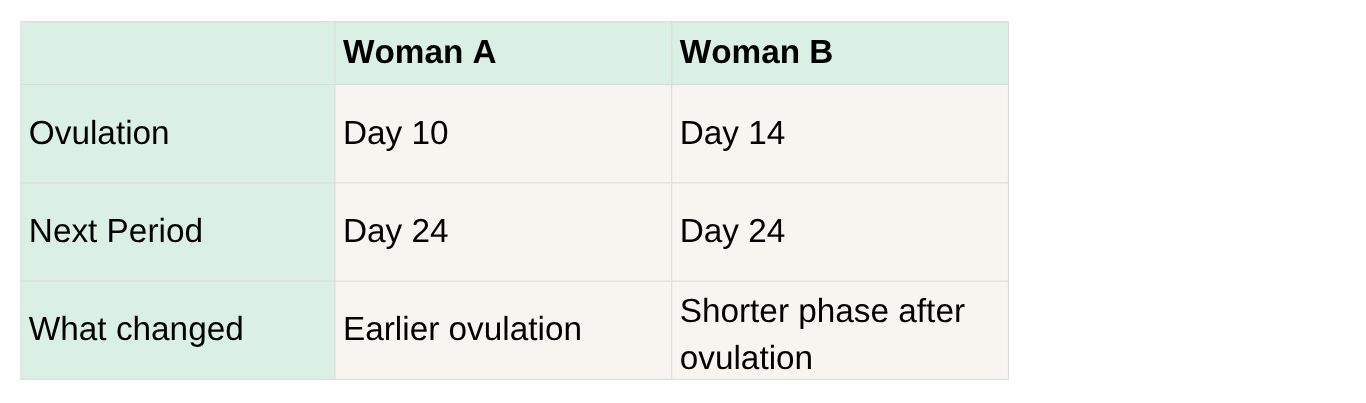
Their calendars look identical. Their hormone patterns don’t.
An LH surge shows when your body is attempting to ovulate. A sustained rise in progesterone afterward supports that ovulation occurred and helps show how long the post-ovulation phase lasted. Our guide to progesterone testing explains why progesterone is an important signal for understanding this half of the cycle.
Other reasons your period may be coming earlier
Perimenopause can make cycles shorter before they get longer
One confusing thing about perimenopause is that periods don’t necessarily start by getting farther apart. Cycles can become shorter before they become more variable or farther apart.
The STRAW+10 staging system describes changes in menstrual cycles across reproductive aging:[1]
- Late reproductive stage: subtle changes in cycle length or flow can appear while cycles still look fairly regular.
- Early menopausal transition: a persistent difference of seven or more days between consecutive cycles becomes a key marker.
The transition doesn’t necessarily move neatly from regular periods to farther-apart periods to menopause. Cycles may first become slightly shorter, then more variable, and later become longer or skipped.
One short cycle can’t tell you whether you’re in perimenopause. But if the change keeps happening, especially alongside heavier or lighter bleeding, worse PMS, disrupted sleep, new anxiety, or hot flashes, it’s worth paying attention. Read more about how periods change during perimenopause.
Stress, illness, sleep, and big lifestyle changes
Significant stress or illness, changes in exercise or weight, under-fueling, and disrupted sleep can all affect the hormonal signaling involved in ovulation timing.[8]
One shorter or longer cycle doesn’t automatically signal perimenopause or a disorder. Think about what else was going on that month, and whether your cycle returned to its usual timing afterward.
Thyroid conditions, PCOS, and other causes
Not every cycle change in your late 30s or 40s comes from reproductive aging. Both overactive and underactive thyroid function are associated with changes in cycle length and bleeding.[7] PCOS, uterine conditions, and some medications can also affect cycle timing.
Perimenopause and PCOS can overlap, and symptoms alone often can’t separate them. Our guide to PCOS vs. perimenopause walks through that overlap.
Is a shorter cycle an early sign of perimenopause?
It can be, but a shorter cycle alone doesn’t mean you’re in perimenopause.
No single blood test can definitively confirm perimenopause.[9] Instead, clinicians look at a combination of factors, including:
- your age and previous cycle baseline
- whether the change persists over several cycles
- how much cycle length varies from month to month
- whether you’re still ovulating consistently
- changes in bleeding
- new or changing symptoms
Why one hormone test may not explain a changing cycle
If your periods are changing, asking for hormone testing makes sense. The challenge is that estrogen, LH, and progesterone are supposed to change dramatically across a cycle.
A result can be perfectly appropriate for the day it was drawn while telling you very little about what happened during the rest of the month.
This gets harder in perimenopause, when hormone levels and ovulation become more variable from cycle to cycle.[1] It’s one reason someone can get a “normal” result and still notice real changes. We cover this in Why Your Hormones Look Normal but You Still Feel Terrible.
That’s why seeing how your hormones change across the cycle can tell you more than a single estrogen, LH, or progesterone result.
When to talk to your doctor about shorter cycles
A change in your cycle doesn’t automatically mean something is wrong. Contact a healthcare professional promptly if you have:
- bleeding between periods or after sex
- bleeding that soaks through a pad or tampon every hour or two
- severe pain
- dizziness or weakness
- cycles shorter than about 21 days that keep repeating
Bring up persistent cycle changes at your next visit if you’re trying to conceive, because shifting ovulation timing can affect your fertile window. Abnormal uterine bleeding should be evaluated rather than assumed to be perimenopause.[5]
Your clinician can determine whether the change looks consistent with reproductive aging or whether it makes sense to look for other causes, such as thyroid disease, structural problems, or medication effects.
What to track if your periods are getting closer together
Start with your period dates, but don’t stop there. Over the next several cycles, track:
- Cycle length: days from the first day of one period to the first day of the next.
- Ovulation timing: whether your LH surge is happening earlier than it used to.
- Ovulation confirmation: whether progesterone rises and stays elevated after the surge.
- Time from ovulation to your next period: whether the first half of your cycle changed, the second half, or both.
- Estrogen leading into ovulation: how your estrogen rises in the days before your surge. Here’s how to test estrogen levels at home.
- Bleeding: whether flow is getting heavier, lighter, longer, or shorter.
- Symptoms: sleep, mood, migraines, hot flashes, breast tenderness, energy, and brain fog alongside your cycle days.
That gives you much more specific information to bring to your doctor:
“My cycles have shortened from 30–31 days to 24–26 days over four months, and my LH surge now comes about five days earlier.”
Or:
“My ovulation timing hasn’t changed much, but the time between ovulation and my next period has shortened.”
How Oova helps you see what changed inside your cycle
Oova tracks your hormones across the cycle rather than relying on a single snapshot. It measures urinary metabolites of estrogen and progesterone alongside LH:
- E3G, an estrogen metabolite
- LH, the hormone involved in triggering ovulation
- PdG, a progesterone metabolite
That lets you see:
- how estrogen builds toward ovulation
- when your LH surge happens
- whether PdG rises afterward and how long it stays elevated
- how your cycle length and variability change from one cycle to the next
Oova’s at-home hormone measurements have shown 99% correlation with serum results in independent testing, giving you quantitative hormone data without repeated blood draws.
If your period is suddenly arriving earlier, Oova can help you see what changed inside the cycle and whether it happens again.
You can also share your results with your clinician directly from the app.
The bottom line
If your period is getting shorter, the number of days between periods is only part of the story.
You may be ovulating earlier. The phase after ovulation may be getting shorter. The change may be temporary. Or, particularly in your late 30s and 40s, a persistent shift may be one clue that your hormones are beginning to change.
If it happens once, it may not mean much. If it keeps happening, tracking what’s going on before and after ovulation can give you a much clearer idea of what changed.
FAQ
Why is my period suddenly coming every 3 weeks?
A period every three weeks means roughly a 21-day cycle. Some people naturally have short cycles. If yours used to be longer, the change from your own baseline matters more than the number alone. Earlier ovulation, perimenopause, stress, and thyroid changes are among the possible explanations.
Do periods get closer together before menopause?
They can. During the late reproductive years and early menopausal transition, cycles may become shorter before periods become more variable and eventually farther apart.
Is a 21-day menstrual cycle normal?
A 21-day cycle sits at the short end of commonly cited ranges, and FIGO considers cycles under 24 days “frequent.” A lifelong 21–24 day cycle is different from a sudden shift from 30 days to 21. If short cycles are new or keep shortening, talk to your clinician.
Why are my cycles getting shorter in my 40s?
One reason is that follicles may develop faster and ovulation may happen earlier, shortening the first half of the cycle. This can happen during reproductive aging and perimenopause, but stress, thyroid conditions, and other causes can also affect cycle timing.
Why is my period getting shorter and lighter?
Fewer or lighter bleeding days can reflect changes in the uterine lining. Possible contributors include changing estrogen exposure, hormonal contraception, weight changes, thyroid conditions, and normal variation. During perimenopause, flow can also vary substantially from month to month.
Can stress make your menstrual cycle shorter?
Yes. Stress can affect the hormonal signaling involved in ovulation. One unusual cycle during a stressful month is different from a new pattern that continues for several months.
Does a shorter cycle mean I’m less fertile?
Not necessarily. Cycle length alone doesn’t tell you whether you’re ovulating. If your shorter cycles are caused by earlier ovulation, your fertile window may simply have moved earlier. Tracking ovulation timing and confirming what happens afterward provides more information than cycle length alone.
Should I test my hormones if my periods are getting shorter?
Hormone testing can provide useful information, but timing matters because reproductive hormones change throughout the cycle. Tracking across the cycle and over multiple cycles can show whether ovulation has moved earlier, the post-ovulation phase has changed, or another change is emerging.
About the author
Sources
- Harlow SD, Gass M, Hall JE, et al. Executive summary of the Stages of Reproductive Aging Workshop + 10: addressing the unfinished agenda of staging reproductive aging. Menopause. 2012;19(4):387–395.
- Bull JR, Rowland SP, Scherwitzl EB, et al. Real-world menstrual cycle characteristics of more than 600,000 menstrual cycles. NPJ Digital Medicine. 2019;2:83.
- Klein NA, Battaglia DE, Fujimoto VY, et al. Reproductive aging: accelerated ovarian follicular development associated with a monotropic follicle-stimulating hormone rise in normal older women. Journal of Clinical Endocrinology & Metabolism. 1996;81(3):1038–1045.
- Fehring RJ, Schneider M, Raviele K. Variability in the phases of the menstrual cycle. Journal of Obstetric, Gynecologic & Neonatal Nursing. 2006;35(3):376–384.
- Munro MG, Critchley HOD, Fraser IS; FIGO Menstrual Disorders Committee. The two FIGO systems for normal and abnormal uterine bleeding symptoms and classification of causes of abnormal uterine bleeding in the reproductive years: 2018 revisions. International Journal of Gynecology & Obstetrics. 2018;143(3):393–408.
- Practice Committee of the American Society for Reproductive Medicine. Current clinical irrelevance of luteal phase deficiency: a committee opinion. Fertility and Sterility. 2015;103(4):e27–e32.
- Krassas GE, Poppe K, Glinoer D. Thyroid function and human reproductive health. Endocrine Reviews. 2010;31(5):702–755.
- Gordon CM, Ackerman KE, Berga SL, et al. Functional hypothalamic amenorrhea: an Endocrine Society clinical practice guideline. Journal of Clinical Endocrinology & Metabolism. 2017;102(5):1413–1439.
- National Institute for Health and Care Excellence. Menopause: identification and management (NG23). Updated 2024.
About the Oova Blog:
Our content is developed with a commitment to high editorial standards and reliability. We prioritize referencing reputable sources and sharing where our insights come from. The Oova Blog is intended for informational purposes only and is never a substitute for professional medical advice. Always consult a healthcare provider before making any health decisions.