
If your period keeps arriving later than it used to, the change may begin well before your period starts. Learn why menstrual cycles get longer, how delayed or skipped ovulation and perimenopause affect timing, and how tracking your hormones can help you understand what's changing.

If your period keeps arriving later than it used to, the change may begin well before your period starts. Learn why menstrual cycles get longer, how delayed or skipped ovulation and perimenopause affect timing, and how tracking your hormones can help you understand what's changing.
If your period keeps arriving later than it used to, your menstrual cycle is getting longer, which usually means you're ovulating later or not ovulating in some months. Stress, thyroid conditions, PCOS, and perimenopause can all affect ovulation timing. One longer cycle usually isn't a reason to worry, but a pattern of periods getting further apart is worth understanding.
Maybe your period used to arrive every 28 days. Then it became 32 days. Now you're waiting 38 or 40 days, wondering when it will show up.
The change may actually begin weeks before your period is due. Understanding what's happening earlier in your cycle can help explain why your period keeps arriving later.
What does it mean when your period is getting longer?
First, there's an important distinction.
A longer menstrual cycle means more days between periods. If your period itself is lasting more days than it used to, that's a different change. Our guide to perimenopause period changes covers longer and heavier bleeding.
Your menstrual cycle starts on the first day of your period and ends the day before your next period begins.
For example:
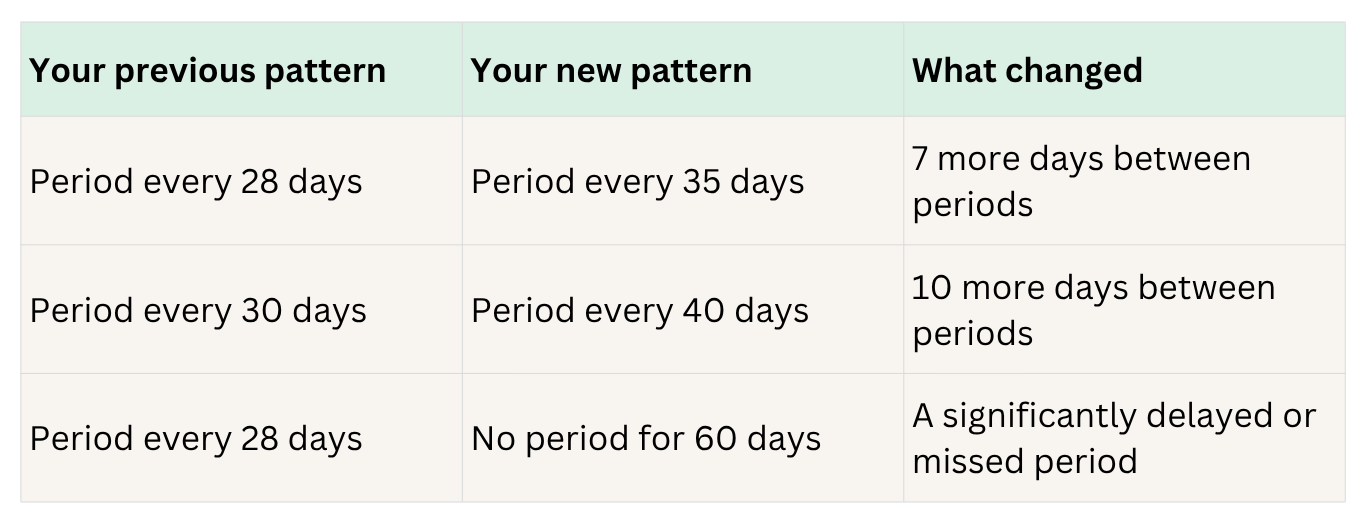
For adults, cycles typically fall between 24 and 38 days, according to FIGO, though what's normal for you can vary.
A 35-day cycle can be normal for someone who's always had longer cycles. But if your period used to arrive every 27 days and now regularly takes 38 days, that change is worth paying attention to.
Why is my menstrual cycle getting longer?
Most changes in cycle length involve ovulation, when your ovary releases an egg.
Your cycle has two main phases:
- Before ovulation: The follicular phase, when an egg develops and estrogen generally rises.
- After ovulation: The luteal phase, when progesterone rises and helps prepare the uterine lining for a possible pregnancy.
The first phase can vary substantially in length. The second is generally more consistent, often lasting around 12 to 14 days.
If ovulation happens later than usual, your next period will typically arrive later too. If ovulation doesn't happen, your period may be significantly delayed or skipped.
1. You're ovulating later than usual (late ovulation)
This is one of the most common explanations for a longer cycle.
Imagine you usually ovulate around day 14 and get your period around day 28.
Then one month, you don't ovulate until day 24. Your period may not arrive until around day 38.
Your period isn't necessarily late because something changed at the end of your cycle. The delay may have started weeks earlier.
Understanding your follicular phase can help explain why ovulation timing matters.
2. You didn't ovulate this month
Sometimes, your body prepares to ovulate but doesn't release an egg.
This is called an anovulatory cycle.
Without ovulation, you don't get the usual rise in progesterone that follows egg release. As a result, your period may arrive much later than expected, or you may skip it altogether.
An occasional anovulatory cycle can happen because of stress, illness, or hormonal changes.
If it happens repeatedly, your clinician may want to investigate the cause.
3. You're entering perimenopause
If you've noticed your periods getting further apart in your 40s, perimenopause may be one explanation.
During perimenopause, ovulation becomes less predictable. Some cycles are shorter, others longer, and some may not involve ovulation at all.
Shorter cycles are often among the earliest menstrual changes during reproductive aging. As the transition progresses, cycles may become more variable and periods may start arriving further apart.
You may also notice changes in sleep, mood, or other symptoms.
Our companion article explains why your period may be getting shorter and how that pattern differs from longer cycles.
4. Stress, illness, or lifestyle changes are affecting ovulation
Your reproductive hormones respond to what's happening in the rest of your body.
Significant stress, illness, changes in weight, inadequate nutrition, or intense exercise can affect the signals that control ovulation.
If ovulation is delayed, your period usually follows later.
One unusually long cycle may resolve on its own. But if your periods continue getting further apart, don't assume stress is the only explanation.
5. A thyroid condition or PCOS is affecting your cycle
Perimenopause isn't the only possible explanation for irregular menstrual cycles.
Thyroid conditions can interfere with the hormonal signals involved in ovulation, leading to delayed or missed periods.
Polycystic ovary syndrome (PCOS) can also cause infrequent ovulation and longer cycles.
The 2023 International Evidence-based PCOS Guideline identifies cycles longer than 35 days as one possible sign of ovulatory dysfunction in adults before perimenopause.
Certain medications, hormonal contraception, and elevated prolactin levels can also affect cycle timing.
If your periods have changed significantly, your clinician can help determine whether testing makes sense.
Are longer cycles a sign of perimenopause?
They can be, particularly when a previously predictable cycle starts becoming more variable.
Researchers use a framework called STRAW+10 to describe the stages of reproductive aging.
Two changes are especially relevant:
Early menopausal transition: A difference of seven days or more between consecutive cycle lengths that recurs within 10 cycles. For example, a shift from 28 to 37 days that happens again within the next 10 cycles may meet this staging criterion.
Late menopausal transition: Going 60 days or longer without a menstrual period.
But cycle length alone doesn't diagnose perimenopause. Your age, symptoms, medical history, and other possible causes all matter.
Not everyone experiences these changes in the same order.
Is a 35-day or 40-day menstrual cycle normal?
It depends on what's normal for you.
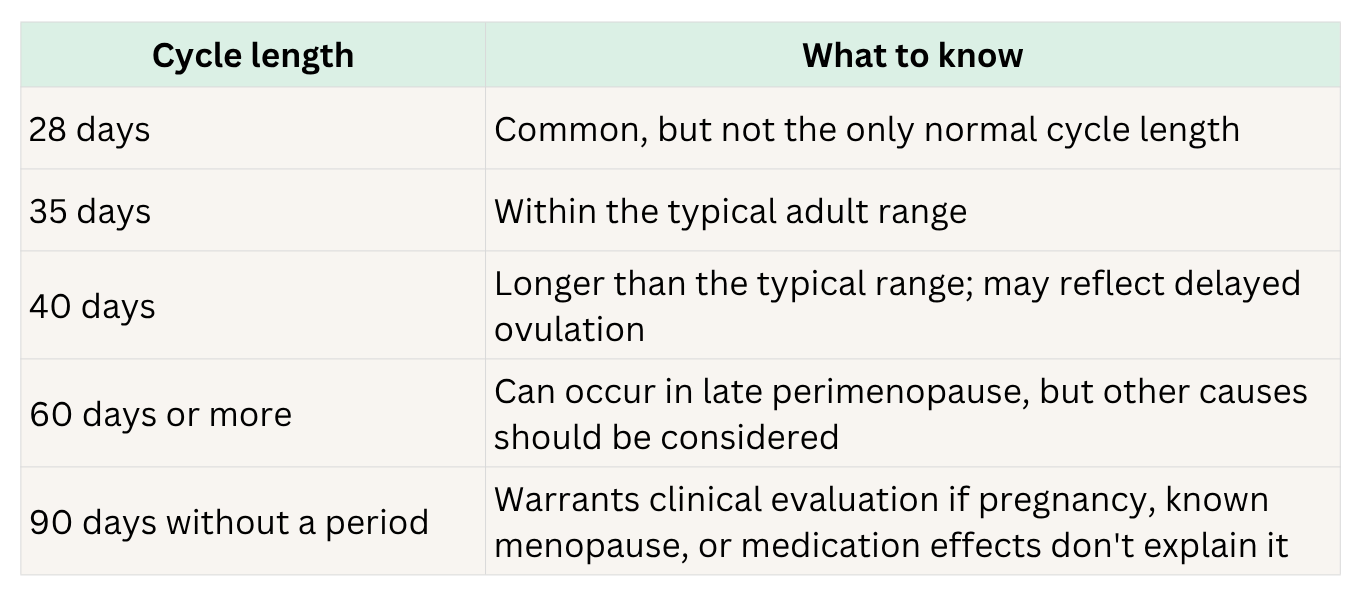
A single 40-day cycle doesn't necessarily indicate a medical problem.
But if your cycles have progressively lengthened from 28 to 35 to 40 days, that pattern can be more informative than any individual number.
When should you see a doctor about longer menstrual cycles?
You don't need to panic because one period arrived late.
But it's worth contacting your clinician if:
- Your cycles are consistently longer than 38 days after previously being regular.
- Your cycle length keeps changing significantly.
- You've gone 90 days without a period and aren't pregnant or known to be menopausal.
- You're experiencing new symptoms such as significant fatigue, hair changes, or unexplained weight changes.
- You're trying to conceive and aren't sure whether you're ovulating.
- You're under 40 and experiencing persistent skipped periods or menopause-like symptoms. These can sometimes indicate primary ovarian insufficiency (POI), which needs evaluation.
If pregnancy is possible, take a pregnancy test when your period is late, even if you suspect perimenopause.
Your clinician may recommend reviewing medications, checking thyroid function, or evaluating other possible causes.
How to understand what's changing inside your cycle
A period tracking app can tell you how many days passed between periods.
But it can't necessarily tell you why your cycle got longer.
Consider two women who both have 40-day cycles.
Woman A ovulates around day 26 and gets her period roughly two weeks later.
Woman B doesn't ovulate that month but experiences bleeding on day 40.
Their calendars may look almost identical, but their hormone patterns are different.
That's where tracking hormones across your cycle can provide more context.
How Oova helps you see the bigger picture
Oova measures three reproductive hormone markers in urine at home:
- E3G: A marker of estrogen, which typically rises as your body prepares to ovulate.
- LH: The hormone surge that helps trigger ovulation.
- PdG: A marker of progesterone, which typically rises after ovulation.
By measuring these hormones over multiple days, you can see when an LH surge occurs and whether PdG rises afterward.
This matters because LH alone can be misleading, especially with PCOS or during perimenopause, when LH may remain elevated or surge more than once. A rise in PdG afterward provides additional evidence that ovulation likely occurred.
Looking at these patterns across cycles can help you understand whether ovulation is happening later or whether a cycle lacks a clear ovulatory pattern.
Oova also supports tracking symptoms alongside hormone results, so you can compare cycle changes with how you're feeling.
Hormone tracking cannot diagnose perimenopause, PCOS, or thyroid conditions, and it cannot rule out ovulation with certainty. But it can provide useful information to discuss with your healthcare provider.
Your period dates tell you when. Your hormone patterns can help show what happened before.
Frequently asked questions
Why is my period coming later every month?
Your period may be arriving later because you're ovulating later or occasionally skipping ovulation. Stress, thyroid conditions, PCOS, and perimenopause can all contribute, so persistent changes are worth discussing with your clinician.
Do menstrual cycles get longer before menopause?
Yes. During perimenopause, ovulation becomes less predictable, and cycles may grow longer or become more variable. Some women experience shorter cycles first, followed by longer gaps between periods as they approach menopause.
Can you have a 40-day cycle and still ovulate?
Yes. A 40-day cycle can still include ovulation. If the phase after ovulation lasts around 14 days, ovulation may occur around day 26. However, some long cycles are anovulatory, so cycle length alone can't confirm ovulation.
Does a longer menstrual cycle mean I'm less fertile?
Not necessarily. If you're ovulating later, your fertile window may simply have moved later too. However, repeatedly skipped ovulation can make conception more difficult.
Tracking LH and PdG together can help show whether and when ovulation is likely happening, which matters more than your average cycle length when you're trying to conceive.
Should I test my hormones if my periods are getting longer?
Hormone tracking can provide useful information about ovulation timing and progesterone changes. Measuring hormones across multiple days may help you see whether ovulation is happening later or appears to be absent in some cycles. Your clinician can help interpret those findings alongside your symptoms and medical history.
The bottom line
If your period is getting longer, the number of days between periods is only part of the story.
You may be ovulating later, occasionally skipping ovulation, or noticing the first changes associated with perimenopause.
A single long cycle doesn't tell you much. But when your periods keep arriving later, it's worth looking at the pattern.
See what's happening between your periods
Your calendar shows when your period arrives. Oova helps you see how your estrogen, LH, and progesterone markers change before it does.
Track your hormone patterns over time and bring a clearer picture to conversations with your clinician.
Track Your Hormone Patterns With Oova →
Medical disclaimer: This article is for educational purposes only and does not replace medical advice, diagnosis, or treatment. Hormone tracking cannot diagnose the cause of menstrual irregularities or replace evaluation by a healthcare professional.
About the author
Sources
- Munro MG, Critchley HOD, Fraser IS, et al. The two FIGO systems for normal and abnormal uterine bleeding symptoms and classification of causes of abnormal uterine bleeding in the reproductive years: 2018 revisions. International Journal of Gynecology & Obstetrics. 2018;143(3):393–408.
- Harlow SD, et al. Executive Summary of the Stages of Reproductive Aging Workshop +10: Addressing the Unfinished Agenda of Staging Reproductive Aging. Menopause. 2012.
- Teede HJ, et al. Recommendations From the 2023 International Evidence-based Guideline for the Assessment and Management of Polycystic Ovary Syndrome. Human Reproduction. 2023;38(9):1655–1679.
- American College of Obstetricians and Gynecologists. Abnormal Uterine Bleeding. Patient FAQ, reviewed August 2025.
- Cleveland Clinic. Follicular Phase: What It Is and What Happens During It.
- FIGO Ovulatory Disorders Classification System. Human Reproduction. 2022.
About the Oova Blog:
Our content is developed with a commitment to high editorial standards and reliability. We prioritize referencing reputable sources and sharing where our insights come from. The Oova Blog is intended for informational purposes only and is never a substitute for professional medical advice. Always consult a healthcare provider before making any health decisions.
