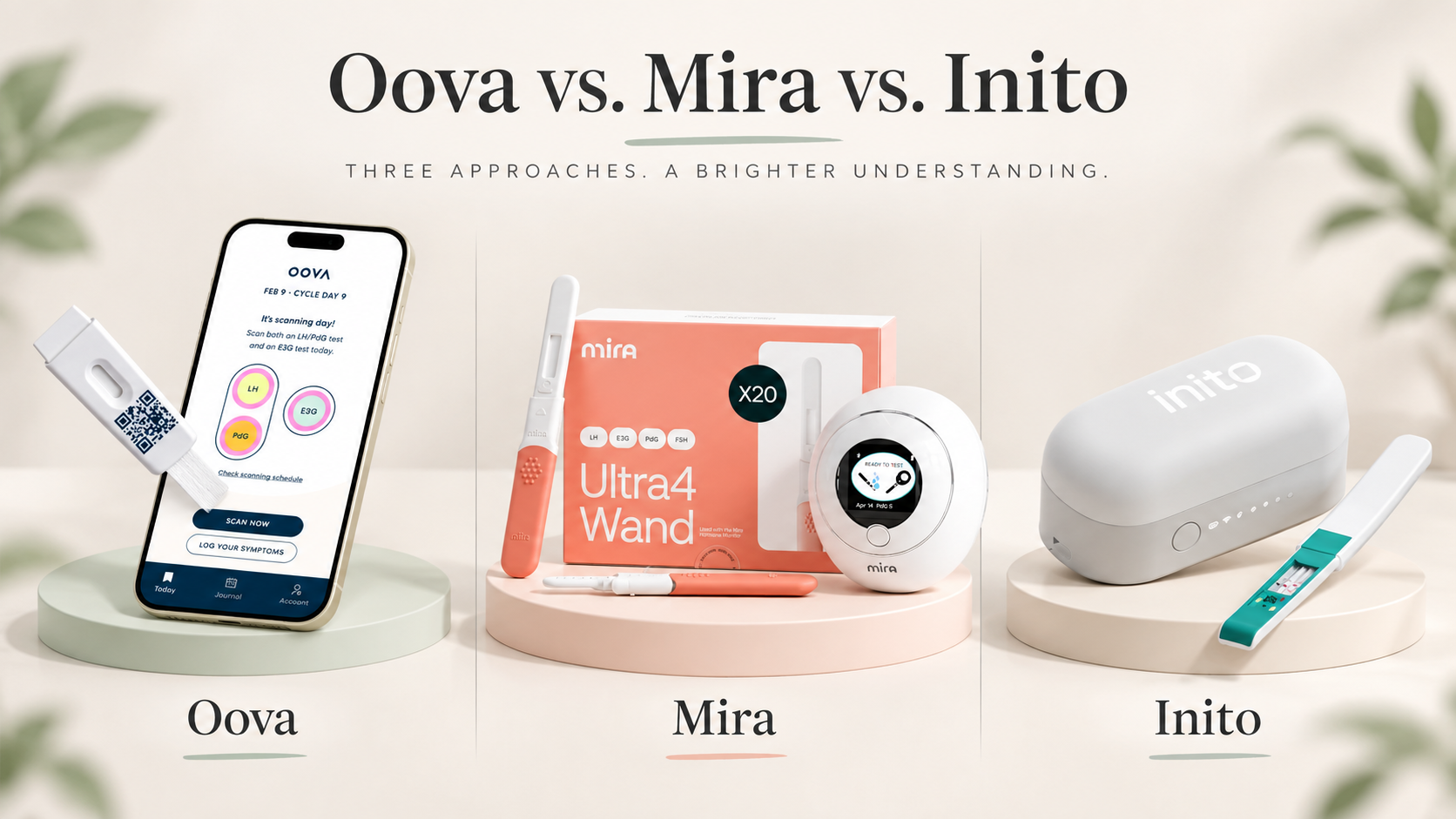
If you’re seeing an LH surge or ovulating earlier than expected, you may have a shorter follicular phase. Learn when that may simply be normal for you, when a change may be worth discussing with your doctor, and how tracking estrogen, LH, and progesterone can give you more context.

If you’re seeing an LH surge or ovulating earlier than expected, you may have a shorter follicular phase. Learn when that may simply be normal for you, when a change may be worth discussing with your doctor, and how tracking estrogen, LH, and progesterone can give you more context.
Quick answer: A short follicular phase means you ovulate relatively early in your menstrual cycle. That doesn’t automatically mean something is wrong or that you can’t get pregnant. It may simply be normal for you. If the timing is new, though, it’s worth looking at whether your fertile window has moved earlier and what your hormones are doing before and after ovulation.
Key takeaways
- The follicular phase begins on the first day of your period and ends at ovulation.
- There is no single universally accepted cutoff for a “short” follicular phase.
- In a study of more than 600,000 ovulatory cycles, the average follicular phase was about 17 days, but there was wide variation.[3]
- If you ovulate earlier, your fertile window also happens earlier.
- Early ovulation alone doesn’t tell you whether a cycle is fertile or whether you have low ovarian reserve.
If you’re tracking ovulation, seeing an LH surge on Day 9, 10, or 11 can be surprising. Most cycle diagrams put ovulation around Day 14, so anything earlier can look abnormal.
But ovulation doesn’t happen on Day 14 for everyone.
Some women naturally ovulate earlier. For others, the timing changes from one cycle to another or starts shifting earlier than it used to.
So if you suddenly see an LH surge on Day 10, the cycle day itself only tells you so much. You also want to know whether that timing is typical for you, whether your fertile window moved with it, and what happened before and after the surge.
What is a short follicular phase?
The follicular phase runs from the first day of your period through ovulation. During this time, follicles develop in the ovary and estrogen rises ahead of the LH surge that precedes ovulation.
For more on what happens during this part of your cycle, see our guide to the follicular phase.
There isn’t one universally accepted cutoff for a short follicular phase. Some studies have classified ovulation before Day 11 as early, while others have grouped follicular phases shorter than about 12 days as short.[1,2]
For context, a large study of 612,613 ovulatory cycles found an average follicular phase of 16.9 days and an average luteal phase of 12.4 days. But the ranges were wide, which is another reason not to treat an average as a rule.[3]
If you’ve always ovulated around Day 11, that’s different from ovulating around Day 15 for years and then suddenly shifting to Day 10.
Is ovulating on Day 10 or 11 normal?
It can be.
Ovulation does not have to happen on Day 14, and ovulating on Day 10 or 11 once doesn’t mean something is wrong.
Pay more attention to whether the timing is normal for you.
If you consistently ovulate around Day 11 and your cycles haven’t otherwise changed, that may simply be your usual timing. If your LH surge has moved from Day 14 or 15 to Day 9 or 10 over several cycles, that change is more useful to bring to your doctor.
If your periods have also started arriving earlier, read more about why your period may be getting shorter.
Why am I ovulating early?
There are a few possible reasons.
It may simply be your normal
The follicular phase varies quite a bit between women and from cycle to cycle.
In the study of more than 600,000 cycles, differences in overall cycle length were driven predominantly by differences in follicular-phase length and therefore the timing of ovulation.[3]
So two women can have different ovulation days without either one necessarily having a problem.
The dominant follicle may be selected earlier
Ovulation timing can also change with reproductive age.
A study comparing ovulatory women ages 40–45 with women ages 20–25 found shorter follicular phases in the older group. The researchers attributed the difference to earlier selection of the dominant follicle rather than simply faster follicle development after selection.[4]
That can move ovulation earlier in the cycle.
But it does not mean that anyone who ovulates early has diminished ovarian reserve or is approaching menopause.
Cycle timing can change with age
Large-scale cycle data show that the follicular phase tends to shorten with age.
Between ages 25 and 45, the Bull study found that mean follicular-phase length decreased by about 0.19 days per year of age.[3]
If you’re noticing more variability between cycles too, read more about why fertility gets more variable before it declines.
Stress, illness, exercise, weight, and other factors can affect timing
Ovulation can move around for reasons unrelated to age.
Illness, significant stress, major changes in exercise or weight, under-fueling, travel, disrupted sleep, medications, and some health conditions can all affect the hormonal signaling involved in ovulation.
One unusually early cycle usually tells you less than a change that keeps happening.
Does a short follicular phase affect fertility?
Not necessarily. You can ovulate early and get pregnant.
Ovulating early doesn’t automatically mean the egg is immature or that the cycle can’t result in pregnancy.
There is some research linking shorter cycles or very early ovulation with lower chances of conception. One prospective study found lower fecundability among women whose usual cycles were shorter than 25 days compared with women whose cycles were 27–29 days.[5]
Two older, small studies in women experiencing infertility also reported lower pregnancy rates with very early ovulation.[1,6]
Those studies don’t mean that ovulating on Day 10 or 11 makes you infertile. The studies were small, some involved women already experiencing infertility, and the day of ovulation is only one part of a cycle.
If you’re trying to conceive, it’s also useful to look at what happened before ovulation and what happens afterward.
Our article Why Some Cycles Are More Fertile Than Others goes deeper into those differences.
If you ovulate early, your fertile window moves earlier too
This is the part that matters immediately if you’re trying to conceive.
The fertile window is generally defined as the six-day period ending on the day of ovulation.
So if ovulation moves earlier, the fertile window moves with it.
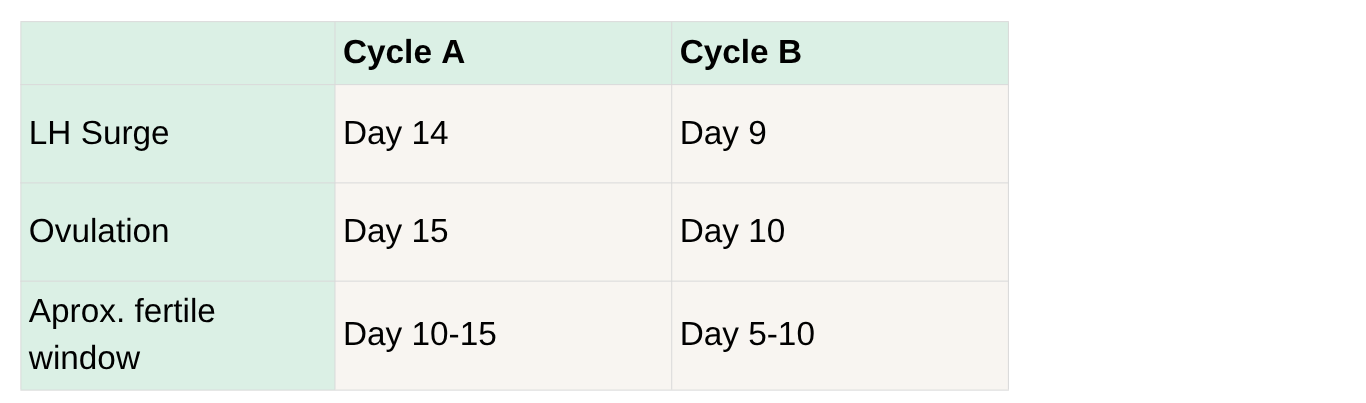
If you normally start ovulation tests around Day 10 or 11, a cycle like Cycle B can be almost over before your first test.
And fertile windows vary more than the standard cycle diagram suggests.
In a prospective study of 221 women, only about 30% had their entire fertile window between Days 10 and 17. Most had at least one fertile day earlier or later than that range.
That’s why an assumed Day-14 ovulation doesn’t work for everyone.
An LH surge is only one part of the story
A positive ovulation test tells you that LH has surged. It doesn’t independently prove that ovulation happened.
If your surge is happening earlier than expected, there are two other things worth looking at.
What was estrogen doing before the surge?
As a follicle develops, estrogen rises. E3G, a urinary estrogen metabolite, can be tracked as that rise happens.
A standard ovulation test detects the LH surge, which happens relatively close to ovulation. Estrogen begins rising earlier, so tracking E3G can give you more notice that your fertile window is opening.
That extra notice can matter when your fertile window starts earlier than expected.
What happened after the LH surge?
After ovulation, progesterone should rise. PdG is a urinary metabolite of progesterone.
A sustained PdG rise after an LH surge provides evidence that ovulation likely occurred.
That distinction matters because a positive OPK doesn’t always mean you ovulated.
So an LH surge on Day 10 doesn’t tell you everything about the cycle. Looking at the estrogen rise beforehand and PdG afterward gives you more context.
Does early ovulation mean low ovarian reserve?
No. You can’t diagnose low ovarian reserve from the day you ovulate.
There’s a reason the two sometimes get connected. Follicular phases can shorten with reproductive aging, and earlier dominant-follicle selection has been observed in older reproductive-age women.[4]
But ovulation timing is not an ovarian-reserve test.
AMH isn’t a direct measure of whether you can get pregnant naturally, either.
In a prospective study of women ages 30–44 without a history of infertility, women with low AMH did not have a significantly lower probability of conceiving than women with normal AMH. The researchers concluded that ovarian-reserve biomarkers should not be used to assess current natural fertility in women like those studied.
If ovulation has recently moved much earlier for you, especially if your cycles are also getting shorter or more variable, bring that change to your doctor rather than trying to infer ovarian reserve from the cycle day.
When should you talk to your doctor about early ovulation?
An occasional early ovulation isn’t necessarily a reason to worry.
It’s worth bringing up with your OB-GYN or fertility specialist if:
- your ovulation has consistently shifted several days earlier than it used to
- your cycles are now shorter than 25 days or becoming increasingly irregular
- you consistently ovulate very early and are having trouble conceiving
- you’re under 35 and have been trying for 12 months without success
- you’re 35 or older and have been trying for 6 months without success
- you’re over 40 and are trying to conceive
- you have other symptoms or medical history that could affect fertility
ASRM recommends fertility evaluation after 12 months of trying for women under 35 and after six months for women 35 and older. For women over 40, more immediate evaluation may be appropriate. ASRM also lists cycles shorter than 25 days as a reason fertility evaluation may be started without waiting.
If you track your hormones, bring a few cycles of data with you. Oova lets you share your results with your clinician directly from the app.
What should you track if you think you’re ovulating early?
Don’t focus only on the day your ovulation test turns positive. Over several cycles, keep an eye on:
- When estrogen starts rising. Is your E3G rise happening earlier too?
- When your LH surge happens. Is Day 9 or 10 normal for you, or is it new?
- What happens afterward. Does PdG rise and stay elevated after the surge?
- When your next period begins.
- Whether the earlier timing happens again.
- What else changed that month. Stress, illness, medications, exercise, sleep, and changes in bleeding are all useful context.
That gives you more to work with than “I got a positive OPK on Day 10.”
How Oova helps when your ovulation timing changes
Calendar predictions rely heavily on what happened in your previous cycles. That can become less useful when your ovulation day moves.
Oova tracks E3G, LH, and PdG across the cycle. Over time, you can see whether your estrogen rise and LH surge are happening earlier than usual and what happens afterward. Oova’s current product materials describe quantitative measurement of all three hormones and personalized fertile-window prediction. Oova 101
That’s especially useful when the question isn’t just when did I ovulate? but is my timing changing?
The bottom line
Ovulating earlier than expected doesn’t automatically mean something is wrong.
Some women naturally have shorter follicular phases. Ovulation timing can also change from one month to another and may shift earlier with age.
If you’re trying to conceive, the most practical thing to know is that earlier ovulation means your fertile window happens earlier too.
And the day you ovulate is only part of the picture. Seeing what happens before the LH surge, what happens afterward, and whether the timing keeps changing can give you a better idea of what’s going on.
FAQ
Is ovulating on Day 10 too early?
Not necessarily. There isn’t a universally accepted cycle day that makes ovulation “too early.” Some studies have classified ovulation before Day 11 or a follicular phase shorter than about 12 days as early, but one Day-10 ovulation doesn’t mean something is wrong.
Can you get pregnant if you ovulate on Day 10?
Yes. Ovulating on Day 10 doesn’t prevent pregnancy. It does mean your fertile window happens earlier, so you may need to start tracking sooner than someone who ovulates around Day 14.
Why am I suddenly ovulating earlier?
Ovulation timing can change because of normal month-to-month variation, age-related changes, illness, stress, major changes in exercise or weight, medications, and other health factors. If your ovulation keeps happening several days earlier than it used to, mention the change to your doctor.
Does early ovulation mean low AMH or diminished ovarian reserve?
No. You can’t determine AMH or ovarian reserve from your ovulation day. Earlier ovulation can occur with reproductive aging, but it can also happen for other reasons or simply be normal for you.
Should I start ovulation testing earlier if I have short cycles?
It can help. If you tend to ovulate early, waiting until Day 10 or 11 to start testing could mean missing part of your fertile window. Tracking estrogen before the LH surge can also give you earlier notice that the fertile window is opening.
About the author
Sources
- Check JH, Adelson H, Lurie D, Jamison T. Effect of the short follicular phase on subsequent conception. Gynecologic and Obstetric Investigation. 1992;34(3):180–183.
- Broom TJ, Matthews CD, Cooke ID, et al. Endocrine profiles and fertility status of human menstrual cycles of varying follicular phase length. Fertility and Sterility. 1981;36(2):194–200.
- Bull JR, Rowland SP, Scherwitzl EB, et al. Real-world menstrual cycle characteristics of more than 600,000 menstrual cycles. NPJ Digital Medicine. 2019;2:83. Nature
- Klein NA, Harper AJ, Houmard BS, et al. Is the short follicular phase in older women secondary to advanced or accelerated dominant follicle development? Journal of Clinical Endocrinology & Metabolism. 2002;87(12):5746–5750.
- Wise LA, Mikkelsen EM, Rothman KJ, et al. A prospective cohort study of menstrual characteristics and time to pregnancy. American Journal of Epidemiology. 2011;174(6):701–709.
- Check JH, Liss JR, Shucoski K, Check ML. Effect of short follicular phase with follicular maturity on conception outcome. Clinical and Experimental Obstetrics & Gynecology. 2003;30(4):195–196.
- Steiner AZ, Pritchard D, Stanczyk FZ, et al. Association between biomarkers of ovarian reserve and infertility among older women of reproductive age. JAMA. 2017;318(14):1367–1376. JAMA Network
- Wilcox AJ, Weinberg CR, Baird DD. Timing of sexual intercourse in relation to ovulation. New England Journal of Medicine. 1995;333(23):1517–1521.
- Wilcox AJ, Dunson D, Baird DD. The timing of the “fertile window” in the menstrual cycle: day specific estimates from a prospective study. BMJ. 2000;321:1259–1262. BMJ
- Practice Committee of the American Society for Reproductive Medicine. Fertility evaluation of infertile women: a committee opinion. Fertility and Sterility. 2021.
About the Oova Blog:
Our content is developed with a commitment to high editorial standards and reliability. We prioritize referencing reputable sources and sharing where our insights come from. The Oova Blog is intended for informational purposes only and is never a substitute for professional medical advice. Always consult a healthcare provider before making any health decisions.