
A normal total testosterone result doesn't always tell the whole story. Learn what free testosterone and SHBG measure, why testing methods matter, and what to ask your doctor.

A normal total testosterone result doesn't always tell the whole story. Learn what free testosterone and SHBG measure, why testing methods matter, and what to ask your doctor.
If you've had a testosterone blood test, you may have noticed that the results aren't as straightforward as you expected. Your total testosterone might be normal, but your free testosterone is low. Or your doctor may have ordered an SHBG test you've never heard of.
So which number should you pay attention to?
A testosterone blood test for women typically starts with total testosterone, but free testosterone and SHBG can provide important additional context. The testing method matters, too. Because women generally have much lower testosterone levels than men, some standard laboratory tests may not measure those concentrations reliably.
Here's what each test tells you, why results can differ, and what to discuss with your doctor.
What are the three main testosterone blood tests for women?
Testosterone circulates in your blood in different forms. Some is attached to proteins, and a small portion circulates without being bound.
The three measurements you'll commonly encounter are total testosterone, free testosterone, and sex hormone-binding globulin, or SHBG.

These measurements aren't interchangeable. They describe different aspects of the same hormonal system.
What is total testosterone?
Total testosterone measures all the testosterone circulating in your blood, including testosterone bound to proteins and testosterone circulating freely.
It's generally the first measurement clinicians consider when evaluating possible excess androgen levels or establishing a baseline before testosterone therapy.
Women naturally produce testosterone in the ovaries and adrenal glands, and additional testosterone is formed through conversion from other hormones. Testosterone plays roles in sexual function and other physiological processes, but there is no single testosterone number that defines healthy sexual desire, energy, or well-being.
A result also needs to be interpreted in context. A level that's appropriate for one person may warrant further evaluation in another based on symptoms, medications, age, and the laboratory's reference range.
What is a normal testosterone level for women?
Normal testosterone levels depend on your age, the laboratory, and the method used to measure them. Reference ranges can differ significantly between laboratories, particularly when comparing LC-MS/MS testing with standard immunoassays.
The most useful comparison is with the reference range provided on your own laboratory report. Even then, a result within that range doesn't necessarily explain your symptoms, and a result outside it doesn't automatically establish a diagnosis.
Your healthcare provider can interpret your result alongside your symptoms, medications, and any other relevant testing.
Why testing accuracy matters so much in women
Many conventional testosterone tests use immunoassays, which rely on antibodies to detect the hormone.
These tests can be useful in some settings, but they may lack sufficient sensitivity and specificity at the low testosterone concentrations typically found in women. Different laboratories may also produce meaningfully different results from similar samples.
Clinical guidelines therefore recommend a validated method called liquid chromatography with tandem mass spectrometry, or LC-MS/MS, when accurately measuring total testosterone in women is important.
LC-MS/MS separates substances in the sample and identifies testosterone with greater analytical specificity. It is generally the preferred approach for evaluating elevated testosterone in women, although assay quality and laboratory calibration still matter.
If your testosterone result seems inconsistent with your symptoms, it's reasonable to ask your provider which testing method was used and whether confirmation with LC-MS/MS would be appropriate.
What is free testosterone?
Free testosterone is the portion of testosterone circulating without being attached to proteins.
Most testosterone in the bloodstream is bound to SHBG or more loosely bound to albumin. Only a small fraction circulates freely.
Because free testosterone isn't bound, it can be an important part of evaluating androgen status. However, the relationship between circulating free testosterone and actual tissue effects is complex. A free testosterone value cannot, by itself, explain a woman's symptoms.
How is free testosterone measured?
There are several ways a laboratory may report free testosterone.
Calculated free testosterone uses total testosterone, SHBG, and sometimes albumin to estimate the unbound amount. Its reliability depends on the quality of the underlying measurements and the calculation method.
Equilibrium dialysis is a specialized laboratory technique that physically separates free testosterone from protein-bound testosterone. It is widely regarded as a reference method, although it is less routinely available.
Direct analog free testosterone immunoassays are another option, but their results are often unreliable at the concentrations found in women.
This is why it matters to know whether a report's free testosterone result was calculated, directly measured using a validated method, or obtained from a less reliable direct immunoassay.
A calculated free testosterone result based on a high-quality total testosterone measurement may be more informative than an inaccurately measured free testosterone value.
What is SHBG, and why does it matter?
SHBG stands for sex hormone-binding globulin. It's a protein produced mainly by the liver that binds testosterone and estradiol in the bloodstream.
Think of SHBG as one factor affecting how testosterone is distributed between bound and unbound forms.
When SHBG is higher, a greater proportion of circulating testosterone may be bound. When SHBG is lower, the unbound proportion may be higher.
That means two women with similar total testosterone results can have different free testosterone estimates.
What causes high SHBG in women?
Several factors can affect SHBG, including:
- Oral estrogen therapy and estrogen-containing birth control
- Thyroid hormone status and certain thyroid treatments
- Liver conditions
- Individual differences in metabolism and hormone regulation
High SHBG isn't automatically a problem. Its significance depends on the reason for testing and the rest of the clinical picture.
What causes low SHBG in women?
Lower SHBG is associated with several metabolic and endocrine conditions, including insulin resistance, obesity, and PCOS. Thyroid dysfunction and certain medications may also affect SHBG.
Low SHBG does not diagnose any of these conditions by itself. A clinician may need to consider symptoms, medical history, other blood tests, and metabolic factors.
If you're also dealing with irregular cycles or suspected PCOS, understanding your androgen results is only one part of the assessment. Ovulatory patterns matter too, which is why women may also benefit from learning how hormone patterns change with PCOS.
Can total testosterone be normal while free testosterone is abnormal?
Yes. This is one of the most important reasons to consider SHBG alongside testosterone results.
For example, a woman can have a total testosterone result within her laboratory's reference range while having a higher estimated free testosterone because her SHBG is low.
The reverse can also happen. A woman with higher SHBG may have a relatively low calculated free testosterone despite a total testosterone result that appears unremarkable.
These patterns can be worth reviewing, but they aren't diagnoses.
Common testosterone test result patterns
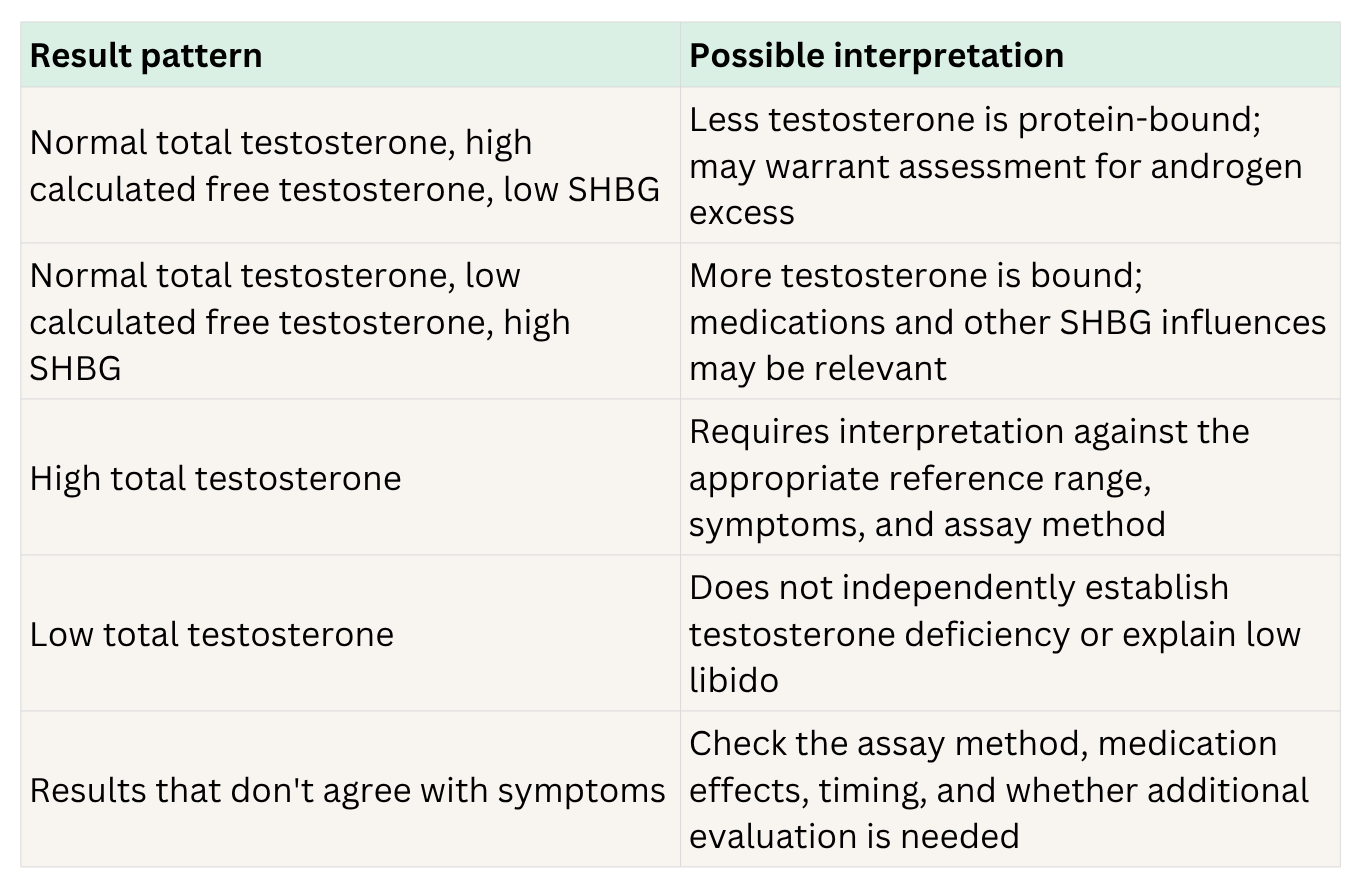
An abnormal number shouldn't be interpreted without knowing the test method, units, and reference interval.
In particular, there is no validated testosterone threshold that diagnoses low sexual desire in women.
Which testosterone blood tests should women ask for?
The answer depends on the clinical question.
If you have acne, facial hair growth, hair thinning, or irregular periods
A clinician may evaluate whether you have excess androgen activity.
This often involves total testosterone measured with a reliable assay, together with an assessment of free testosterone or an appropriate calculated index.
SHBG may help explain a discrepancy between total and free testosterone.
Depending on the findings, the evaluation may include other hormones such as DHEAS or androstenedione. Testosterone is only one part of assessing possible PCOS or other causes of androgen excess.
If you're concerned about low libido during perimenopause
Testosterone testing serves a different purpose.
Low sexual desire can involve sleep, stress, relationship factors, vaginal symptoms, medications, health conditions, and hormonal changes.
A low testosterone result does not automatically explain the problem, and normal testosterone does not rule out a sexual health concern.
If you're exploring this topic, our guide to low sex drive during perimenopause explains the broader factors that can affect desire.
If you're considering testosterone therapy
Clinicians may check total testosterone and SHBG before treatment to establish baseline values and identify factors that could affect interpretation.
Those results help guide safety monitoring. They aren't used to diagnose low sexual desire from a blood test alone.
For an overview of the evidence and treatment considerations, read Testosterone for Women: What Everyone Is Missing.
Does the timing of a testosterone blood test matter?
It can.
Testosterone concentrations can vary with the time of day, and some androgen measurements may be influenced by menstrual-cycle timing.
For women being evaluated for androgen excess, clinical guidance recommends morning blood collection, with early follicular-phase sampling when feasible. Your clinician may recommend a different approach depending on your symptoms, medication use, menstrual regularity, or the reason for testing.
Hormonal contraception is especially important to disclose. Combined oral contraceptives can increase SHBG and suppress androgen production, making biochemical evaluation of androgen excess more difficult.
Do not stop contraception or hormone therapy simply to obtain a laboratory result. If medication changes are necessary for testing, your healthcare provider should explain the timing and alternatives.
What if your testosterone test is normal but you still have symptoms?
A normal result doesn't mean your symptoms aren't real. It means that the particular measurement, under the conditions in which it was collected, fell within the laboratory's reference interval.
It doesn't automatically answer why you're experiencing fatigue, changing sexual desire, irregular periods, or other concerns.
The next step depends on your symptoms.
Someone with progressive facial hair growth and irregular periods may need a different evaluation from someone experiencing sleep disruption and low libido during perimenopause.
Your healthcare provider may consider other endocrine conditions, medication effects, reproductive hormone changes, or nonhormonal causes.
One normal testosterone result should not be used to dismiss persistent symptoms, but repeating testosterone tests indefinitely is not necessarily the answer either.
The goal is to match the testing approach to the clinical question.
Is testosterone testing different from tracking estrogen and progesterone?
Yes. They answer different questions, and one doesn't replace the other.
A testosterone blood test measures an androgen at a particular point in time. Depending on why it was ordered, it may help evaluate androgen excess or support clinical monitoring.
Estrogen, progesterone, and LH measurements provide information about other parts of reproductive hormone function, particularly menstrual-cycle and ovulation patterns.
For example, if you're experiencing irregular cycles, tracking several reproductive hormones across a cycle may provide context that a single measurement cannot capture.
Oova's current hormone kit tracks estrogen, progesterone, and LH patterns through urine testing. It does not measure testosterone or SHBG.
For a closer explanation of the differences between sample types, read Urine Hormone Testing vs. Blood Tests.
And if you're interested in exactly what Oova measures, our guide to how estrogen, progesterone, and LH are measured explains the technology.
When looking at more than one hormone makes sense
If your main question is whether you have excess testosterone, an appropriate clinical blood test is the right starting point.
If your question is how your menstrual cycle is changing, whether ovulation is occurring, or how reproductive hormone patterns vary over time, longitudinal tracking can provide a different kind of information.
Some women may benefit from both approaches, depending on their goals and clinical circumstances.
Neither approach should replace appropriate medical evaluation when symptoms require it.
Five questions to ask your doctor about testosterone testing
If you're reviewing your results or preparing for a blood test, these questions can help make the conversation more useful:
- Why are we measuring testosterone in my situation?
- Was my total testosterone measured using LC-MS/MS?
- Would SHBG or a reliable free testosterone assessment change how you interpret my result?
- Could my medications, birth control, thyroid status, or other conditions affect the measurement?
- Based on my symptoms, what additional evaluation or follow-up would be helpful?
You don't necessarily need every testosterone-related test available. You need the measurements that help answer your specific medical question.
Frequently asked questions
Is total testosterone or free testosterone more important for women?
Both may matter, depending on why testing is being performed. Total testosterone is generally the starting point, while free testosterone and SHBG can add context, especially when evaluating androgen excess or when SHBG is altered.
What is the most accurate testosterone blood test for women?
A validated LC-MS/MS assay is generally preferred for measuring total testosterone at the low concentrations commonly found in women. Free testosterone requires appropriate calculation or specialized laboratory methods, such as equilibrium dialysis.
Can SHBG be high if testosterone is normal?
Yes. SHBG is affected by factors beyond total testosterone, including estrogen-containing medications, thyroid status, and other physiological conditions. A normal total testosterone result does not establish that SHBG is normal.
What does low free testosterone mean in women?
It means the measured or estimated unbound testosterone is below the laboratory's reference interval. It does not independently diagnose a clinical testosterone deficiency or establish the cause of symptoms such as fatigue or low libido.
Should women get testosterone tested during perimenopause?
Not every woman needs testosterone testing during perimenopause. It may be appropriate when a clinician suspects androgen excess or is evaluating and monitoring testosterone therapy. Perimenopause itself is generally assessed through clinical history and symptoms rather than routine testosterone testing.
Can Oova test testosterone at home?
No. Oova currently measures estrogen, progesterone, and LH patterns, not testosterone or SHBG. Testosterone evaluation requires an appropriate laboratory test ordered or interpreted with a healthcare professional.
The bottom line
Total testosterone, free testosterone, and SHBG tell you different things.
Total testosterone measures how much testosterone is circulating in your blood. Free testosterone describes the unbound portion, while SHBG helps explain how much testosterone is bound to proteins.
For women, the laboratory method matters. Reliable measurement is particularly important because circulating testosterone concentrations are much lower than those typically found in men.
Most importantly, no single testosterone result can explain every symptom or determine whether you need treatment.
If you're also trying to understand changes in your menstrual cycle, ovulation, or broader reproductive hormone patterns, tracking estrogen, progesterone, and LH over time can provide additional information to discuss with your healthcare provider.
About the author
Sources
- Elhassan YS, et al. (2025). Society for Endocrinology Clinical Practice Guideline for the Evaluation of Androgen Excess in Women. Clinical Endocrinology.
- Parish SJ, et al. (2021). International Society for the Study of Women's Sexual Health Clinical Practice Guideline for the Use of Systemic Testosterone for Hypoactive Sexual Desire Disorder in Women. Journal of Women's Health.
- Teede HJ, et al. (2023). Recommendations From the 2023 International Evidence-based Guideline for the Assessment and Management of Polycystic Ovary Syndrome. Human Reproduction.
- Davis SR, et al. (2019). Global Consensus Position Statement on the Use of Testosterone Therapy for Women. The Journal of Clinical Endocrinology & Metabolism.
- Quest Diagnostics: Testosterone Testing, Clinical Frequently Asked Questions.
About the Oova Blog:
Our content is developed with a commitment to high editorial standards and reliability. We prioritize referencing reputable sources and sharing where our insights come from. The Oova Blog is intended for informational purposes only and is never a substitute for professional medical advice. Always consult a healthcare provider before making any health decisions.
