Compare Oova, Mira, and Inito side by side to see how these at-home hormone monitors differ in hormones measured, fertility and perimenopause support, symptoms, wearable integration, provider sharing, testing experience, and cost.
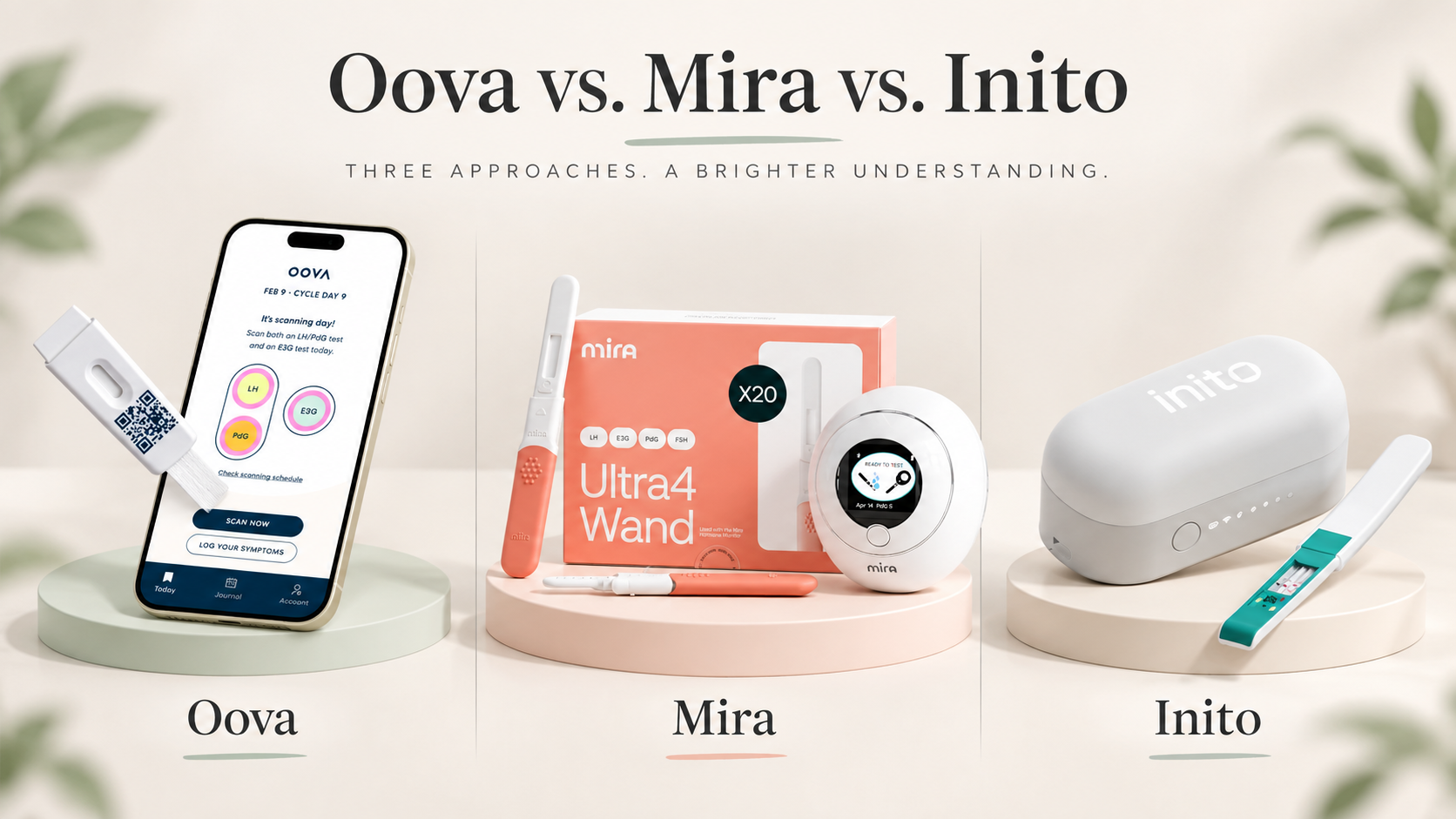
Compare Oova, Mira, and Inito side by side to see how these at-home hormone monitors differ in hormones measured, fertility and perimenopause support, symptoms, wearable integration, provider sharing, testing experience, and cost.
If you’re comparing Oova, Mira, and Inito, you’re probably looking for more than a standard ovulation predictor kit.
All three platforms provide quantitative at-home hormone data, and all three can help users understand reproductive hormone patterns over time. But they differ in the hormones they measure, the hardware they require, the experiences they are built around, and how far they extend beyond fertility.
The right choice depends less on which monitor has the longest feature list and more on what you are actually trying to understand about your body.
If you’re already narrowing your decision down to two options, you can also read our detailed Oova vs. Mira comparison or Oova vs. Inito comparison.
Here’s how all three compare.
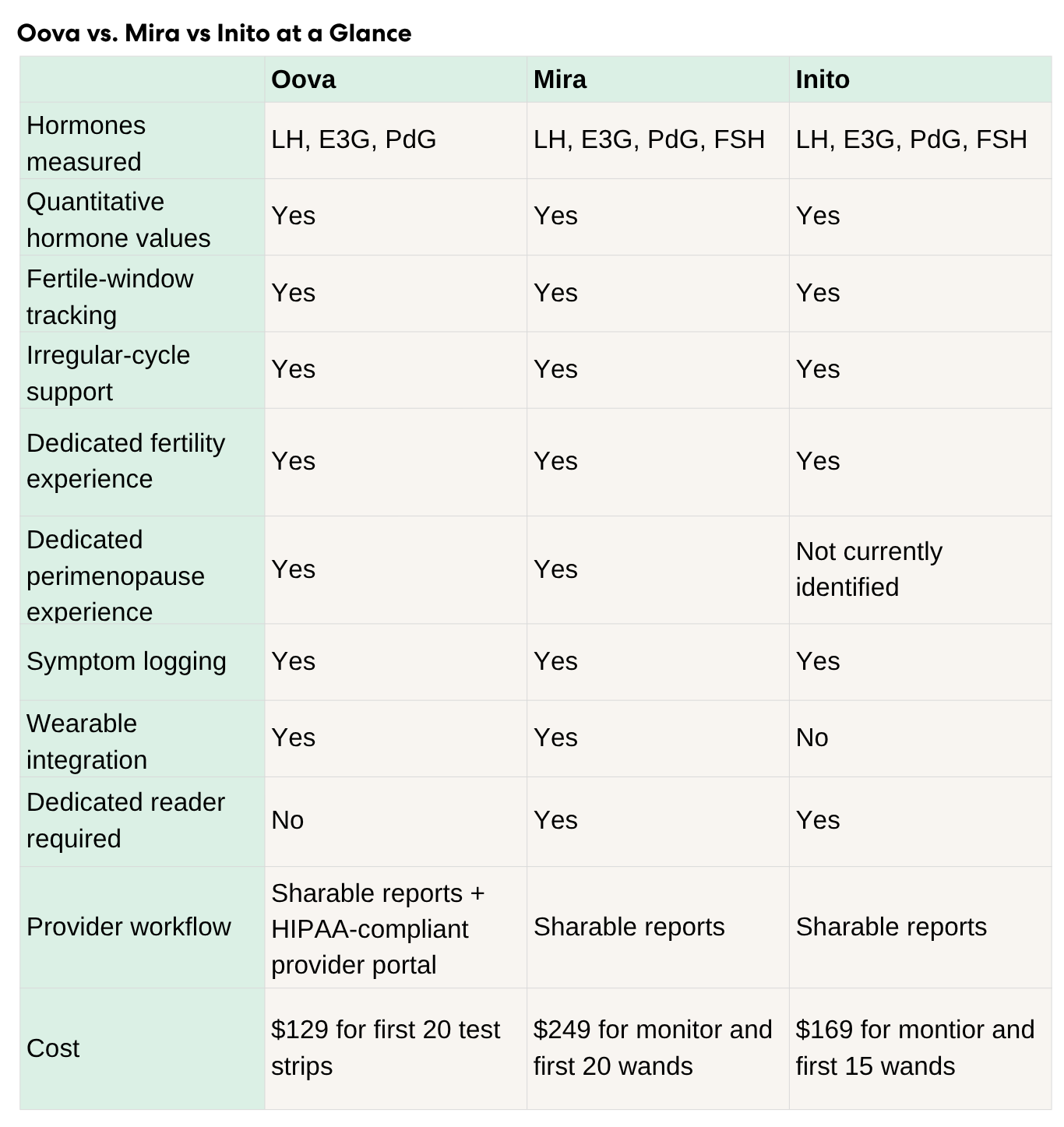
Product features, pricing, intended uses, and availability can change. This comparison reflects publicly available product information as of September 2026. Review each company’s current product materials before purchasing.
What Is Oova?
Oova is an at-home hormone monitoring platform designed around longitudinal hormone patterns rather than a single measurement or a fixed 28-day cycle.
Oova measures three urinary hormone markers:
- LH, which typically surges before ovulation
- E3G, a urinary estrogen metabolite
- PdG, a urinary progesterone metabolite
The platform is built around three primary health journeys:
- Fertility
- Hormone Optimization
- Perimenopause
That means Oova is designed not only for identifying fertile windows and following ovulatory patterns, but also for people trying to understand irregular cycles, symptoms, reproductive transitions, and how hormone patterns change over time.
Oova does not require a separate proprietary analyzer. Users test at home and scan their results through the Oova app.
Oova can also connect with Oura, allowing supported sleep and readiness information to be viewed alongside hormone data and symptoms.
If you’re interested specifically in how Oova supports reproductive aging, learn more about Oova’s perimenopause hormone tracking.
What Is Mira?
Mira is an at-home hormone monitoring system that uses disposable testing wands with a separate Mira analyzer.
Its Ultra4 system measures four hormones: LH, E3G, PdG, and FSH.
Mira supports fertility tracking and also offers a dedicated menopause-transition experience.
Its current perimenopause offering allows users to track hormone patterns, symptoms, and cycle changes over time. Mira states that its Ultra4 Perimenopause kit is intended for hormone tracking and personal cycle awareness and is not intended to monitor, assess, or evaluate response to HRT or another medical treatment.
For users who specifically want FSH included in routine at-home testing, Mira’s four-hormone Ultra4 system may be particularly relevant.
Want a deeper head-to-head look? Read Oova vs. Mira: Which Hormone Monitor Is Right for You?
If you’re already considering Mira but exploring other options, see our guide to Mira alternatives.
What Is Inito?
Inito is an at-home fertility monitor that measures four urinary hormone markers from a single test strip: E3G, LH, PdG, and FSH.
It uses its InSight Wireless Reader to analyze test strips and provides quantitative hormone values in the Inito app.
Inito’s current positioning is centered primarily around fertility and cycle tracking, including fertile-window identification, ovulation prediction, and following PdG after the LH surge.
Inito also supports users with irregular cycles and PCOS and allows users to log additional information such as symptoms, medications, sex, and pregnancy tests.
Users can export cycle reports containing hormone patterns and exact hormone values to share with healthcare providers.
For a more detailed comparison, read Oova vs. Inito: Which Hormone Tracker Is Right for You?
Which Hormones Do Oova, Mira, and Inito Measure?
All three systems measure three reproductive hormone signals that are particularly useful for understanding cycle patterns:
LH
Luteinizing hormone typically rises sharply before ovulation.
A rise in LH can indicate that ovulation may be approaching, but an LH surge by itself does not establish that ovulation occurred.
E3G
Estrone-3-glucuronide is a urinary metabolite of estrogen.
E3G typically rises as estrogen increases during the follicular phase and can provide additional context around the fertile window.
PdG
Pregnanediol glucuronide is a urinary metabolite of progesterone.
Looking for a sustained PdG rise after the LH surge can provide additional evidence consistent with ovulation.
For a deeper explanation of why the post-LH pattern matters, read how to confirm ovulation at home.
FSH
Mira Ultra4 and Inito also measure follicle-stimulating hormone.
Oova does not currently measure FSH.
FSH can add another reproductive hormone signal, but no single at-home hormone value should be treated as a standalone diagnosis or definitive measure of reproductive status.
Oova vs. Mira vs. Inito for Fertility
For someone trying to conceive, all three platforms provide significantly more information than a traditional LH-only ovulation predictor kit.
Each can help users:
- identify fertile-window patterns
- observe changes in LH
- follow estrogen-related changes through E3G
- look for a PdG rise after the LH surge
Mira and Inito also include FSH in their four-hormone systems.
For someone whose primary goal is fertility tracking, the decision may therefore come down to:
- whether you want FSH included
- whether you prefer dedicated hardware
- how you want your data displayed
- price and refill structure
- whether you expect your hormone-tracking needs to extend beyond trying to conceive
Oova uses the same longitudinal approach across fertility, symptom investigation, and perimenopause, which may matter to users who want to continue using the same platform as their health questions change over time.
Oova vs. Mira vs. Inito for Confirming Ovulatory Patterns
An LH surge is useful for predicting that ovulation may be approaching.
It does not, by itself, confirm that ovulation occurred.
Oova, Mira, and Inito all measure PdG, allowing users to look for the progesterone-metabolite rise that typically follows ovulation.
This makes all three systems more informative for understanding ovulatory patterns than an LH-only test.
Consistent testing across the relevant portion of the cycle matters because longitudinal patterns generally provide more context than a single measurement.
You can learn more about what healthy hormone patterns can look like across a cycle.
Oova vs. Mira vs. Inito for Irregular Cycles
Calendar-based fertility predictions become less useful when cycle length varies significantly.
All three platforms collect actual hormone measurements rather than relying entirely on an assumed 28-day cycle.
That makes each potentially useful for people with irregular cycles.
The differences become more important when the questions go beyond fertility.
For example:
- Why are my cycles changing?
- Are my symptoms occurring alongside changes in my hormones?
- Am I entering perimenopause?
- What does my hormone pattern look like across several cycles?
- What information can I bring to my healthcare provider?
Those are areas where Oova’s broader hormone-health positioning becomes more relevant.
For more on irregular or anovulatory patterns, read ovulatory vs. anovulatory PCOS and what it can mean for TTC.
Oova vs. Mira vs. Inito for Perimenopause
Perimenopause is one of the clearest areas of differentiation among the three platforms.
Oova
Oova offers a dedicated perimenopause experience built around longitudinal hormone patterns, symptoms, and reproductive-aging context.
Its approach is designed to help users follow how hormones and symptoms change together over time and organize that information for conversations with healthcare providers.
Learn more about Oova for perimenopause →
Mira
Mira also offers a dedicated menopause-transition experience.
Its Ultra4 Perimenopause system tracks: LH, E3G, PdG, and FSH.
Mira also allows users to track symptoms and other relevant information alongside hormone measurements.
Mira states that its Ultra4 Perimenopause kit is intended for hormone tracking and personal cycle awareness and is not intended to monitor, assess, or evaluate response to HRT or other medical treatment.
Inito
Inito’s current product is positioned primarily around fertility and cycle tracking.
We did not identify a dedicated Inito perimenopause product or menopause mode in its current product materials.
That may make Oova or Mira more relevant for someone whose primary reason for testing is perimenopause rather than conception.
If your periods are still regular but something feels different, you may also find Can You Be in Perimenopause With Regular Periods helpful.
Oova vs. Mira vs. Inito for Symptoms
All three platforms allow users to capture more context than hormone values alone.
But they differ in how central symptoms are to the overall product experience.
Oova
Oova offers a dedicated Hormone Optimization experience for people who may not be trying to conceive.
It is built around investigating longitudinal hormone patterns alongside symptoms, including situations such as:
- irregular cycles
- unexplained symptoms
- post-birth-control changes
- possible PCOS-related patterns
- changes that may be associated with perimenopause
Oova also provides symptom insights designed to help users see how reported symptoms may overlap with hormone patterns over time.
If you’re trying to figure out whether what you’re experiencing may have a hormonal component, start with Are My Symptoms Hormonal or Something Else?
Mira
Mira includes symptom tracking within its fertility and menopause-transition experiences.
Users can view symptom information alongside their hormone data to help provide additional cycle context.
Inito
Inito allows users to log symptoms, medications, sex, pregnancy tests, and other cycle-related information.
Its broader product experience remains centered primarily around fertility and reproductive cycle tracking.
What About Wearables?
Hormones are only one piece of the broader health picture.
Sleep, recovery, symptoms, and lifestyle can all provide useful context when looking at longitudinal changes.
Oova integrates with Oura.
With permission, supported Oura data such as sleep duration and readiness information can be brought into the Oova experience alongside hormone and symptom data.
That can help users look at questions such as:
- Do changes in sleep overlap with certain points in my cycle?
- Does readiness shift alongside hormone changes?
- Do symptoms and recovery patterns appear at similar times?
- Are there broader patterns across hormones, symptoms, and sleep?
For someone who already uses a wearable, this can make hormone data part of a broader longitudinal view rather than a completely separate dataset.
Wearable integrations can change over time, so users considering Mira or Inito should review each company’s current integration capabilities directly.
Oova vs. Mira vs. Inito for Sharing Data With Your Doctor
All three platforms provide information that can be brought into a healthcare-provider conversation.
Inito
Inito allows users to export structured cycle reports containing hormone charts and exact hormone values.
Mira
Mira provides hormone-tracking information and reports that can be reviewed or shared.
Oova
Oova is designed around longitudinal hormone and symptom data and includes a clinician-facing experience through Oova360.
When users choose to share their information with participating providers, clinicians can review longitudinal hormone and symptom information rather than relying only on a single measurement.
The distinction is therefore less about whether data can be shared and more about the workflow and amount of longitudinal context each platform provides.
Learn more about Oova for healthcare providers.
Do You Need a Separate Monitor?
This is another practical difference among the three products.
Oova
Oova does not require a separate proprietary analyzer. The testing experience uses the Oova app and a smartphone.
Mira
Mira uses a dedicated Mira Monitor to analyze its testing wands.
Inito
Inito uses its InSight Wireless Reader to analyze its hormone strips. Some users may prefer dedicated hardware. Others may prefer not to purchase, charge, carry, or maintain another device.
Oova vs. Mira vs. Inito: Which Is Better for PCOS?
People with PCOS may experience irregular or anovulatory cycles, which can make traditional calendar-based fertility methods less useful.
All three platforms provide quantitative hormone tracking and can support users with irregular cycles.
Inito explicitly includes PCOS among the use cases it discusses for fertility tracking.
Mira also positions its multi-hormone monitoring for users with irregular cycles.
Oova is designed not to assume a standard 28-day cycle and includes irregular cycles and possible PCOS-related patterns within its broader fertility and Hormone Optimization experiences.
None of these products should be used to diagnose PCOS.
For a deeper explanation, read Anovulatory vs. Ovulatory PCOS: What It Means for TTC.
Oova vs. Mira vs. Inito: Hardware and Testing Experience
The three platforms take somewhat different approaches.
Oova
- Home urine testing
- Smartphone-based scanning
- No separate proprietary reader
- Longitudinal app experience
Mira
- Disposable testing wands
- Dedicated Mira Monitor
- Multiple testing configurations
- Four-hormone Ultra4 option
Inito
- Single fertility test strip
- InSight Wireless Reader
- Four hormones measured on the strip
- Fertility-focused app experience
The best workflow is ultimately the one you are most likely to use consistently.
So, Which Hormone Monitor Is Right for You?
There is no single monitor that is the best choice for every person or every goal.
Oova may be a good fit if you:
- Want hormone tracking that extends beyond fertility
- Want to see symptoms alongside longitudinal hormone patterns
- Are dealing with irregular or changing cycles
- Are navigating perimenopause
- Want to connect supported Oura sleep and readiness data with your hormone information
- Want longitudinal information that can be shared with participating healthcare providers
- Prefer not to purchase a separate analyzer
- Want to stay within the same platform as your health questions change over time
Mira may be a good fit if you:
- Specifically want LH, E3G, PdG, and FSH in its Ultra4 system
- Prefer a dedicated analyzer
- Want a product ecosystem that includes both fertility and menopause-transition experiences
- Want four-hormone measurements as part of routine testing
- Are comfortable purchasing the Mira Monitor and replacement wands
Inito may be a good fit if you:
- Are primarily focused on fertility and cycle tracking
- Want E3G, LH, PdG, and FSH measured from one test strip
- Want quantitative fertile-window and ovulation information
- Want structured cycle reports that can be shared with a healthcare provider
- Have irregular cycles or PCOS and want individualized fertility tracking
- Prefer Inito’s dedicated reader-based testing workflow
Still deciding between specific options? Read Oova vs. Mira, Oova vs. Inito, or explore Mira alternatives.
Frequently Asked Questions
Is Oova better than Mira or Inito?
There is no universally better option.
Oova, Mira, and Inito differ in hormone selection, hardware, use cases, and how they organize longitudinal data.
Oova may be particularly relevant for people who want hormone tracking to extend beyond fertility into symptoms, perimenopause, wearable data, and longitudinal provider conversations.
Mira and Inito may be particularly relevant for people who specifically want FSH included in their at-home testing.
Which hormone monitor measures the most hormones?
Mira Ultra4 and Inito currently measure four hormones: LH, E3G, PdG, and FSH.
Oova measures LH, E3G, and PdG.
The number of hormones measured is only one consideration. The usefulness of a platform also depends on how the data are tracked over time, what additional context is included, and the question a user is trying to answer.
Which is better for perimenopause: Oova, Mira, or Inito?
Oova and Mira both currently offer dedicated perimenopause experiences. Inito’s current product positioning is primarily fertility-focused, and we did not identify a dedicated menopause or perimenopause product in its current materials. Oova and Mira approach perimenopause somewhat differently, including differences in hardware, hormone selection, symptom context, and longitudinal workflows.
For a deeper comparison between those two platforms, read Oova vs. Mira.
Which is better for fertility?
All three platforms support fertility tracking. Mira and Inito measure FSH in addition to LH, E3G, and PdG. Oova measures LH, E3G, and PdG and uses the same longitudinal platform across fertility, symptom investigation, and perimenopause. The right choice depends on which measurements and workflow matter most to you.
Do Oova, Mira, and Inito confirm ovulation?
All three measure PdG in addition to LH. This allows users to look for a PdG rise after the LH surge rather than relying only on the LH surge itself when assessing ovulatory patterns.
Learn more about confirming ovulation with longitudinal hormone tracking.
Does Oova measure FSH?
No. Oova currently measures LH, E3G, and PdG. Mira Ultra4 and Inito also measure FSH.
Does Oova require a separate reader?
No. Oova uses a smartphone-based testing workflow rather than a separate proprietary analyzer. Mira and Inito currently use dedicated reader hardware.
Can I share my hormone data with my doctor?
Yes. All three platforms provide ways for users to bring hormone information into healthcare-provider conversations. The format and workflow differ among Oova, Mira, and Inito.
Learn more about Oova’s provider experience.
The Bottom Line
Oova, Mira, and Inito all move at-home hormone tracking beyond a simple positive-or-negative ovulation test.
Mira and Inito offer four-hormone testing that includes FSH. Mira also offers a dedicated menopause-transition experience. Inito remains primarily centered around fertility and cycle tracking.
Oova focuses on longitudinal LH, E3G, and PdG patterns across fertility, symptom investigation, and perimenopause, while also bringing in symptom context, supported Oura wearable data, and clinician-facing longitudinal workflows without requiring a separate proprietary analyzer.
The most useful question is therefore not simply: Which hormone monitor measures the most? It is, What do you want your hormone data to help you understand?
About the author
Sources
- Oova. Which Hormones Does Oova Monitor? Oova hormone measurements
- Oova. When and Where Is the Oura Integration Available? Oova + Oura integration
- Oova. What Data Does Oova Receive From Oura? Oova Oura data
- Oova. Can My Clinician See My Oura Data? Oova360 clinician sharing
- Oova. Using Oova With HRT. Oova and HRT
- Mira. Ultra4 / Menopause Transition Kit. Mira Ultra4 Perimenopause Kit
- Mira. Doctor’s Report. Mira Doctor’s Report
- Inito. What Is Inito and How Does It Work for Fertility Tracking? Inito fertility monitor overview
- Inito. InSight Wireless Reader. Inito wireless reader
About the Oova Blog:
Our content is developed with a commitment to high editorial standards and reliability. We prioritize referencing reputable sources and sharing where our insights come from. The Oova Blog is intended for informational purposes only and is never a substitute for professional medical advice. Always consult a healthcare provider before making any health decisions.