
A practical comparison of overlapping symptoms, the blood tests used to investigate POI, and what to bring to an appointment before assuming early perimenopause.

A practical comparison of overlapping symptoms, the blood tests used to investigate POI, and what to bring to an appointment before assuming early perimenopause.
Perimenopause can begin in your 30s. But before 40, new hot flashes, irregular periods, or months without bleeding also warrant checking for premature ovarian insufficiency, or POI. Both can change ovulation and estrogen production. Your age, cycle history, and blood tests help explain which process is happening.[2,13]
The difference matters because POI calls for specific care for fertility, symptoms, and long-term health. Occasional periods or ovulation can still happen with POI.[3] If your periods have stopped, arrange an evaluation while you learn about the possible causes.
Can perimenopause start in your 30s?
Yes, although many women first notice the transition in their 40s. Perimenopause is the stretch leading up to menopause, when ovarian hormone production becomes less predictable.[2]
An earlier change might be periods arriving closer together. Later, cycles can become more uneven, with longer gaps or skipped periods. Ovulation may happen in some cycles and be skipped in others.[4]
For example, your usual monthly period might begin arriving several days earlier, then later than expected. That pattern describes a change worth investigating. At 38, several months without periods also raises the question of POI.
Menopause means reaching 12 consecutive months without a period, when another cause or medication isn't responsible. The average age in the United States is about 51. Menopause before 40 is called premature menopause; between 40 and 44, it is called early menopause.[5,13]
POI has a different feature: ovarian activity can come and go. That is why a return of bleeding after a long gap can coexist with the diagnosis.[3]
What is happening in your ovaries?
Your ovaries contain follicles, small sacs where eggs develop. In a typical cycle, a developing follicle produces estrogen. After ovulation, the remaining follicle tissue produces progesterone.[6]
As the menopause transition approaches, ovarian activity becomes less consistent. Estrogen can rise and fall unevenly. In cycles without ovulation, the usual progesterone rise is missing.[2,4]
POI involves a loss of normal ovarian activity before age 40. There may be fewer working follicles, or remaining follicles may function poorly. Estrogen production and ovulation can become intermittent.[3,7]
FSH, or follicle-stimulating hormone, is part of the brain's signaling system that encourages follicles to develop. Reduced ovarian feedback can cause FSH to rise. Blood testing helps separate this pattern from other causes of missed periods.[8]
That biology explains the symptom overlap. Changes in estrogen can contribute to hot flashes, night sweats, and vaginal dryness. Irregular ovulation can change when bleeding happens.[2,3]
Perimenopause vs. POI at a glance
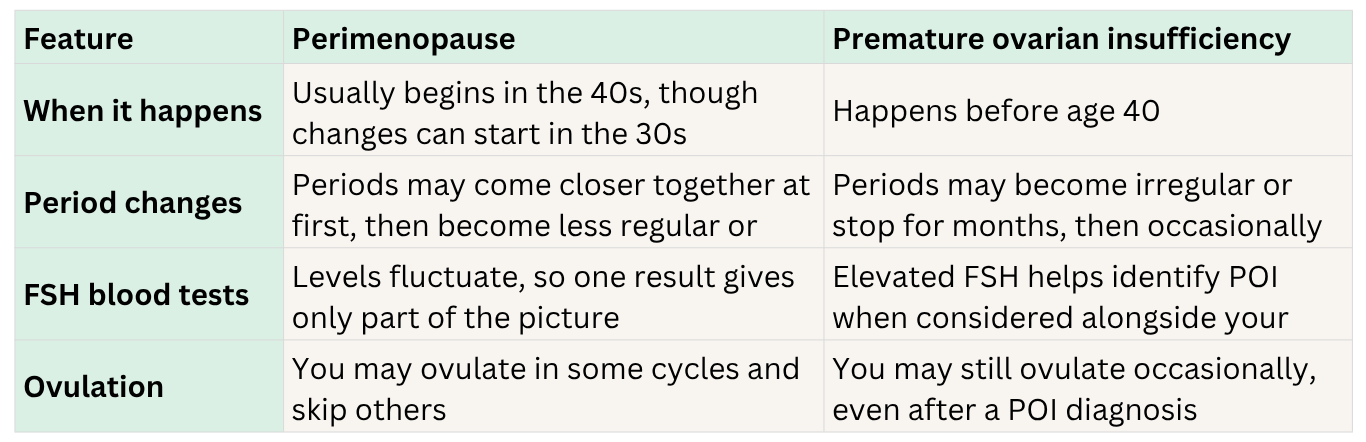
The patterns overlap, especially when perimenopause is further along. Before 40, months without periods deserve a POI assessment even if symptoms resemble a friend's menopause experience.[1–4]
How common is POI? Older studies estimated about 1 in 100 women. The updated international guideline cites newer estimates around 3.5%, with differences across populations.[1]
What causes POI?
Several different processes can affect follicles or ovarian function. In many cases, the cause remains unknown despite testing.[7]
Genetic causes include chromosome differences, such as Turner syndrome, and the FMR1 premutation associated with fragile X. A premutation is a particular change in that gene. Genetic counseling can explain its implications for you and your family.[7,13]
Autoimmune conditions can also be involved. The immune system may mistakenly target the body's own tissues. Certain chemotherapy drugs and pelvic radiation can damage ovarian follicles.[7]
A family history of POI or unusually early menopause makes that history especially relevant. The investigation may include chromosome testing, FMR1 testing, and selected autoimmune tests. Which tests are useful depends on whether a cause is already known.[7,13]
Which blood tests help identify POI?
The international guideline uses at least four months of irregular or absent cycles plus blood FSH above 25 IU/L. Repeat FSH testing after four to six weeks is recommended when the diagnosis is uncertain. Testing for this purpose can happen on any cycle day.[1]
NICE guidance takes a different approach: two elevated FSH results, four to six weeks apart, in someone under 40 with compatible symptoms. Local practice may therefore differ.[9]
Estradiol can add information about estrogen production. AMH can sometimes help when findings are unclear, but menstrual history and FSH remain central to assessing POI.[1] Our guide to FSH, AMH, and estradiol tests explains the general differences.
Hormonal contraception and other hormone treatments can change bleeding and lower FSH. A doctor may adjust the testing plan around those effects. Continue prescribed medication until you have instructions about any change.[13]
What else could explain similar symptoms?
Pregnancy is the first possibility to check when periods stop and pregnancy is possible. Other explanations include thyroid conditions, elevated prolactin, PCOS, and functional hypothalamic amenorrhea.[8]
In hypothalamic amenorrhea, the brain reduces the signals that support ovulation. Low energy availability, substantial exercise demands, and stress can contribute. The ovaries then receive less stimulation, which can lower estrogen.[10]
This differs from the ovarian pattern in POI, where FSH is elevated. Symptoms such as missed periods can look similar while the underlying hormone signals differ.[8]
PCOS can also cause infrequent ovulation and long gaps between periods. Acne or increased facial hair may add clues, but the full medical history and testing guide the diagnosis.[8]
What changes if POI is diagnosed?
Care addresses more than the return of periods. Estrogen supports bones and other tissues, so prolonged deficiency at a young age deserves attention. Treatment plans cover symptoms, bone health, cardiovascular health, and reproductive goals.[11]
For many people with POI, hormone therapy is recommended until the usual menopause age, around 50–51, unless a medical reason makes it unsuitable. This replaces hormones that would usually be present during those years.[9,11]
HRT itself is not contraception. Because ovarian activity can return intermittently, pregnancy prevention may still be needed. A treatment plan should account for whether you want pregnancy now, later, or not at all.[9]
For someone trying to conceive, POI warrants a fertility discussion early. Occasional ovulation can occur, while overall fertility is reduced.[3] Our guide to trying to conceive around 40 covers the broader age-related questions.
Where does Oova fit if you are still cycling?
Blood tests investigate ovarian function; daily cycle tracking follows changes around ovulation. Oova measures urinary LH, E3G, an estrogen metabolite, and PdG, a progesterone metabolite.[12]
An LH rise can signal approaching ovulation. A subsequent sustained PdG rise provides evidence of ovulation afterward. This sequence may help you understand whether and when ovulatory patterns appear during irregular cycles.[6,12]
Follow your ovulation patterns alongside your care
Already working with your clinician and still cycling? Oova tracks LH and estrogen- and progesterone-related patterns to help you follow ovulation alongside your blood tests. It does not diagnose POI.[12]
Explore the Oova Perimenopause Kit
How to prepare for an evaluation
Keep this practical: record bleeding dates, new symptoms, medication use, and any family history of early menopause. “I've had three periods in eight months” is more useful than “my hormones feel off.”
Include previous blood results and whether pregnancy is a goal. Our guide to what to track before a menopause appointment has a fuller preparation list.
If your concerns have been dismissed, you can request an explanation of the other causes being considered and a follow-up plan. Our article on getting care when perimenopause symptoms are dismissed offers ways to prepare for that discussion.
Frequently asked questions
Can I have POI if I still get periods?
Yes. Ovarian activity may return intermittently, allowing occasional ovulation and bleeding. The diagnosis accounts for your longer cycle history and blood results.[3]
Does one normal FSH result rule out POI?
FSH can change, and hormone medications can lower it. Persistent symptoms or cycle changes may warrant repeat testing and a review of the full pattern.[13]
Is early menopause at 38 the same as POI?
At 38, menopause is described as premature. POI describes impaired ovarian activity that can be intermittent. A specialist can clarify the terminology and its implications for fertility.[3,13]
Should I wait four months before getting help?
You can seek care earlier. Four months describes the international diagnostic cycle-history criterion. New symptoms, fertility concerns, or several missed periods are reasons to arrange an evaluation.[1,8]
Can hormone tracking replace the blood tests?
Oova follows cycle and ovulation patterns using urinary LH, E3G, and PdG. POI assessment uses clinical history and blood FSH, sometimes with additional tests.[1,12]
For a broader symptom overview, read signs of the menopause transition from 40 to 50.
About the author
Sources
- ESHRE, ASRM, CRE-WHiRL, and IMS. Evidence-based guideline: premature ovarian insufficiency. 2024 international guideline. ASRM.
- Mayo Clinic. Perimenopause: Symptoms and causes. Patient information.
- NICHD. Primary Ovarian Insufficiency. NICHD PO Overview.
- The Menopause Society. Perimenopause. Cycle changes.
- ACOG. The Menopause Years. Patient FAQ.
- U.S. Office on Women's Health. Your menstrual cycle. Cycle biology.
- NICHD. What causes POI? Causes and follicle function.
- ASRM. Current evaluation of amenorrhea: a committee opinion. 2024. Clinical guidance.
- NICE. Menopause: identification and management, NG23. Recommendations 1.7. Guidance.
- Endocrine Society. Functional Hypothalamic Amenorrhea. 2017. Clinical practice guideline.
- NICHD. What are the treatments for POI? Treatment overview.
- Oova. Perimenopause Hormone Tracking Kit. Product information.
- European Society of Endocrinology. Clinical practice guideline for evaluation and management of menopause and the perimenopause. 2025. Guideline.
About the Oova Blog:
Our content is developed with a commitment to high editorial standards and reliability. We prioritize referencing reputable sources and sharing where our insights come from. The Oova Blog is intended for informational purposes only and is never a substitute for professional medical advice. Always consult a healthcare provider before making any health decisions.
